The Biggest Climate Progress Trends You Probably Haven't Seen
A data-driven guide to climate progress trends already visible in warming projections, renewable energy, emissions, climate investment, and public support.
Climate progress can be hard to see when climate news is dominated by disasters, political fights, and missed targets. That leaves a lot of people asking the same question: is climate action actually working? are we making progress or are things getting worse?
But progress is happening. The clearest answer is in the data. Some of the biggest climate progress trends are already visible in warming projections, renewable energy growth, falling emissions intensity, coal decline, electrification, climate investment, and public support for action.
This doesnt' mean that we don't have much more work to do - we need to keep pushing these trends to see more and faster progress. But its important to know that in many areas, we are heading in the right direction.
Warming projections are improving compared with older worst-case climate scenarios
One of the biggest progress signals is also one of the least understood. A lot of people still talk as if the world is locked into the most catastrophic warming pathways that dominated older climate discussions. With this mindset, its easy to feel like it's too late and that there's no point in taking action. However, this doomsday scenario is no longer what current projections show.
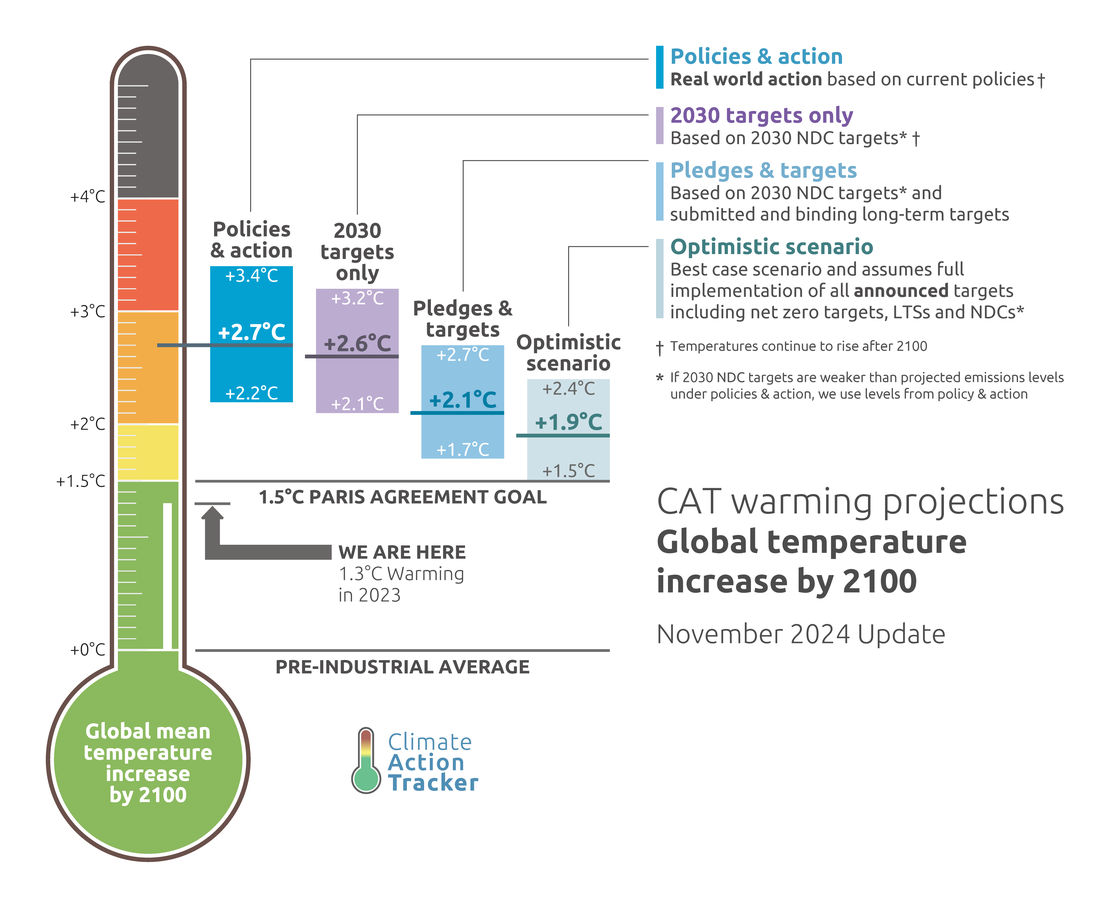
Current analyses from Climate Action Tracker suggest existing policies put the world closer to roughly 2.5 to 2.7°C of warming by 2100, not the older 4 to 5°C expectations that shaped so much climate doomism. That is still bad, but not apocalyptic. But it is a very different future from the one many people still assume is inevitable.
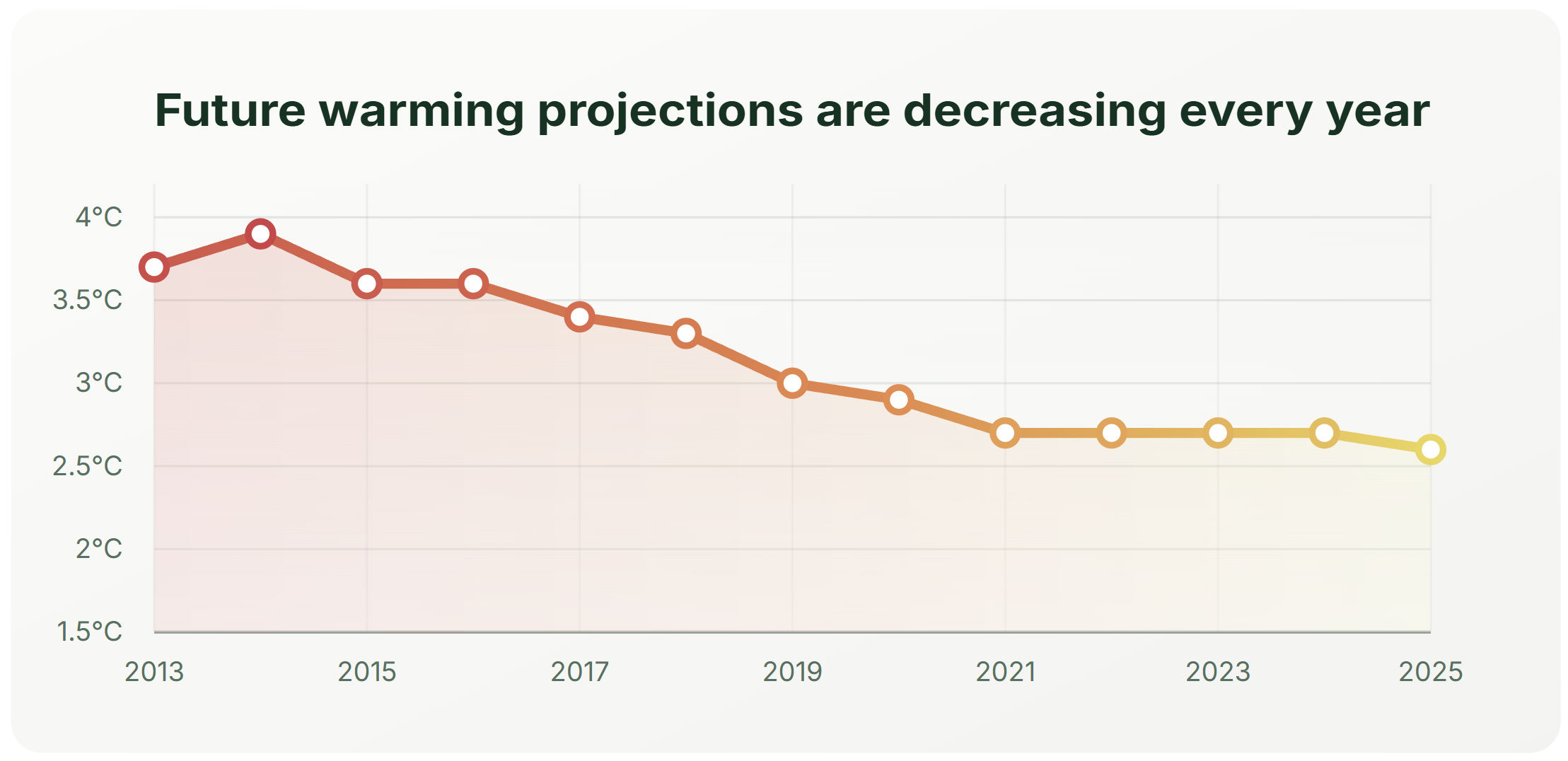
The baseline has moved in the right direction because policy, technology, and deployment have already changed the trajectory. As we explain in We really aren't doomed; here's the data to prove it, there is a huge difference between serious danger and civilization-ending inevitability. That difference exists because action has already bent the curve.
A related point gets lost in the constant focus on climate goals, like the 1.5°C by 2100 target. Missing this goal is very likely at this point, but it is not a cliff where action stops mattering. Every fraction of warming avoided still prevents harm, which is why it is still worth acting even if we do not hit 1.5°C. That is progress too: we are no longer choosing between perfection and failure. We are shaping how bad or how manageable the future becomes.
Renewable energy is supplying the majority of new power generation
Another major signal is the shift in what is actually being built. For years, renewable energy was treated like a niche add-on to the real energy system. It was far more expensive than fossil fuels, and could not compete economically. That is not what the numbers look like now. In many places, renewables are becoming the default source of new power generation because they are simply cheaper to build.
It takes time for existing power generation to be phased out, but one of the clearest indicators is that new power generation additions are increasingly dominated by renewables. That matters because new build decisions are what shape the future grid. When the cheapest and most attractive new option is increasingly low-carbon, the direction of travel changes even before the old system fully disappears.

In 2025, we actually reached the point where renewable power growth met more than total demand, and fossil fuel use slightly decreased. We are at an inflection point - renewables are only going to get cheaper.
This is closely tied to another powerful signal: costs for renewables are falling consistantly. Solar, wind, and batteries have all seen dramatic price declines over the last decade. Technologies that used to rely on moral persuasion now increasingly sell themselves on cost, convenience, and performance. That is a much stronger foundation for durable change than asking everyone to sacrifice forever.
Solar has grown beyond even the most optimistic predictions
The growth of renewables is on an exponential trend, and consistantly exceeds even optimistic predictions. Again and again, actual global solar additions have blown past what major energy forecasts expected only a few years earlier. The transition to renewables is not just continuing, it is exploding.
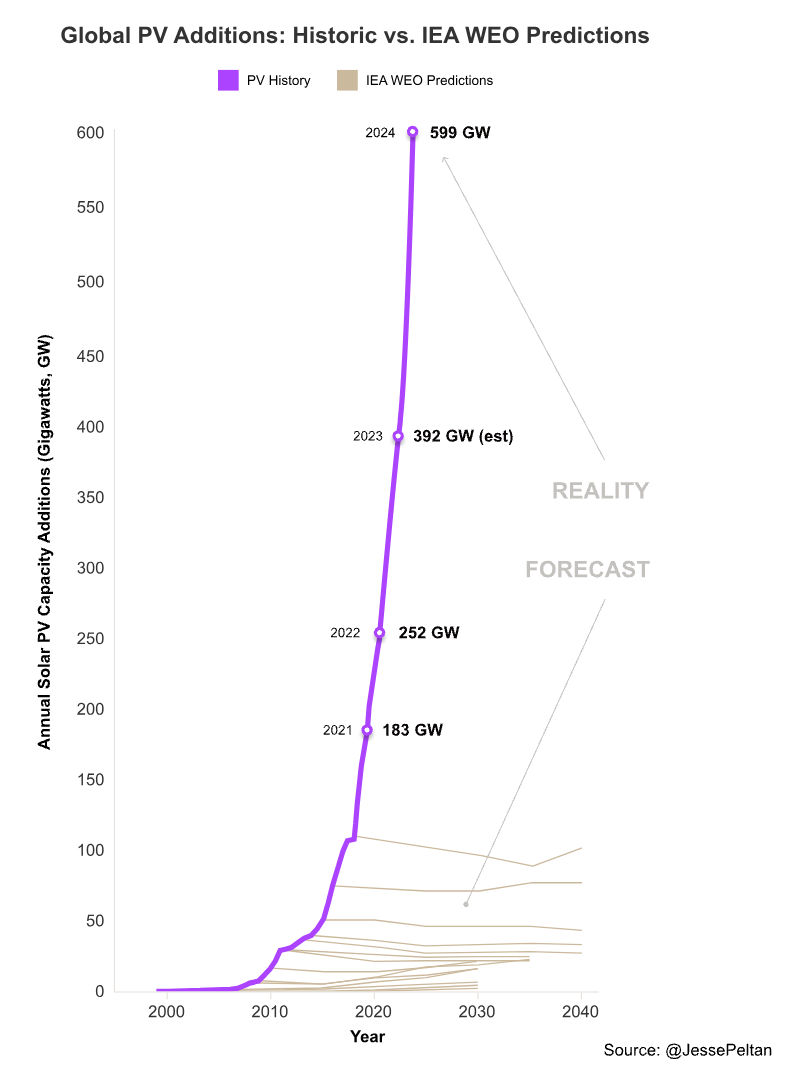
This isn't just a good thing for emissions reduction and climate change, in clean energy is a good idea even if climate change is not your main concern, we explore the many other beenfits. Better air quality, lower operating costs, energy security, and industrial competitiveness are all part of the same trend.
Coal power is expected to decline sharply over time
Progress is not only visible in what is growing. It is also visible in what is losing its long-term grip. Coal, the most emmision heavy fossil fuel, remains a huge part of the global power system today, but even relatively conservative outlooks now expect a major decline over the next few decades.
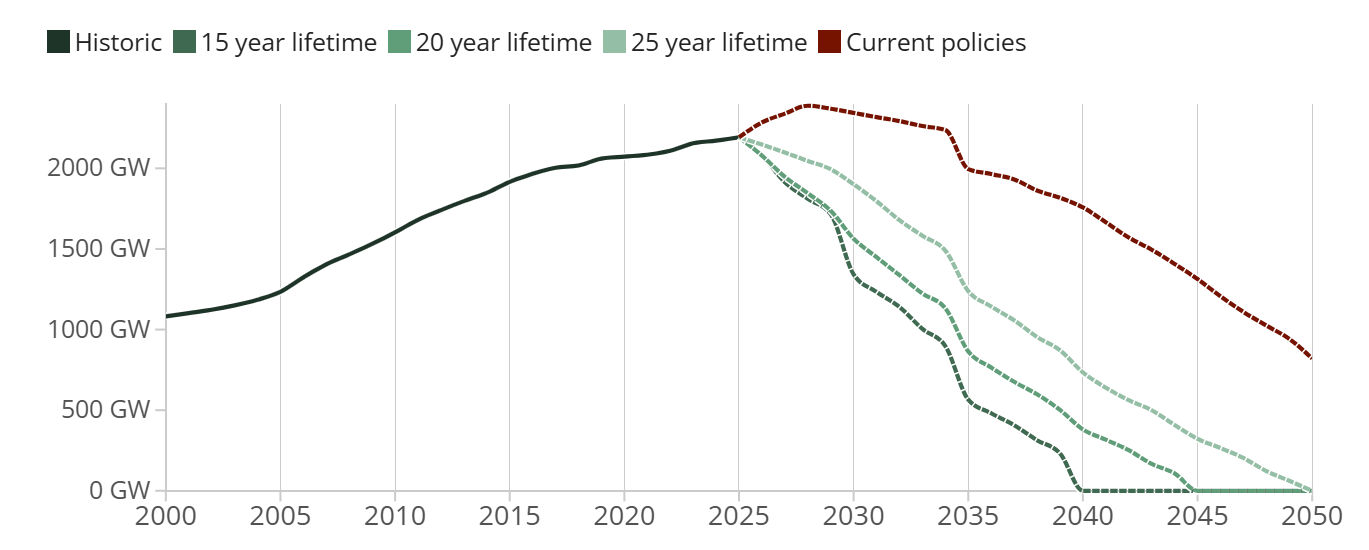
The International Energy Agency projects that global coal power capacity falls from roughly 2,200 gigawatts today to about 750 gigawatts by 2050 even in relatively pessimistic scenarios. That is not a marginal adjustment. It is evidence that the future grid is being reimagined around very different economics and technologies. While some of this energy will be replaced by natural gas power which is still a fossil fuel, gas emits less than half of what coal does watt for watt, and it definitely a step in the right direction, even if not the final answer.
Fossil fuels are still deeply embedded, and policy can absolutely influence how fast we transition to clean energy. But it is harder than it used to be to argue that the future belongs automatically to coal, oil, and gas. The buildout patterns, investment trends, and policy expectations increasingly point the other way. And these trends are only growing.
Electrification is spreading beyond electric vehicles
One of the clearest climate progress signals is that electricity is steadily replacing fossil fuel combustion in more parts of daily life and the economy.
EVs are the most visible example, but the deeper trend is broader: heat pumps, electric water heaters, induction stoves, industrial electrification, electric buses, battery-backed grids, and cleaner building systems. The International Energy Agency's chart on the share of electricity in total final energy consumption shows the direction clearly. Electrification is not a niche side trend. Electricity is expected to take up a larger share of how buildings, transport, and industry are powered over time.

This is not one product category. It is a systems shift, as Electrification beyond EVs explores in more detail.
The reason this is such an important signal is that electrification compounds with cleaner grids. Every time a building, appliance, or vehicle moves from direct fossil fuel use to electricity, it becomes easier to decarbonize further as the grid improves. One infrastructure change unlocks additional gains over time.
That is also why technologies like heat pumps matter so much. They are not flashy, but they are exactly the sort of practical upgrade that shows the transition is becoming concrete: technologies that both electrify and improve efficiency over their predecessors.
Emissions trends are improving in parallel with economic growth
A lot of people still assume that serious climate progress would require society to get poorer, smaller, or more austere. But one of the most underappreciated signals is that economic output is correlating with emissions less and less.
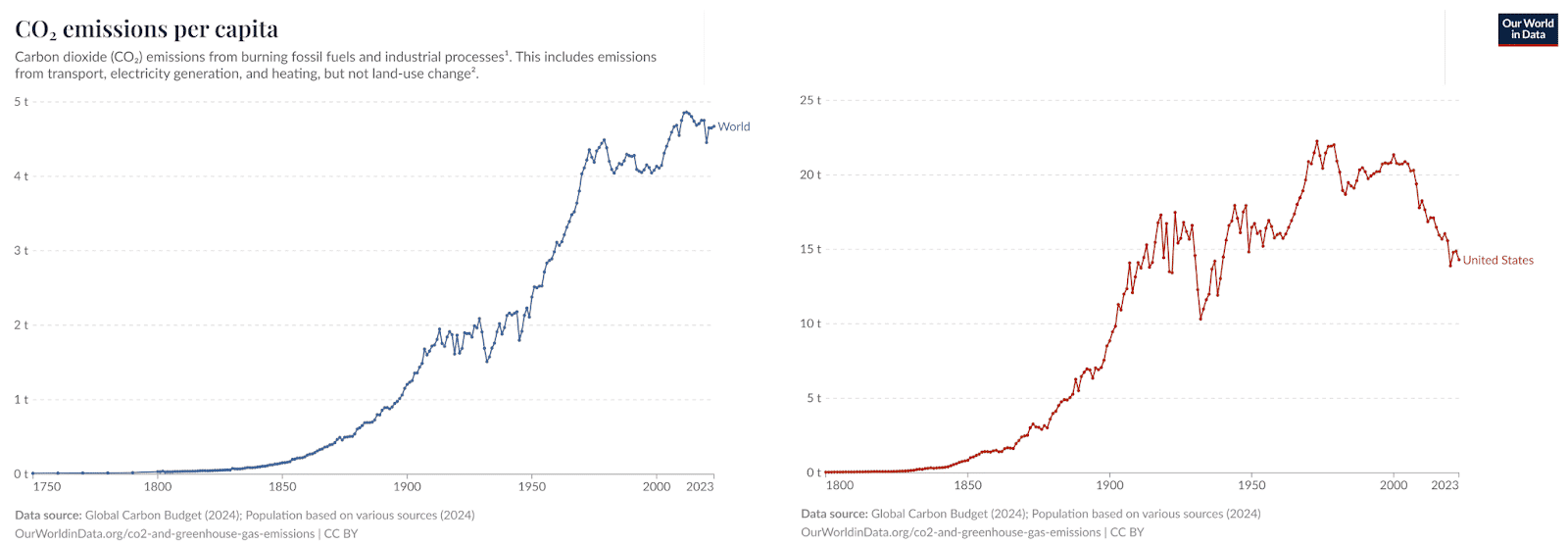
A telling example is that greenhouse gas emissions in high-income countries have fallen by roughly 15% since peaking around 2007. More broadly, average emissions per person appear to have peaked globally around 2012 and have edged downward since. Those trends show that the old assumption that emissions must always rise with prosperity is no longer a given.
This is why arguments against depopulation and degrowth as climate solutions matter so much. They point to a real shift in the structure of the problem. The most effective climate progress is not about asking people to make large sacrifices or not have children. It is increasingly about changing how energy, industry, and infrastructure work.
The climate economy is growing faster than many people realize
Another major signal is the rise of the climate economy itself. Once climate action starts generating jobs, investment, new business models, and political constituencies, it becomes much harder to reverse.
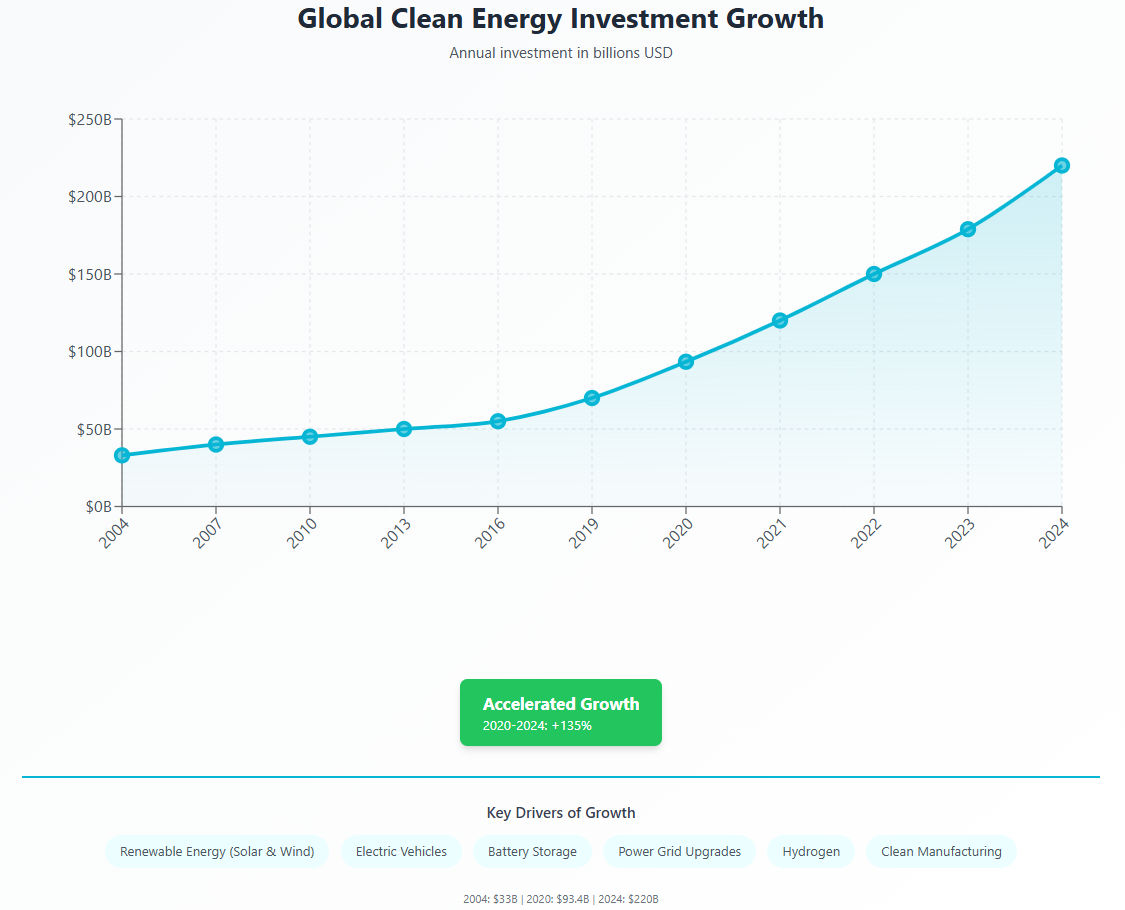
That is already happening. The climate economy is already here shows how this transition is no longer a side project for idealists. It is becoming a major economic reordering across energy, buildings, manufacturing, finance, and infrastructure.
This is one of the strongest long-term signals because markets create momentum. When firms invest in cleaner supply chains, workers retrain into electrification and clean-tech roles, utilities build around storage and renewables, and consumers start seeing low-carbon options as normal, climate progress stops depending on a single moment of public enthusiasm. It becomes embedded in systems.
That is also why some of the quieter trends matter. The quiet revolution behind the products you love shows how a lot of progress does not arrive with a dramatic headline. It shows up in product design, packaging efficiency, manufacturing upgrades, logistics, and procurement decisions that make the economy incrementally cleaner year after year.
Public support for climate action is stronger than many people think
A transition becomes much more durable when it is backed not just by experts and activists, but by broad public legitimacy. Another strong signal is public opinion: according to a 2023 global survey, 86% of respondents said people in their country should try to fight global warming.
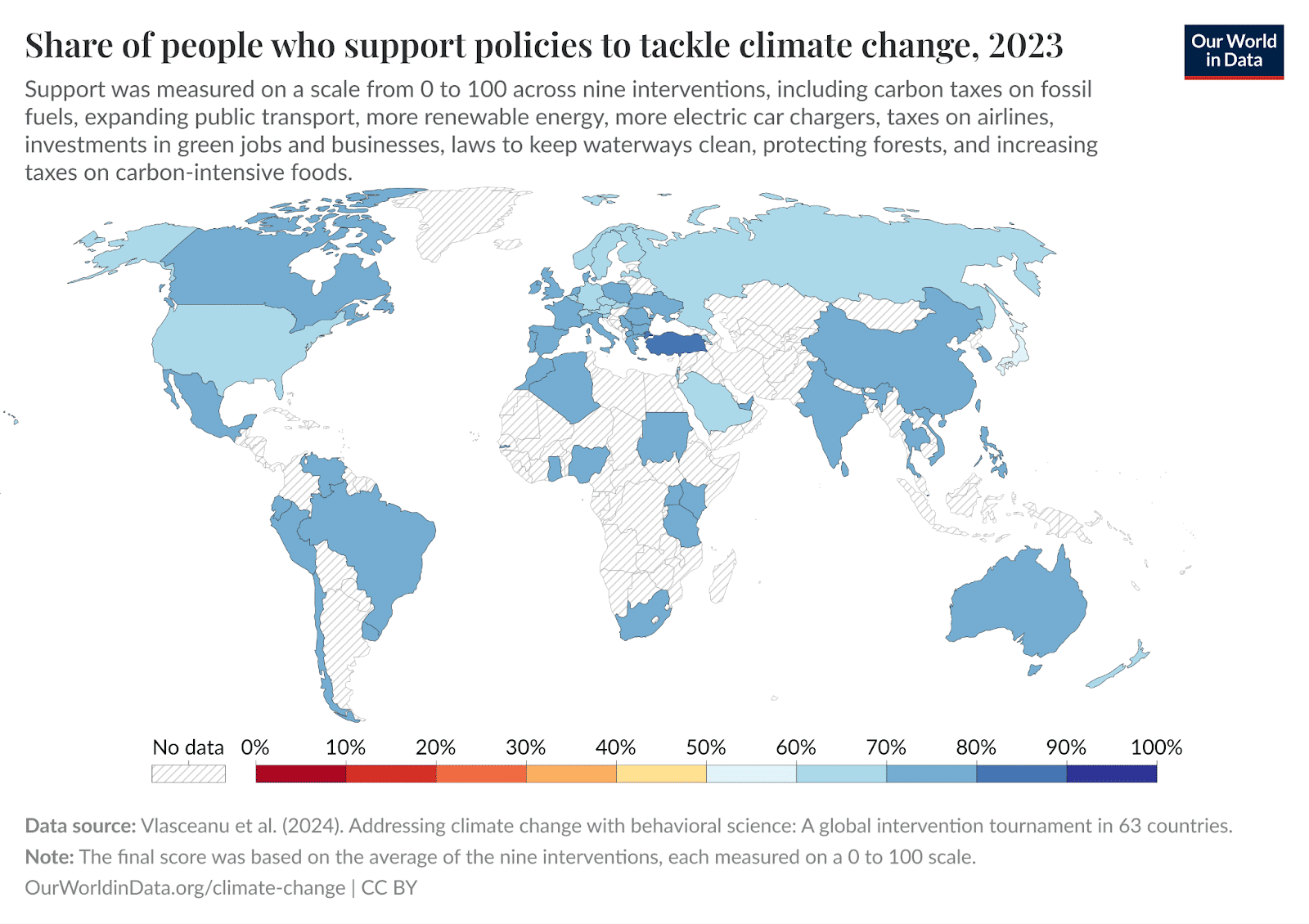
That does not mean everyone agrees on policy details. It does mean climate concern is not some fringe priority carried only by a small committed group of activists. The public mood in many places is more supportive of action than media narratives suggest, which matters because policy becomes easier to defend and scale when most people already believe the problem deserves a response.
This kind of support is easy to underestimate because it is quieter than outrage. But it is one of the reasons climate policy, corporate strategy, and consumer expectations keep ratcheting in the same general direction even when politics is messy.
The ozone recovery shows that global environmental policy can work
Climate change is harder than previous environmental challenges, but it is not the first time humanity has recognized a large-scale atmospheric threat and acted on it. The recovery of the ozone layer remains one of the most important underused examples of what coordinated policy can accomplish.

The ozone recovery story matters because that crisis did not fade because it was fake. It faded because policy worked. Industry adapted. Harmful chemicals were phased down. The problem became more manageable because people took it seriously and built a response.
No, the ozone story is not a one-to-one template for climate change. But it is powerful evidence against the belief that global environmental coordination is impossible.
What these signals mean together
None of these trends mean mission accomplished. Progress is uneven. Politics still matters. Fossil fuel systems are still deeply entrenched. A lot of future harm depends on how much faster we can move from here.
But taken together, these signals tell a much more grounded and useful story than either doom or complacency. The world is not ignoring climate change. It is responding imperfectly, unevenly, and often too slowly, but in ways that are visible in costs, deployment, investment, technology, and public expectations.
That is the key difference between blind optimism and realistic optimism. Blind optimism says things will somehow work out. Realistic optimism says there is measurable progress already happening, and that progress creates more leverage for the next round of action.
If you want to know whether climate progress is real, do not just look for hopeful headlines or feel good stories. Watch the data: changing economics, cleaner infrastructure, falling costs, improving projections, declining coal dependence, broader public support, and momentum across multiple sectors at once.
That is where the most important climate story is being written.
Want to learn more?
Get updates on climate progress and how you can help.