We really aren't doomed; here's the data to prove it
With all the bad news about climate change, it can feel like we have no chance of addressing it and that we only have a few short decades before the earth is uninhabitable. This isn't actually true. While climate change is a major problem and there is a lot to be concerned about, its important that we are realistic about what is happening and that we look at the progress we have already made at averting the worst impacts.
There’s a pervasive sentiment that climate change is an existential threat to humanity. When you ask younger people who have grown up in the midst of climate change (and they did in this survey), over half of them agreed with the statement “humanity is doomed”. More and more people are wondering how to stay hopeful about climate change when it feels like it’s just getting worse or it’s too late.
It’s not surprising. News headlines are designed to shock and draw attention, and journalists often take the worst possibilities and state them as fact. The rise of social media increases how much news we see, and more frequent bad news makes us feel like things are just getting worse. Climate activists also often focus on the worst impacts, or use emotionally charged descriptions like “a burning earth”, “an unlivable world” in order to drive people to urgent action. However, this can often have the opposite effect - instead of being inspired to act, people just feel like there’s no point.
Climate change needs to be taken seriously, but it’s important to look at the data, which show these important ideas that aren’t talked about enough:
- The current projections for the effects of climate change are no longer close to an existential threat to humanity
- We are making a lot of progress toward reducing emissions, and are heading in the right direction
- The individual climate actions that matter most are the ones that shift societal norms and perceptions
What are the scientists really saying?
If you are reading this article, you probably already know the basics - we are already seeing about 1.2°C of warming, and we know it is linked to human emissions. Experts have projected different scenarios of how much warming we will see by 2100 based on future emissions.
Back in the ‘90s, there was no signs of emissions decreasing or slowing down, and projections were in the 4-5°C range. This is the temperature range where some of the largest, global impacts were projected. Things like major shifts in ocean currents, major reductions in crop yields, runaway sea level rise, and other catastrophic effects.
As of this writing, the current expected projections based on real world data is 2.7°C. While this is still a very concerning amount of warming, it is significantly better than the baseline scenario. This level will likely still bring about a lot of problems, including more severe storms and wildfires, significant pressure on food systems, and some sea level rise, but we’ve averted the very worst effects already.
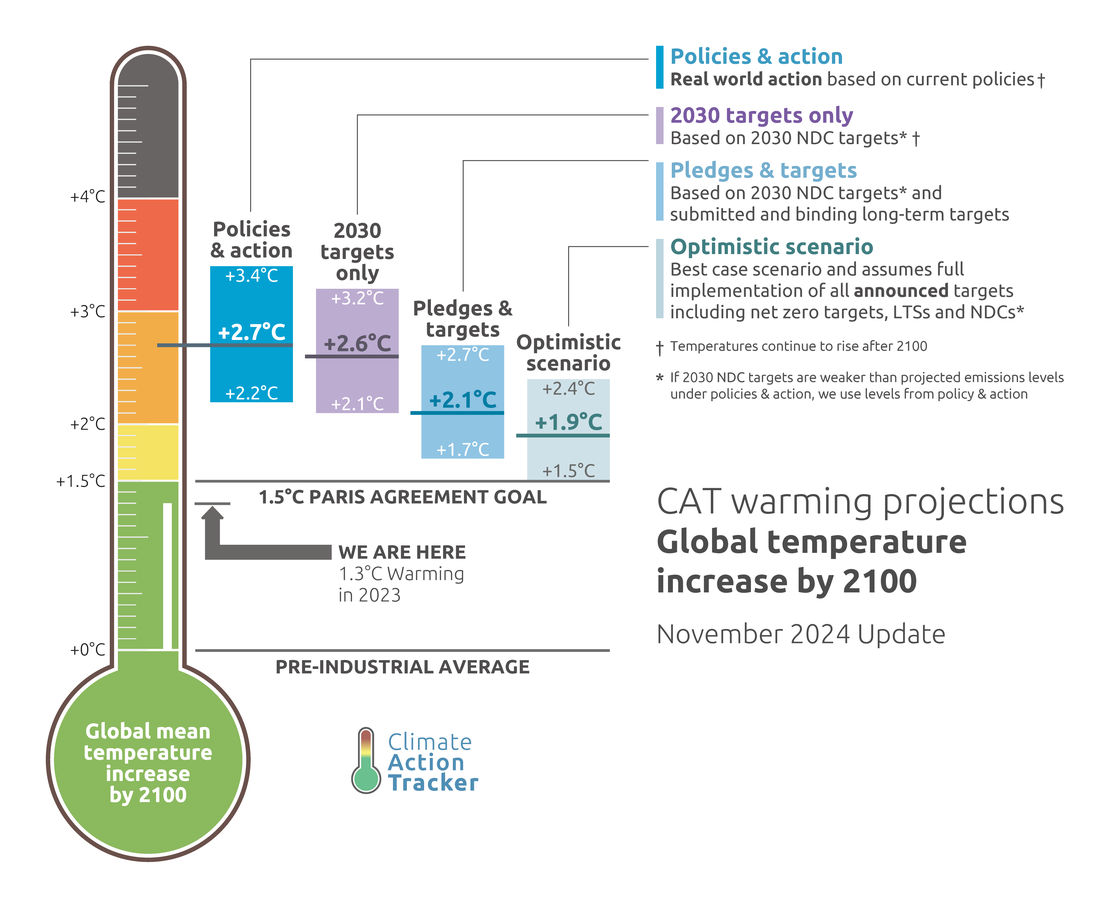
The most important thing to take from this is that the projections are going down over time. This is an indicator that as time goes by, more people and governments are taking this seriously, and the steps they are taking are already working to reduce the impact. That means that we are likely to see even more reductions in the projections as time goes on, but by how much is yet to be determined.
Missing a goal does not mean we aren’t making progress
In the 2014 Paris agreement, nations set an ambitious goal of targeting 1.5°C peak warming, and this is often used as the benchmark of whether we have “succeeded" or “failed” at fixing climate change. While ambitious goals are a good way to drive action, it's important to recognize progress even if this goal is missed, and realize that passing this benchmark does not mean we are doomed.
For example, the climate action tracker frames individual country’s progress against this goal, labeling most of the largest as “Highly Insufficient” or “Critically insufficient”. This paints a picture of a world that is not taking action or is moving the wrong way, when in reality, most countries are making significant progress toward scaling up clean energy and reducing emissions.

While it is convenient to use specific numbers like 1.5°C to make projections and set targets, the impacts of climate change are gradual. Any reduction in emissions also reduces the impacts, and makes adaptation easier. While we need to continue to push on this momentum to move even faster, we shouldn’t use this as a reason to be critical of our progress.
To put this into perspective, let’s say you have a goal for your child to get an A on a test, and they come home with a C despite studying. Which of these reactions do you think would best motivate them to be a better student long term?
- This grade is unacceptable. You need to actually start trying at school or you will never get a job and you will be a failure.
- We know you worked hard, and we know you can do even better if you keep working at it. Let’s look at how you studied and see how we can improve for next time.
Seeing progress in the emissions data
If you look at a graph of emissions over time, it’s easy to feel like we are not doing anything. Emissions are still going up each year. If you look at cumulative emissions, it doesn’t look good:
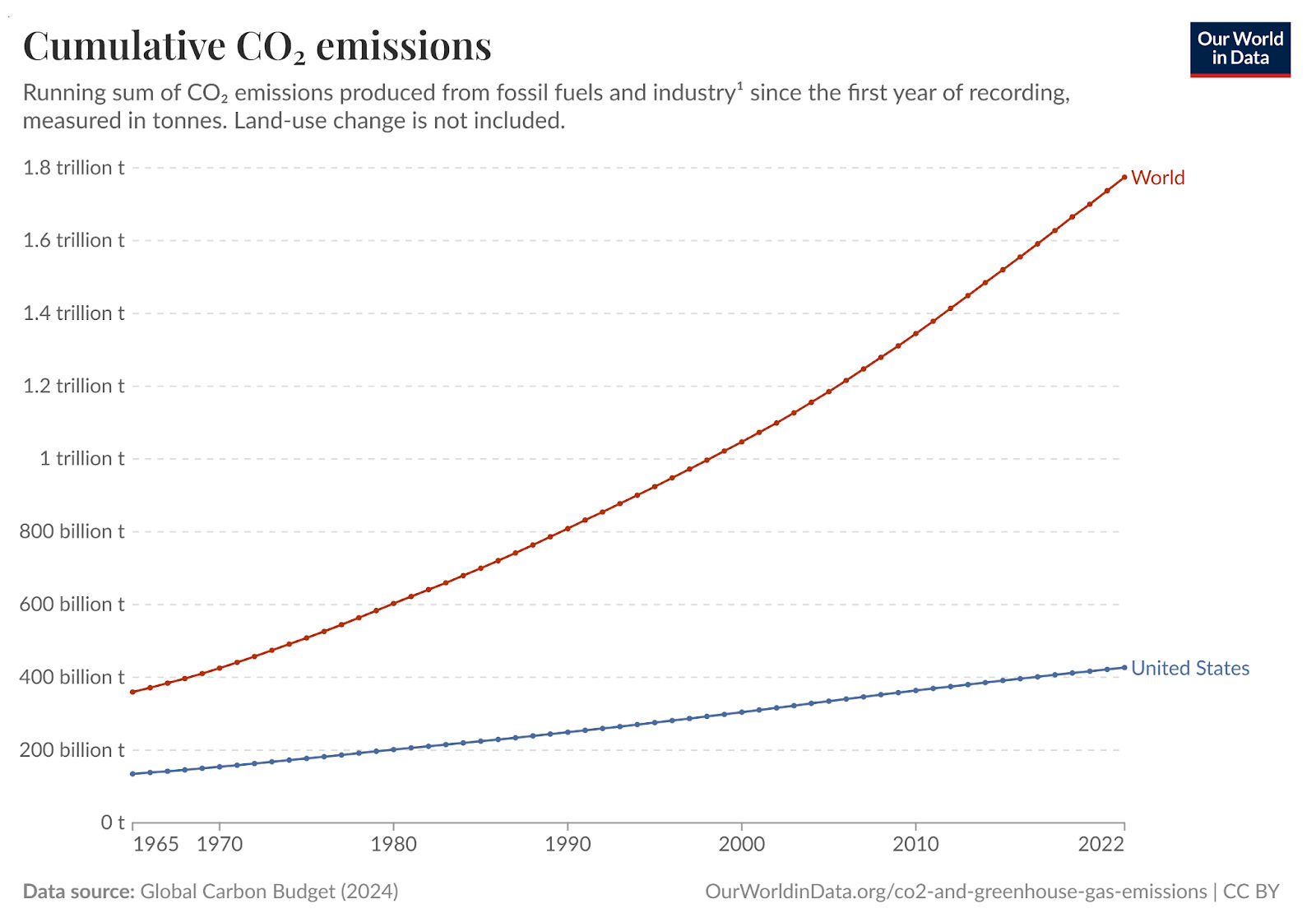
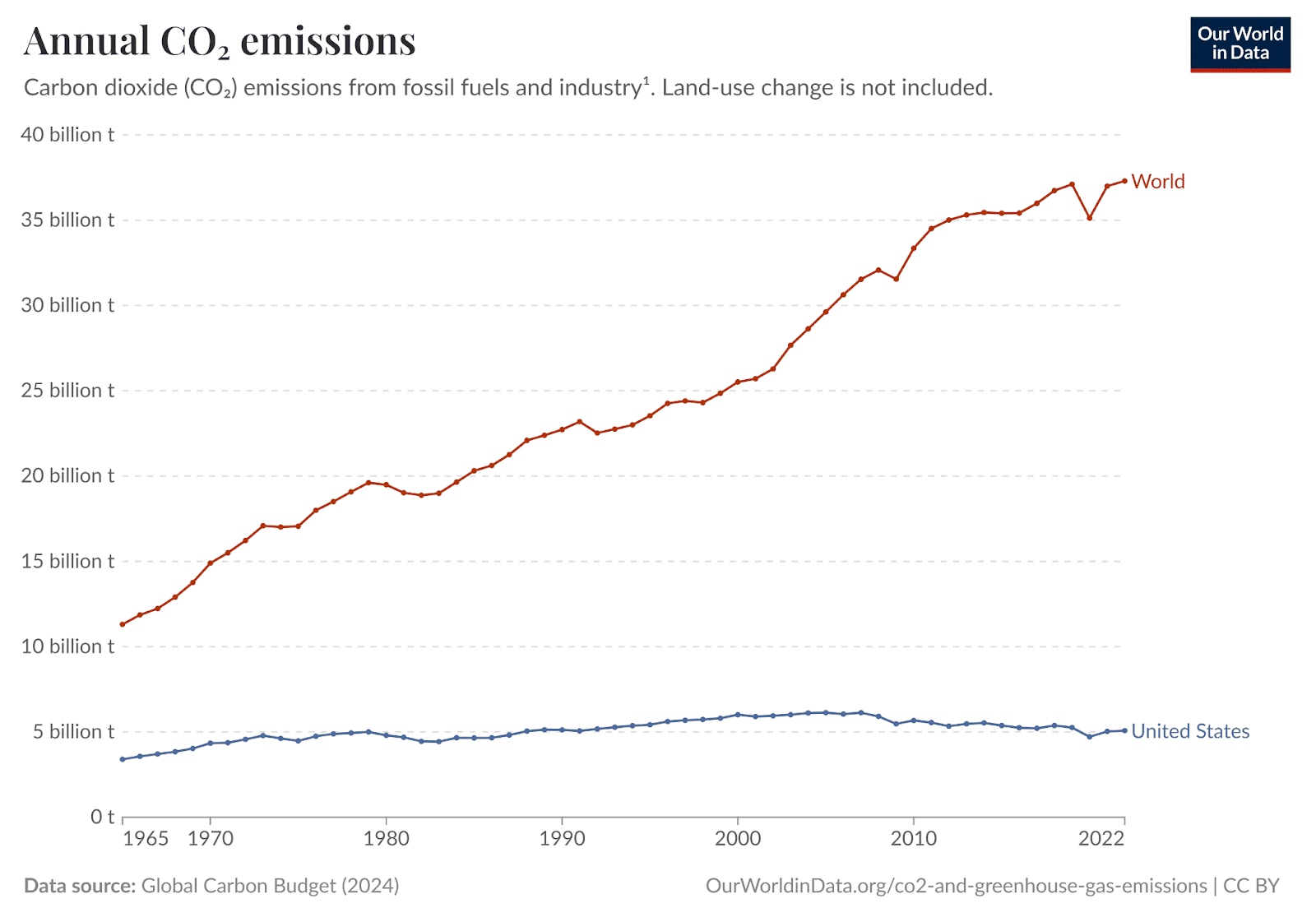
However, to see progress, especially with something as large as global emissions, we need to focus on how things are changing. Looking at the emissions released per year, we can see that emissions have been gradually slowing down, and are likely near a peak if the trend continues. In many countries, like the United States, emissions already peaked in 2007 and are now trending downward.
Another important thing to look at is the per-capita emissions, or emissions per person, which shows improvements to emissions reductions without factoring in population growth. For this metric, worldwide emissions already peaked in 2012, and are now decreasing (and are decreasing quickly in the US since 2005).
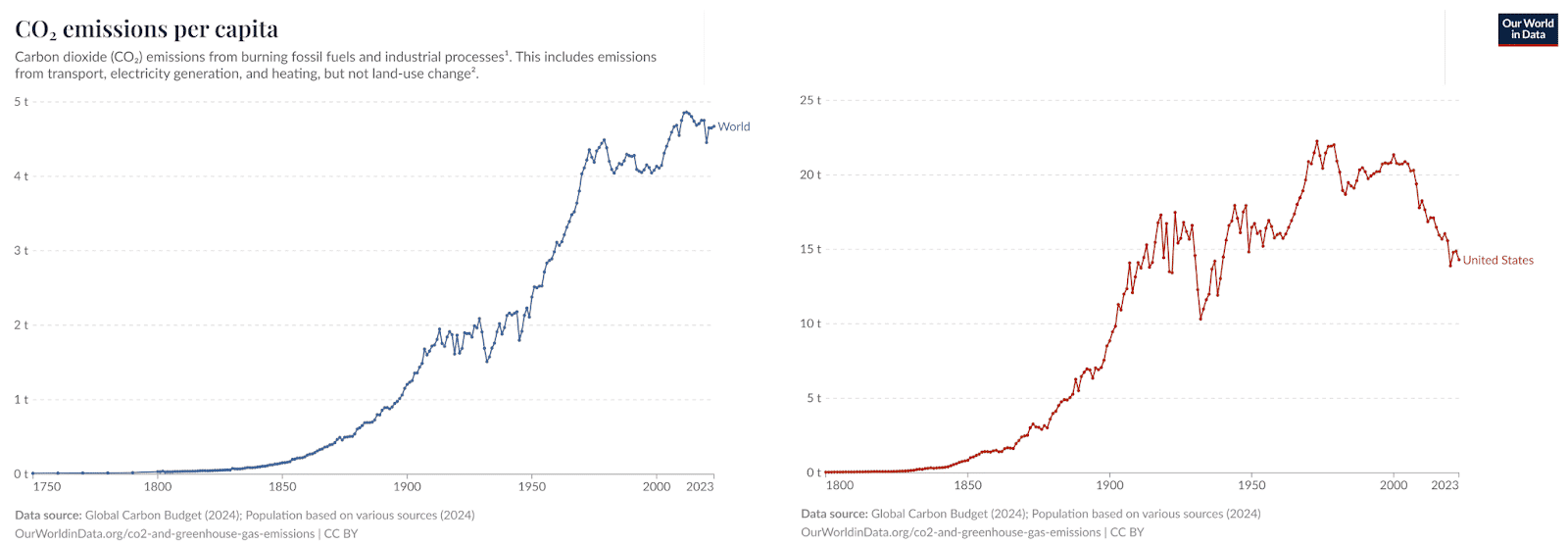
Some argue that per-capita doesn’t mean much, because we are going to see explosive population growth, however this isn’t accurate. The world population is actually projected to level off at around 10 billion people, as more of the world becomes more stable and healthy, and more people choose to have fewer children.

Global emissions are a lot like a large ship - it has a lot of momentum and it takes a lot of effort to change its direction. Even if you run the motor in reverse at full throttle, the ship will continue moving in the same direction as it slows. It isn’t realistic to expect emissions to go from a point of accelerating upward to being significantly reduced within a short period of 10 years. Reduction of this scale would take drastic levels of change, that would have severe consequences on systems and people in the near term.
You can make an argument that we are not moving fast enough, but it is simply untrue to say that things are getting worse, or that we are doing nothing.
Seeing progress in rolling out clean energy
You can also see similar trends when looking at the progress of solutions. The biggest single source of emissions comes from electricity generation (around 40%), which needs to be addressed by moving from carbon heavy sources of power (like burning coal and natural gas) onto low carbon sources (including nuclear, solar, wind, and others). Again, looking at the power generation sources over time paints a dim picture: Fossil fuel production is growing, and low carbon sources are still a small portion of overall generation.
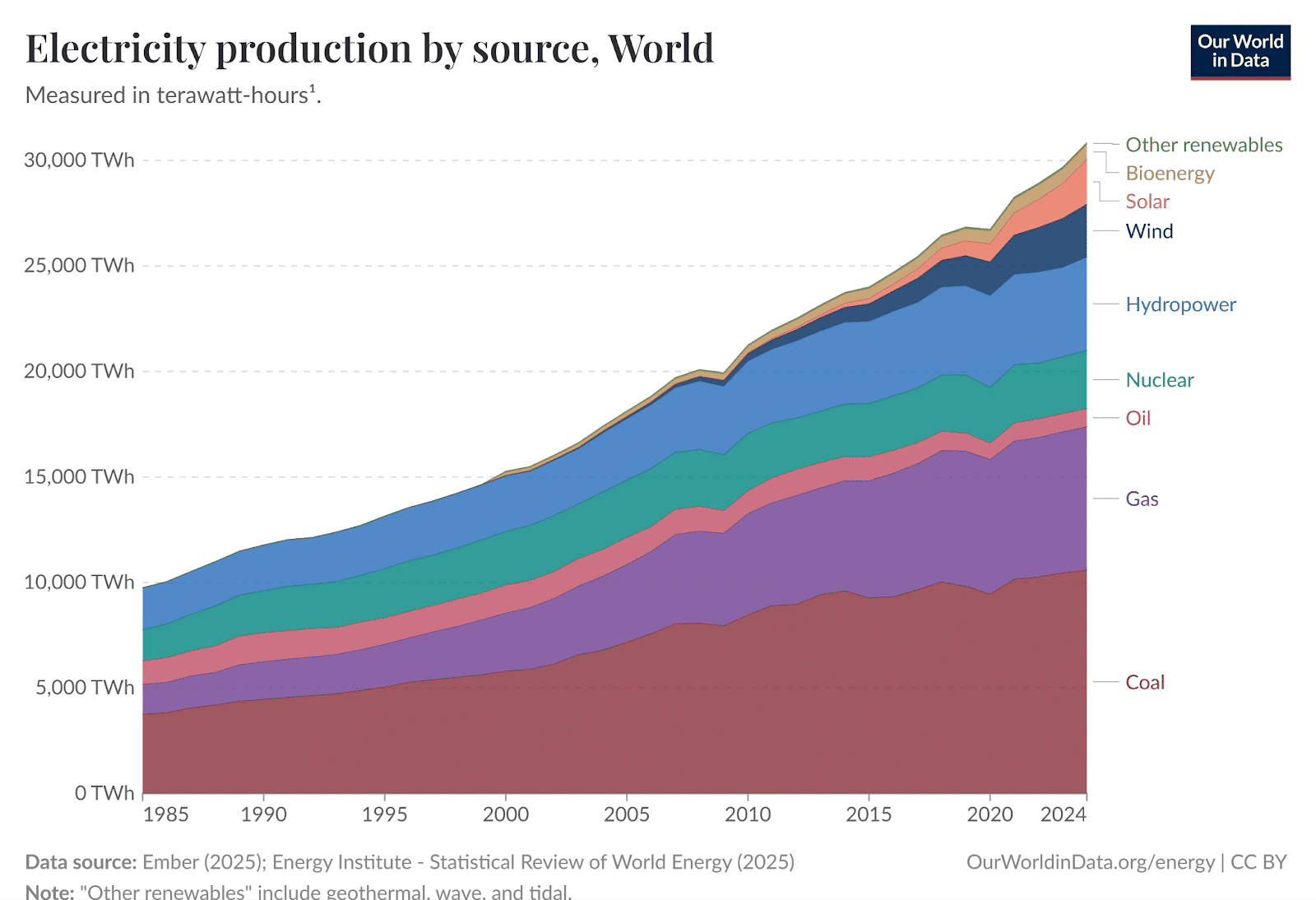
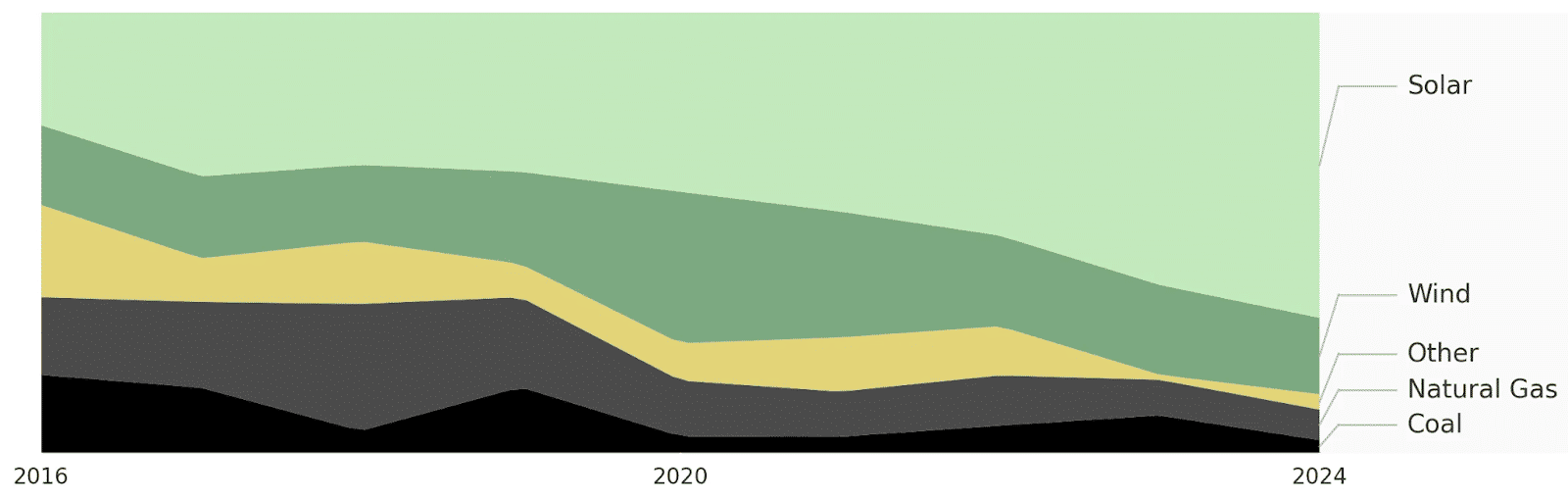
However, in order to see progress and whether we are moving in the right direction, we need to look at the rate of change, not where we are now. For power generation, this means looking at what new power capacity is being built now. The graph below shows the new power generation built worldwide in 2024, and paints a much different picture: nearly 80% of new capacity was from low carbon sources, and this number is growing every year. If this trend continues, we will soon see an end to new coal power generation, the most pollutant and carbon heavy fossil fuel.
Another important metric to look at is the retirement of existing coal power generation. Experts project that we will hit peak coal production in 2028, and will see a nearly 66% reduction by 2050 with current policies.
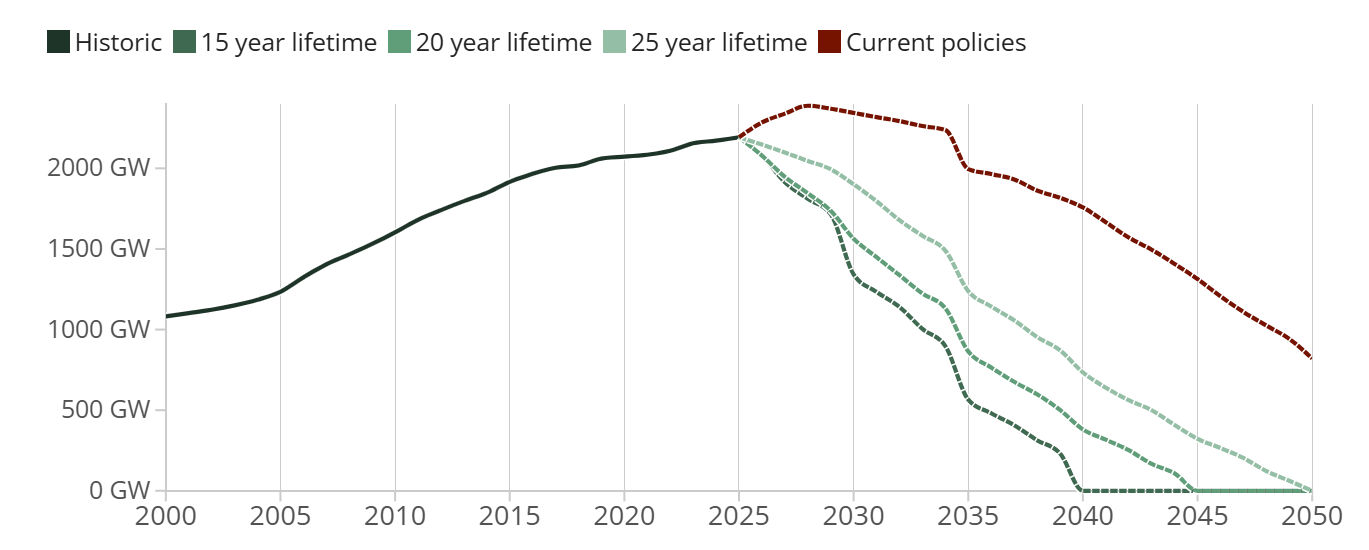
Projected phaseout of coal energy, from Global Energy Monitor
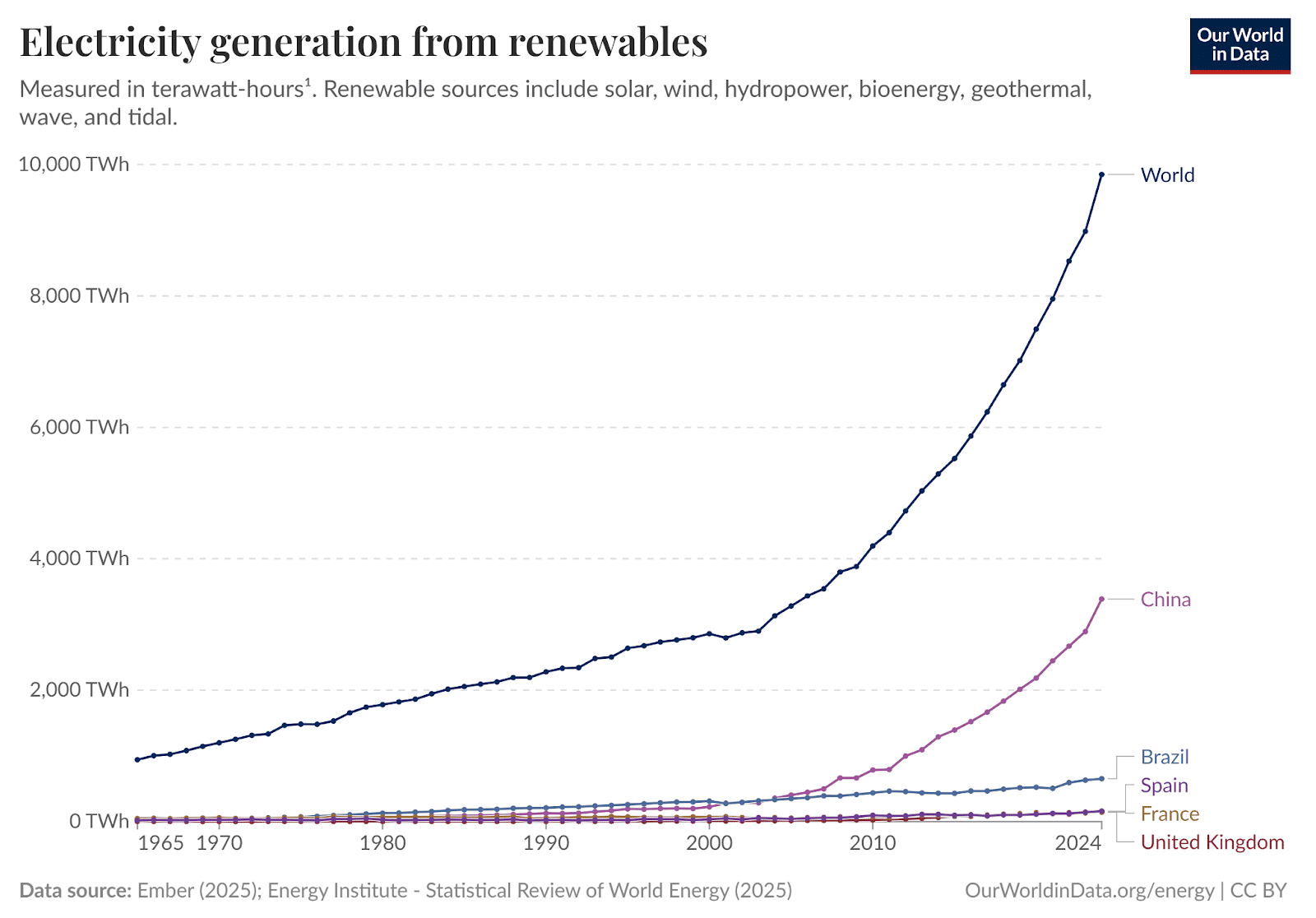
On the flipside, renewable energy sources, especially solar, have been on an exponential growth curve, and the rate of deployment has continued to surpass even the most optimistic estimates. This growth is apparent even just looking at the total energy generation from renewables. Not only is generation growing every year, it is growing at a faster rate.
Capitalism is now on the side of climate action
The driver for the growth in renewables is no longer primarily political, it is economic. Capitalism has often been seen as the enemy of climate action, with many climate activists calling for the end of capitalism (good luck with that). However, we have now reached the point where green energy is cheaper to deploy in most cases, due to the rapidly falling costs of solar and battery technology due to significant investments in improving efficiency in technology, manufacturing, and deployment.
To see this, we can look at the cost over time in comparison to fossil fuels. While fossil fuel generation has gotten cheaper, the rate is nowhere close to that of renewables.

This is not the full picture though. It’s important to keep in mind though that solar and wind are not baseload power, meaning that their generation is dependent on external factors, unlike fossil fuels which can be controlled by the power plant. This is an important consideration, since we not only need to have enough power capacity, but also have the power at the right time. Fortunately, this can be addressed using batteries to store energy when it is needed, but this does add to the cost of renewables.
For a truly fair comparison, it’s important to compare the cost of renewables and battery storage to fossil fuels, for an apples to apples comparison. This is known as the Levelized cost of energy, or LCOE. As of June 2025, the chart below shows the current levelized costs. Looking at this, it’s a closer call, but renewables are still cheaper than fossil fuels, especially coal.
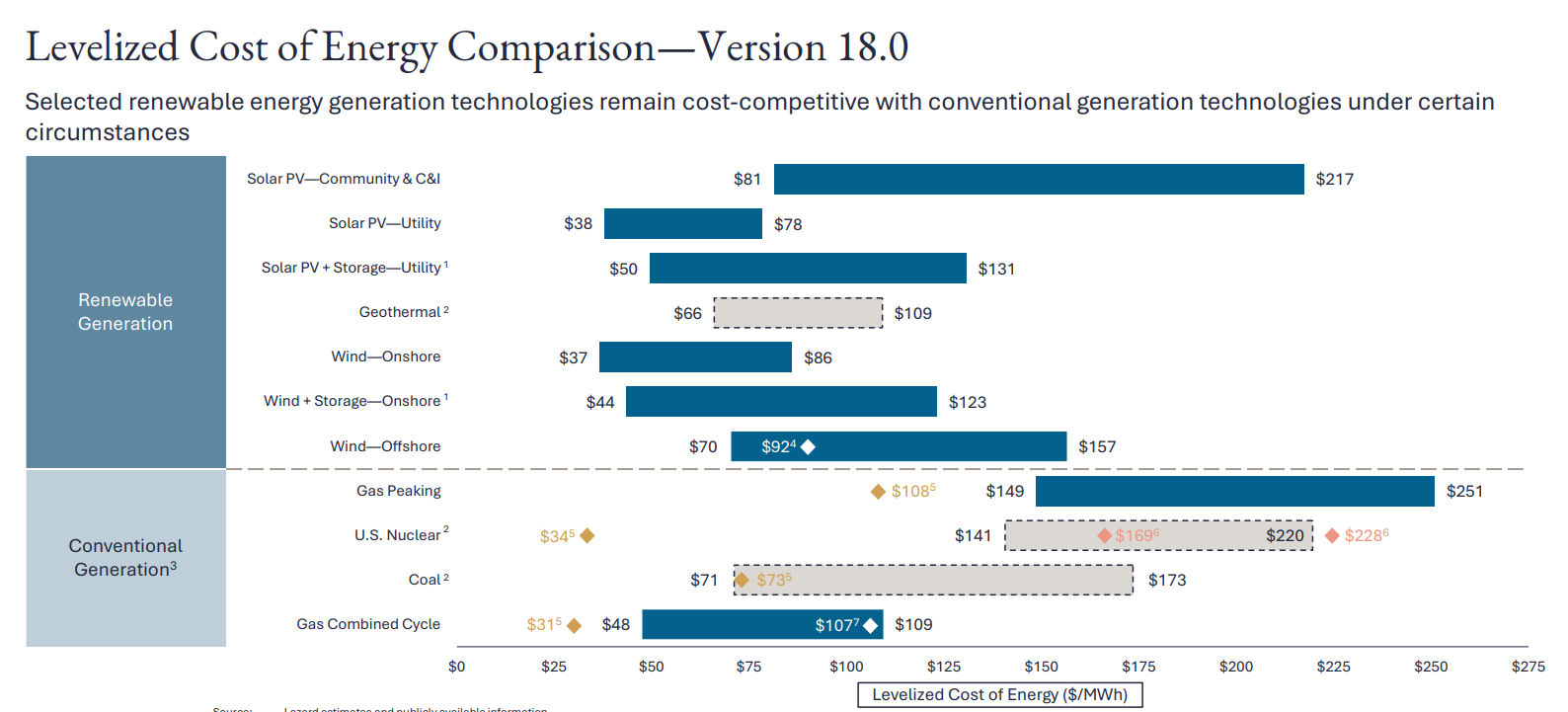
Levelized cost of energy from different sources accounts for the needs of storage for renewables (source: Lazard LCOE report)
This changes the narrative for climate change and environmentalism
This is a very recent development, and is a significant inflection point for clean energy where it is not only a cleaner alternative, but it is more cost effective too. This effect is likely to feed on itself, many call it a positive tipping point - as more renewables are deployed, more investments into innovation and manufacturing efficiencies will become more worthwhile, further reducing costs. More and more policy debates are no longer about subsidies, but how to reduce unnecessary regulations on renewables so that they can be deployed quickly.
It also means that for poorer countries building energy infrastructure, their leaders no longer need to choose between the climate and their country’s energy prosperity. Historically, many environmentalists argue that we need to prioritize emissions reductions over the growth of poor countries. Some have even gone as far as to say that “overpopulation” and economic growth in these countries is a problem we need to fix. This comes from a very short sighted view that we need to reduce emissions drastically no matter the cost, due to perceptions of extreme urgency in solving climate change.
Not only are these views extremely short sighted and unethical, they are ineffective. We can’t solve climate change at the expense of economic growth - no leader of a developing country will realistically put climate change above their country’s prosperity, and rightly so. Instead of spending energy on this uphill battle, we need to invest in ways to both improve prosperity and reduce emissions, like we are doing with investments in solar and battery technology.
Climate change certainly has urgency - the faster we reduce emissions, the more warming we can prevent, and every bit matters. We cannot wait to take action to address this problem. However, it is also not a short-term problem, and cannot be addressed with short-term solutions. We need to be thinking about how to best decarbonize for decades, not just in the near term. While short term solutions like degrowth or extreme personal sacrifice may have more impact now, longer term changes have a much more profound impact over time.
Can technology solve everything?
One school of thought on climate is “techno-optimism”, which argues that every climate issue can be addressed with new technology. However, there are many aspects of climate change that are likely not solvable by technology alone. For example, agricultural land use and food waste contribute to about 25% of climate impact.
While there are technical solutions to help here like improved farming technology and supply chain efficiencies, we also need cultural shifts, like moving toward less beef-heavy diets and moving away from low quality manufacturing practices like fast fashion. Like technology, these shifts take time to become the new normal. Pushing too hard for fast or drastic changes is typically counterproductive - telling someone they need to be a vegan or they don’t care about the Earth is unlikely to get you very far.
How you fit in
It may sound like all this progress means that individuals are off the hook. We are seeing progress and long term change, so we’re fine, right? While this does mean that drastic individual action is not critical, individuals are a very important part of changing how we think as a society about climate change, and normalizing climate action.
We need to reframe “climate action” as a new normal we are moving toward as a society, and not a heroic minority of activists attacking an uncaring system head on. This was closer to the reality 10-20 years ago, but not today. In fact, the majority of people think we need more climate action. In a 2023 study, 89% wanted to see more political action. 86% think people in their country “should try to fight global warming”. This is not what a fringe movement looks like.
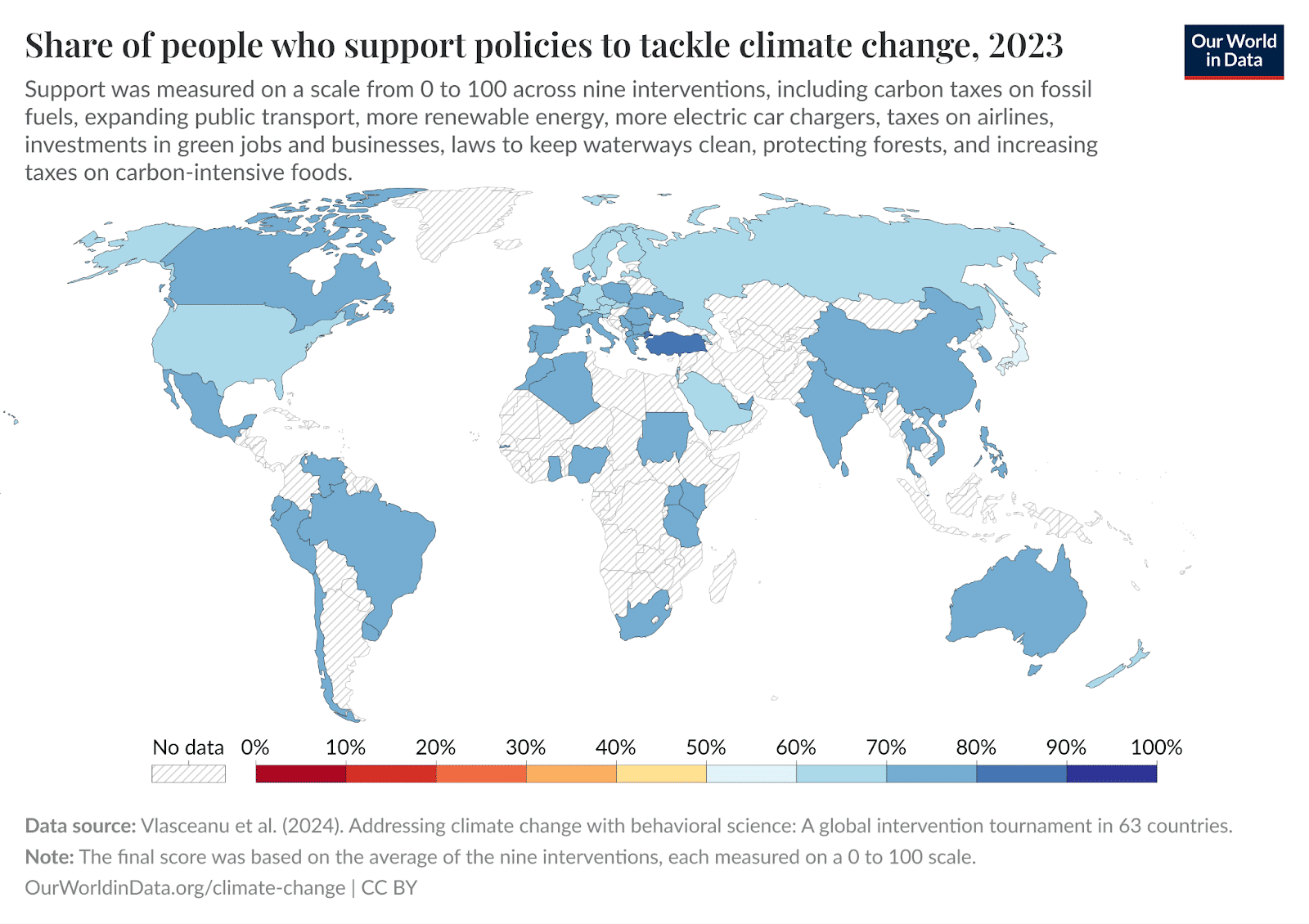
Small changes from many people shift the norms of society, and lead to profound, long-term movement. We’ve already seen so much progress here. There are many more products being marketed as sustainable than there were even 10 years ago. Large companies often have sustainability officers and are posting their plans to decarbonize. They aren’t doing this out of kindness, they know that the trend is that more and more of their customers care about it. While it's true that some of this is greenwashing, it shows that sustainability is a growing concern that companies are taking seriously.
Changing the narrative will take many individuals showing what everyday climate action looks like through what they do and how they talk about climate. This can look like a lot of things, and is different for everyone. It could be mentioning that you got a new electric mower and you love it. Telling your friends you tried a bean burger and it was actually pretty good. Posting on instagram that you learned that clean energy is now cheaper than fossil fuel alternatives (yes, coal is the alternative energy now).
If you need some inspiration, our actions page will help you get started on some ways you can start taking climate action based on a short survey.
If you want to learn more about climate progress, I highly recommend Not the End of the World by Hannah Ritchie, a leading climate and data scientist. It looks more into how we are actually making progress in many ways, from reductions in deforestation to preventing plastics from getting into the ocean.
Want to learn more?
Get updates on climate progress and how you can help.