The quiet revolution behind the products you love
While everyone's arguing about climate doom, something remarkable is happening behind the scenes. The products on your shelf hold secrets about progress no one's talking about.
When we talk about climate change, the conversation often bounces between doom and denial, between "we're out of time" and "someone should really do something." But here's what doesn't get said nearly enough: real progress is happening. It's not a billionaire launching rockets or a celebrity going vegan. It's happening in factories you've never heard of, in labs where engineers argue about packaging thickness, in the quiet decisions that shape the products sitting in your pantry right now.
And honestly? That might be the most encouraging thing about where we're headed.
Your Morning Routine Is Changing (You Just Haven't Noticed)
Think about your shampoo bottle for a second. The one in your shower. Chances are it weighs less than it did five years ago, not because you got ripped off, but because someone figured out how to use 15% less plastic without making it flimsy. Same deal with that soda can in your fridge. Lighter. Thinner. Still does the job. The coffee cup in your hand. Even the soda-can sitting in your fridge. Chances are, every one of those products comes from a cleaner, more efficient manufacturing process than it did just a few years ago. Breweries are chasing carbon neutrality. Packaging is getting lighter, recyclable, even compostable. It's not perfect but it's real.
What's fascinating is that most of the people doing this work aren't trying to save the planet in some grand, sweeping way. They're packaging engineers. Supply chain managers. People who get excited about shaving two millimeters off a bottle cap because it means they can fit more units on a truck. Less fuel burned. Fewer trips needed. Money saved.
Often the best climate action doesn't feel like activism at all. It just feels like doing your job well.
The Revolution Hiding in Plain Sight
Progress isn't just happening behind closed lab doors, it's visible if you know where to look. Industrial emissions are dropping as companies adopt energy-efficient technologies and find ways to do more with less. More importantly, the economy is growing while emissions decline. That's not a distant dream; it's happening now.
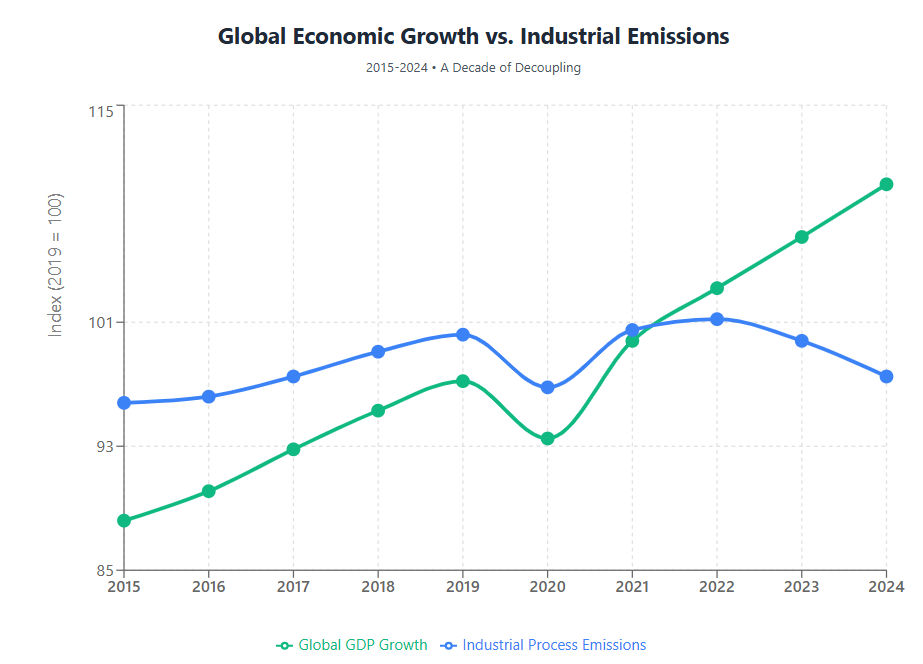
A dual-line graph illustrating how global GDP has grown by 3.2% in 2024 while industrial process emissions declined by 2.3%. The visual demonstrates the decoupling of economic prosperity from carbon emissions—proof that we can grow cleaner, not just smaller.
Here's where it gets interesting. When a major beverage brand decides to lighten its bottles, something unexpected happens. The plastic manufacturer retools its production line. The shipping company adjusts its logistics because lighter products mean more units per truck, less fuel burned. The retailer notices reduced waste in their stores. What started as a single product decision becomes an industry standard within months.
Over the past few years, most major brands have been quietly reducing virgin plastic in their packaging. That lighter bottle you barely noticed? It's teaching entire industries new ways of doing business. A coffee company experiments with compostable cups, proves it works at scale, and suddenly three competitors are testing similar materials within a year. That's how revolutions actually spread, not through grand announcements, but through quiet proof that something better is possible.
Companies are getting creative too, and some of these stories are remarkable. Take Notpla , a London startup that created biodegradable packaging from seaweed. Their edible bubble packaging has now replaced over 16 million single-use plastic items across Europe and also heading towards the USA. These items are being used everywhere from sports stadiums to food delivery services. What started with two students at Imperial College has grown into a company that won Prince William's Earthshot Prize.

Or consider what's happening in laundry aisles. Unilever has been tackling one of packaging's toughest challenges: putting liquid detergent in paper instead of plastic. It sounds simple, but liquids need serious barrier protection, something plastic does easily but paper struggles with. Their R&D team has evaluated over 3,000 different technologies , some borrowed from pharmaceuticals and electronics, to find materials that can seal and protect without compromising recyclability. Meanwhile, Procter & Gamble introduced Tide bottles made from 25% recycled plastic, and Ecover launched laundry capsules in boxes made from 90% recycled cardboard, using upcycled rose petals and apricots for fragrance.
Then there's ITC , blending South Asian packaging needs with sustainability by launching sugarcane-fiber coated paperboard as a plastic alternative for ready-to-drink cartons. Or Be Green Packaging in California, which launched a home-compostable coffee cup that's getting great feedback from independent cafes. Each company's success makes the next improvement easier. Each innovation creates a template others can follow, and the momentum builds on itself.
Where the Real Power Shift Is Happening
Behind many of these manufacturing improvements is something even more fundamental: a shift in where the energy comes from.
Last year, something remarkable happened in the United States. For the first time ever, wind and solar combined generated more electricity than coal. Coal, which dominated American power as recently as 2015, has been overtaken by renewables. The transition hasn't been instantaneous, and it's worth understanding what's actually happening. Natural gas has played a bridging role in this shift, it produces about half the carbon emissions of coal when burned for electricity. While it's not the final destination, it's been a practical stepping stone. Many coal plants have converted to natural gas as renewables have scaled up, cutting emissions significantly while the grid adapts to handle more variable renewable sources. This didn't happen because of a single law or dramatic shutdown. It happened because factories switched to solar to cut energy costs. Because warehouses installed panels on their roofs and realized they could sell excess power back to the grid. Because the facility making your shampoo bottles found it cheaper to run on wind power than fossil fuels.
Share of US electric power sector generation by fuel source,1990-2024 (EIA,2025) .
Wind now powers over a tenth of the country's electricity, while solar has more than doubled its share in just four years. Each percentage point represents thousands of individual choices by facility managers and business owners who decided cleaner energy made sense for their bottom line.
Globally, renewable energy capacity grew by over 15%, adding enough new power to supply hundreds of millions of homes. The UK hit a milestone too, renewables generated more than half their electricity for four straight quarters. On one December day, wind alone powered more than two-thirds of the entire country. An entire modern economy, running mostly on wind.
When Economics Drives the Revolution
Here's where it gets interesting: a lot of this shift isn't being driven by regulation or government mandates. It's economics.
Renewable energy is now the cheapest way to add new power capacity in most countries. Not "competitive with fossil fuels if you squint" but actually cheaper. And here's what makes this even more significant: battery storage technology has advanced to the point where solar and wind can now provide reliable, round-the-clock power, matching what fossil fuels have always offered. Batteries store excess energy generated during sunny or windy periods and release it when needed, solving the intermittency challenge that once held renewables back. So, when companies need more electricity, they're going solar or wind because it makes financial sense. When data centers, those massive facilities powering the internet and all our cloud storage need more electricity, they're contracting solar and wind capacity because it makes financial sense. They've signed deals for enough clean energy to represent nearly half of all corporate renewable contracts in the U.S.
The technology keeps getting better too. Solar panels installed over just the last six years now prevent as much carbon from entering the atmosphere annually as if France, Germany, Italy, and the UK all stopped emitting entirely. Wind power prevents another massive chunk of emissions every year.
It takes time to replace a world’s energy infrastructure, so the picture can look grim when seeing that we are still using plenty of coal power, and emissions have yet to peak. However, an important signal of our current direction is looking at what types of new power generation is being built. As of 2024, nearly 80% of new power is from renewable sources, and this rate is steadily going up over time.

Worldwide new power capacity additions by technology, 2016-2024 ( generated from data from ember-energy.org )
But let's bring this back to what it actually means for you. That laundry detergent you bought last week? Good chance it was manufactured in a facility partly powered by solar. The aluminum in your soda-can was likely smelted using increasingly clean energy. The cardboard box your online order arrived in, came from a mill that's been steadily cleaning up its production.
These reductions are happening right now, embedded in the everyday products you already use. Every purchase becomes a small vote for cleaner production, whether you realize it or not. And when millions of people make those purchases, manufacturers notice. They double down. They invest more in clean energy. They redesign more products. The revolution compounds.
In Europe, power sector emissions dropped significantly last year thanks to wind, solar, and rebounds in hydro and nuclear. The challenge now is extending similar progress to transportation and heating, areas where change is more complex but equally important.
Hope Isn't Naive, It's Contagious
Here's the truth about optimism: it's not about blind faith or wishful thinking. It's the ability to see small wins and recognize that they matter. Communities everywhere are proving that schools installing solar panels, towns recycling wastewater for irrigation, companies swapping fossil plastics for bio-based ones.
When people see change happening, it clicks. Hope stops feeling abstract as it becomes action. You can't always measure it in spreadsheets, but you can feel it in the way conversations shift, in how decisions get made, in the way people’s concern turns into action.
We're at an inflection point. Progress is accelerating in ways that seemed impossible a decade ago. Coal plants are closing not because of a picket protest, but because they can't compete. Electric vehicles are becoming the practical choice, not just the idealistic one. Solar panels and wind turbines are going up because they make financial sense.
There's still a lot of work ahead. The infrastructure we're building today won't show its full impact on total emissions for years, it takes time for new solar farms to come online, for electric vehicles to replace gas-powered ones, for cleaner factories to outpace older facilities. But the momentum is real, and the direction is clear. We're not at the finish line, but we've turned the corner. The emissions reductions will follow as these changes scale up and compound over time.
Small Steps Add Up
So where do you fit into all this? Chances are, you already do. Every time you reuse something, repair instead of replace, or simply notice the thought that went into a more sustainable product, you're part of that progress.
Progress isn't about giant leaps. It's about passing the baton, one effort to the next. The engineers redesigning packaging, the plant managers switching to renewable energy, the logistics teams finding more efficient routes, they're not waiting for permission or perfect solutions. They're moving forward with what works today while building toward what works better tomorrow.
This is how change actually happens. Not through dramatic pronouncements or sweeping mandates alone, but through thousands of practical improvements happening simultaneously across industries, communities, and supply chains. Each one makes the next one easier. Each success proves what's possible.
And right now, it's in your hand. The future isn't waiting to begin, it's already unfolding quietly, right in front of us. In the products you buy, the energy powering your home, the materials being designed today for tomorrow's goods. The revolution is happening. You just have to look for it.
How You Can Help
Your choices amplify this momentum. When you pick products with lighter packaging, support companies investing in clean energy, or upgrade to an electric appliance, you're sending a signal. Companies notice what sells. Investors notice what grows. Each purchase becomes a small vote for the direction we're heading, and those votes add up faster than you might think. The engineers and managers pore over the data to make sure they are responding to what people choose. By supporting the companies doing the right thing, you're not just participating in progress. You're accelerating it.
Want to learn more?
Get updates on climate progress and how you can help.