How are heat pumps so much more efficient?
Heat pumps generate heat far more efficiently than traditional sources, and are becoming more and more popular. They have been in use for home heating for a while, but they are also moving into other areas too, like water heaters and clothes dryers.
You may have started hearing more about “heat pumps” lately, and how they are an important tool for reducing emissions. Heat pumps are significantly more efficient than standard electrical heating, but how is it possible to generate so much more heat with the same amount of energy?
They’re vastly more efficient than any other form of heating because they use the properties of boiling and condensing liquids to move heat from one area to another, rather than generating heat like traditional methods. This saves you money since you don’t have to consume any fuel and only require some electrical energy to compress the vapour and move air using fans. They’re gaining in popularity, especially in regions where low-cost natural gas is unavailable.
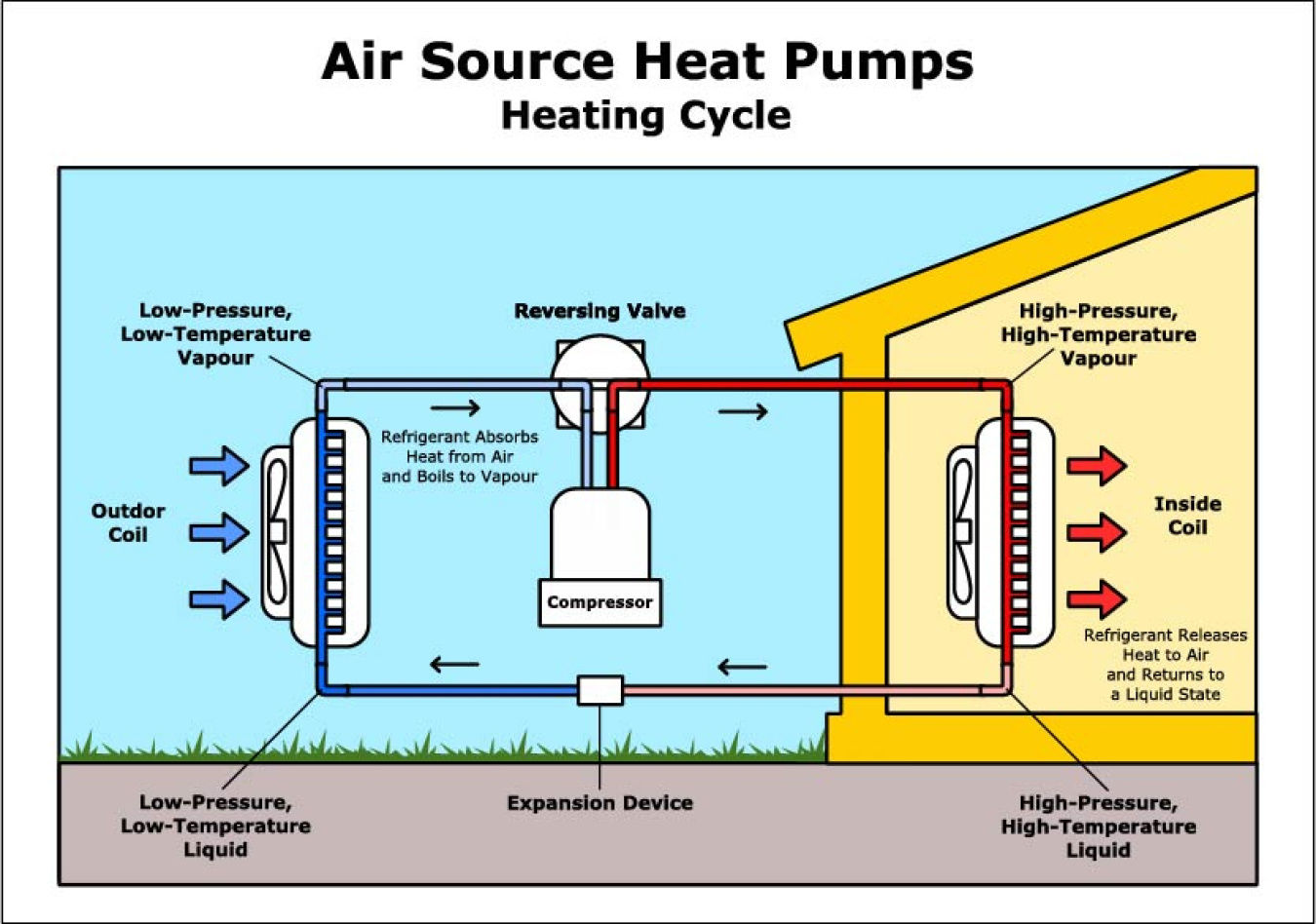
They’re essentially inverted air conditioners. While air conditioners absorb heat from inside the home and discharge it outside of your home, heat pumps absorb heat from outside your home and discharge heat inside your home. They can also function in reverse, just like an air conditioner.
[[Source: Department of Energy, https://www.energy.gov/energysaver/air-source-heat-pumps]]
Heat pumps, like air conditioners, refrigerators, and dehumidifiers, use refrigerant inside sealed metal tubing. A refrigerant is a liquid with a low boiling point. In heating mode, a compressor takes in low-pressure, low-temperature refrigerant vapor and raises its pressure and temperature. This vapor then passes through many coils of tubing, with a fan blowing air over them. The cooler air removes heat from the hot vapor, blowing it out into the house. The vapor cools below its boiling point, condensing into a liquid, so these coils are known as a condenser. This high-pressure, warm liquid passes through an expansion valve, which reduces the temperature and pressure. This low-temperature, low-pressure liquid is very close to its boiling point at that pressure. The liquid passes through another set of coils with a fan blowing over it. The air the fan blows is slightly warmer than the liquid, causing it to boil, absorbing heat from the air. This coil is known as the evaporator. The resulting low-temperature, low-pressure vapor goes into the compressor, starting the cycle over.
To operate this system as an air conditioner, a reversing valve reverses the flow of refrigerant, turning the outside coil into a condenser, giving off heat, and the inside coil into an evaporator, absorbing heat and cooling the house.
This system is incredibly efficient because it uses the properties of a liquid that absorbs heat as it evaporates into a vapor and that gives off heat as it condenses into a liquid. The compressor uses electrical energy to pressurize and pump vapor through the system, and the fans also consume electrical energy to move air over the evaporator and condenser coils. But this amount of energy is far less than the amount of heat energy heat pumps move from outdoors to indoors. Normal heat pumps move 3 times the thermal energy around than the electrical energy they consume (so they are 300% efficient), and cold climate heat pumps move 4 times the thermal energy than the electrical energy they consume, so they’re 400% efficient. By contrast, a high-efficiency gas furnace converts 98% of the energy contained in natural gas into thermal energy, creating carbon dioxide (a greenhouse gas) along the way.
Even if your local power source is high carbon and produces power entirely from fossil fuel, this is still a significant reduction in greenhouse gas. If your local power is low carbon, your greenhouse gas reduction is even greater.
Since heat pumps are so incredibly efficient, they cost far less to operate.

You’ll always have lower operating costs with a heat pump if you’re replacing an electric, oil, low-efficiency natural gas, or propane furnace or electric baseboard heaters. Enter your local gas and electricity rates into an online calculator if you’re replacing a high-efficiency gas furnace, since savings in this scenario depend on the differential between your electricity price and your natural gas price.
Heat pumps also save space inside and outside your home since they replace both your furnace and your air conditioner equipment.
Cost and Installation
Heat pumps need to be installed by professionals, and whole-house systems can be expensive. But if you need a system for a single room, small, split ductless heat pumps can be quite affordable. The indoor unit is small and quiet. It pays for itself in power savings quite quickly.
Whole-house systems are considerably more expensive, but if you’re replacing both a furnace and an air conditioner, the savings in operating costs will offset the purchase and installation costs in time. You should also check with your local utility. Many offer discounts and rebates for the purchase and installation of heat pumps.
Heat Pump Water Heaters
Another appliance that moves around a lot of heat is a water heater. Water heaters can burn oil, propane, or natural gas to produce hot water, These produce carbon dioxide directly and involve piping flammable or explosive fuels. They also require proper venting and run the risk of leaking toxic carbon monoxide into your home.
Electric hot water heaters use electrical resistive heating, have none of these risks, and don’t require venting. However, they consume a lot of electricity, so they are expensive to operate. If your electrical source is high carbon, then this also produces carbon dioxide.
A heat pump is far more efficient at heating water than an electric resistive heater. Like an air source heat pump for heating your home, it uses an evaporator coil to extract heat from air in order to boil refrigerant, a compressor to heat and increase the pressure of the refrigerant vapor, and a condenser coil, which releases the heat and condenses the vapor back into a liquid. The condenser sits in the insulated water tank, and the evaporator often sits above the tank, surrounding the hot compressor and discharging cold air out into the room or through a vent outdoors.

If the evaporator is vented indoors, there needs to be at least 1000 cubic feet of air around the cold air exhaust to prevent the room from getting too cold, or the hot water heater needs to be installed in the furnace room that could benefit from cooling. You can also combine this water heater with an air source heat pump that heats your home, moving heat from the outside of your home to the inside of your home and the water tank in the winter, and from the inside of your home to the outside and to the water tank in the summer.
Cost and Installation
Since heat pump water heaters use a lot of metal piping and a compressor, they are more expensive to purchase than other types of water heaters. The much lower operating cost will offset the higher purchase cost over time.
They don’t have special water piping requirements, so they aren’t necessarily more expensive to install than a conventional hot water heater. If you have to vent the cold air outside, then the installation costs may be higher, although you might be able to reuse the vent hole if you’re replacing an oil, propane, or natural gas water heater.
Heat Pump Clothes Dryers
Similar to a water heater, a clothes dryer moves large amounts of heat. Typically, clothes dryers use electric resistive heating, which consumes a large amount of electric power, although they can use natural gas. A natural gas clothes dryer will produce carbon dioxide directly and require good venting to prevent lethal carbon monoxide from leaking into your home.
A heat pump clothes dryer uses a heat pump to heat air in order to dry clothes.
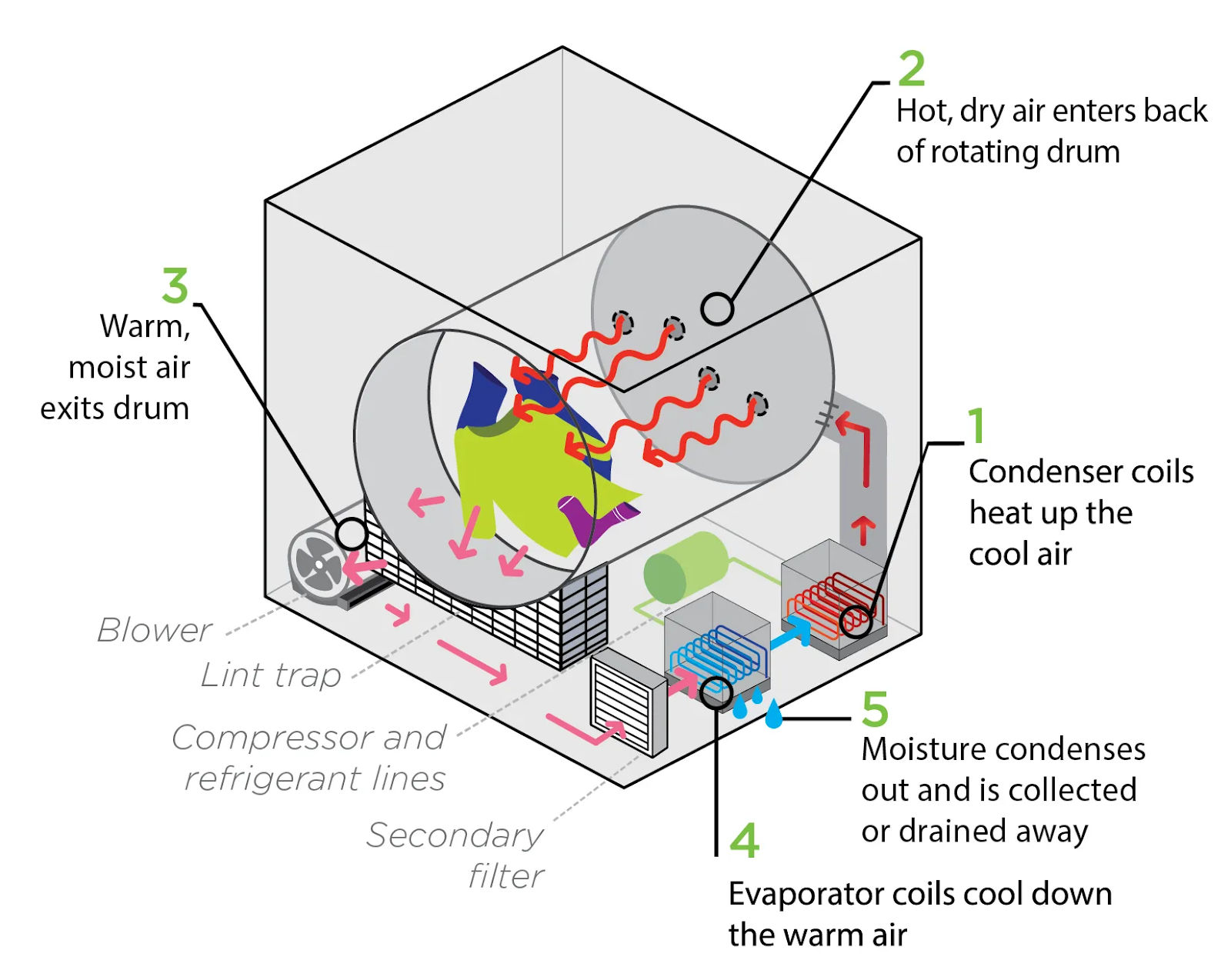
The hot condenser heats cold, dry air, and a fan blows the warm, dry air into the drying drum. The clothes dry, giving up their moisture into the air, and the resulting warm, moist air passes over the cold evaporator. The cold evaporator causes moisture to condense out of the air and cools the air. It then passes back to the condenser, and the cycle continues.
This is a very efficient process, resulting in very low operating costs. Another advantage is that this is a closed system, requiring no venting. Conventional clothes dryers discharge warm, moist air out of a vent and draw room air in to replace it. This creates low pressure in your house, increasing air leakage from outside. This isn’t the case with a heat pump clothes dryer that recirculates its air, so it makes your home more efficient in another way.
The condenser doesn’t provide as much heat as an electric or natural gas clothes dryer, so the dryer drum temperature is lower, resulting in much longer drying times. However, the advantage of this is much more gentle drying, preventing damage and saving wear and tear on your clothes.
Cost and Installation
Since heat pump clothes dryers are more complicated than other types of clothes dryers, using a lot of expensive metal piping and components, they cost more than other types of clothes dryers. However, the lower operating cost offsets the higher purchase cost over time, and the benefit to your home’s air balance adds to the savings.
Installation costs are lower than conventional clothes dryers because heat pump clothes dryers don’t require a vent. Most heat pump clothes dryers reuse the 240 V electrical plug that already exists for an electric clothes dryer, although some use conventional 120 V electrical plugs used by natural gas clothes dryers, so you don’t need to rewire.
Want to learn more?
Get updates on climate progress and how you can help.