The climate economy is already here (and it's massive)
What if the biggest economic shift of your lifetime is happening right now, and most people aren't noticing? Climate adaptation and solutions are already a trillion-dollar industry—here's who's benefiting and why timing matters.
Imagine you're an HVAC technician. For fifteen years, you've been installing gas furnaces and traditional AC units which is standard stuff. But over the past few years, something has shifted. More and more customers start asking about heat pumps.
If you don't know, heat pumps are systems that both heat and cool your home using electricity, basically an air conditioner that can run in reverse. They're significantly more efficient than traditional heating systems, often using 50-70% less energy than gas furnaces. What used to be niche technology mainly used in mild climates now works efficiently even in cold regions.
At first, it's just a handful of requests from early adopters, environmentalists, and people chasing rebates. But the volume keeps growing. So you get certified. Take a weekend course, learn the systems, start offering heat pump installation alongside your regular furnace work.
Fast forward a few years: nearly half your jobs involve heat pumps. You're busy, your rates are competitive, and you're not worried about your work drying up. Meanwhile, your colleagues who didn't bother learning the new systems are starting to notice their furnace-only business isn't growing like it used to.
This isn't a prediction or some brilliant strategic move. It's just paying attention to what customers are asking for and adapting before you have to.
That's the thing about major economic transitions, they don't announce themselves with trumpets. They show up as small shifts in demand, gradual changes in what people are buying, incremental movements that only become obvious in hindsight.
The Numbers Nobody Talks About
Let's start with scale, because the numbers are genuinely wild.
In the global climate adaptation market, things like flood barriers, resilient infrastructure, drought-resistant agriculture, cooling systems are already valued at over $2 trillion and growing rapidly. Cities are spending billions on sea walls. Countries are rebuilding their agricultural systems. Insurance companies are completely restructuring their risk models.
Combined, we're watching one of the fastest industrial transformations in human history. And it's accelerating. Global investment in climate tech grew 40% just between 2021 and 2023. More and more capital is flowing into this space every quarter, not because investors suddenly care about polar bears, but because the returns are there and the risk of staying in the old economy is becoming clearer.

Global renewable energy investment continues to rise, with solar and wind showing different patterns. In the first half of 2024, solar investment hit $221 billion. (BloombergNEF).
What this means practically: we're past the "will this happen?" phase. It's happening. The question now is whether you're positioned to benefit from it or you're going to be playing catch-up.
What We're Building (The Adaptation Economy)
Walk through Miami and you'll see something remarkable: a $6 billion infrastructure transformation happening in real-time. Sea walls, pump stations, elevated roads, resilient power systems. This isn't climate activism, it’s pragmatic economics. The city calculated that spending billions now beats spending tens of billions later on disaster recovery.
They're not alone. More and more coastal cities are making similar calculations. New York is building massive flood barriers. Jakarta is literally moving its capital to higher ground. The Netherlands has been doing this for decades and has turned climate resilience into an export industry, selling their expertise n globally.
But adaptation goes way beyond coastlines. Phoenix and other Southwest cities are building extensive cooling center networks and updating building codes for extreme heat. European cities that never needed air conditioning are retrofitting buildings for a hotter future. Agricultural regions globally are shifting to drought-resistant crops and precision irrigation systems that use 40-50% less water.
The insurance industry might be the clearest signal that this is economically real, not ideologically driven. They're repricing risk based on climate projections, pulling out of high-risk markets entirely, and charging massive premiums for coastal properties. When insurance actuaries, whose entire job is calculating risk and return, are restructuring their entire business model around climate change, that's not politics. That's math.
And here's what's interesting: properties with climate resilience features are already commanding premiums. Homes with flood protection, backup power, efficient HVAC systems, solar panels. They're selling faster and for more money than comparable properties without those features. Early movers who installed these features years ago are seeing their investments pay off not just in lower utility bills, but in property values that held steady or increased while climate-vulnerable properties declined.
The real estate market is already pricing in climate risk, even if most people aren't consciously thinking about it yet.
The Solutions Economy (What's Replacing the Old System)
While cities are adapting to change, there's a parallel transformation happening: the actual energy and transportation systems that created the problem are being replaced.
Solar and wind are now the largest sources of new electricity generation globally, not because of subsidies or mandates, but because they're the cheapest options. In most markets, building new renewable energy is less expensive than even operating existing fossil fuel plants. That cost advantage is only growing as technology improves and scale increases.
The EV market went from "maybe someday" to "mainstream within a decade" faster than almost anyone predicted. Ten years ago, EVs were expensive novelties. Now they're approaching price parity with gas cars, performing better in most metrics, and cheaper to operate. More importantly, every major automaker has restructured their entire business model around electrification. They didn't do that because of environmental pressure, they did it because they see where the market is going and don't want to be left making obsolete products.
Heat pumps outsold gas furnaces in the U.S. for the first time in 2022, and that gap is widening. What was once niche technology for environmentalists is now the economically rational choice for most new construction and many retrofits. They're more efficient, they provide both heating and cooling, and operating costs are typically lower, especially as electricity grids get cleaner and gas prices stay volatile.
Building efficiency has become a massive industry. Retrofitting existing buildings with better insulation, efficient windows, smart thermostats, and LED lighting used to be seen as nice-to-have upgrades. Now it's a $300+ billion market because the payback periods got short enough that it's just smart economics. Battery storage is transforming grid economics in ways that seemed impossible just five years ago. Large-scale battery installations are making variable renewable energy reliable, and costs have dropped so dramatically that what was recently cutting-edge is now routine.
That cost advantage is only growing as technology improves and scale increases. As we discussed in the Depopulation and Degrowth article, we don't need economic contraction to solve the climate, we need better technology becoming more accessible.
Here's the pattern: these technologies used to be for early adopters willing to pay a premium for environmental benefits. That's not the market anymore. The market now is people making economically rational decisions. The clean option increasingly is the cheap option, the reliable option, the obviously better option.
More and more people are switching not because they're "green," but because it makes financial sense. That's what makes this transition inevitable, it's not running on ideology anymore. It's running on economics.
The Jobs Are Following the Money
This is where the conversation turns practical. The job market is shifting faster than most people realize, and skills are becoming the real differentiator.
Clean energy jobs in the U.S. grew to over 3.3 million in 2023, and they're still growing at about 4-5% annually. Solar installer is one of the fastest-growing occupations. Wind turbine technician training programs can't keep up with demand. Electricians who know EV charging systems and heat pump installation are commanding premium rates.
The HVAC technician isn't an outlier, he's an example of a pattern. HVAC technicians who got trained on heat pumps early positioned themselves well. Electricians who learned EV charging installation before the rush captured the early market when there was less competition . Construction workers who specialized in efficiency retrofits and resilience upgrades are working constantly. The old skills are still valuable, we still need people who can fix traditional systems. But the growth, the premium pay, the job security, that's increasingly on the new side. And there's a first-mover advantage to building expertise in growing fields before everyone else does.
This isn't hypothetical. I talked to a contractor who specialized in home efficiency retrofits. She started five years ago when it was a niche market. Now she's turning down work, charging higher rates, and training new employees to keep up with demand. Meanwhile, contractors who are stuck exclusively with traditional work are competing for a market that's not growing.
The same pattern is playing out globally. Countries investing heavily in clean energy manufacturing and installation are creating stable, well-paying jobs. Europe's push for heat pumps created a labor shortage, there aren't enough trained installers to meet demand. That's an opportunity for workers who get trained, and a bottleneck for the transition.
The skill development angle is compelling because it's tangible and time-sensitive. You can wait on solar panels because they'll keep getting cheaper. You can't wait on skills because the market is growing now, and being early means less competition and more opportunity to establish yourself.
What This Means for Regular People
You're not being asked to sacrifice for the climate. You're being offered a front-row seat to a massive economic transition and a chance to position yourself on the right side of it.
Early adopters of these technologies and industries aren't doing better because they're morally superior. They're doing better because they recognized a shift and acted while there was still an advantage to moving early. Jake didn't become a heat pump installer because he's an environmentalist, he did it because he looked at market trends and made a bet on where his industry was going.
Properties in climate-resilient areas or with green features are already commanding premiums. People who bought or upgraded early got in before the market fully adjusted. That advantage compounds over time. For people building careers or considering career shifts, the first-mover advantage in developing skills in growing industries is very real. The HVAC tech who learns heat pumps now has less competition than the one who waits three years when everyone else has also figured out the market is shifting.
You don't need to wait for perfect conditions or make perfect choices. As we've covered before, taking imperfect action creates momentum that waiting for perfection never will.
None of this requires you to be perfect or radically change your life. It's just recognizing where things are going and making decisions with that knowledge. The people who benefited from getting solar five years ago aren't climate heroes, they're people who did math, saw the payback made sense, and acted. Now they're laughing at utility rate increases while their neighbors' bills keep climbing.
The Trajectory Is Clear
Here's what's increasingly obvious: this economic transition is happening with or without any individual's participation. The market forces are too strong, the cost advantages too clear, the investment too massive.
But participation timing matters. Not in a "you're too late" way, these opportunities will exist for years. But early participants in growing markets typically capture advantages that later participants don't: less competition, better incentives, establishing expertise before it's commoditized, buying assets before prices adjust upward.
The climate economy isn't speculative anymore. It's not "maybe this will be big someday." It's already one of the largest economic forces globally, growing faster than most traditional industries, and creating opportunities for people who recognize the shift.
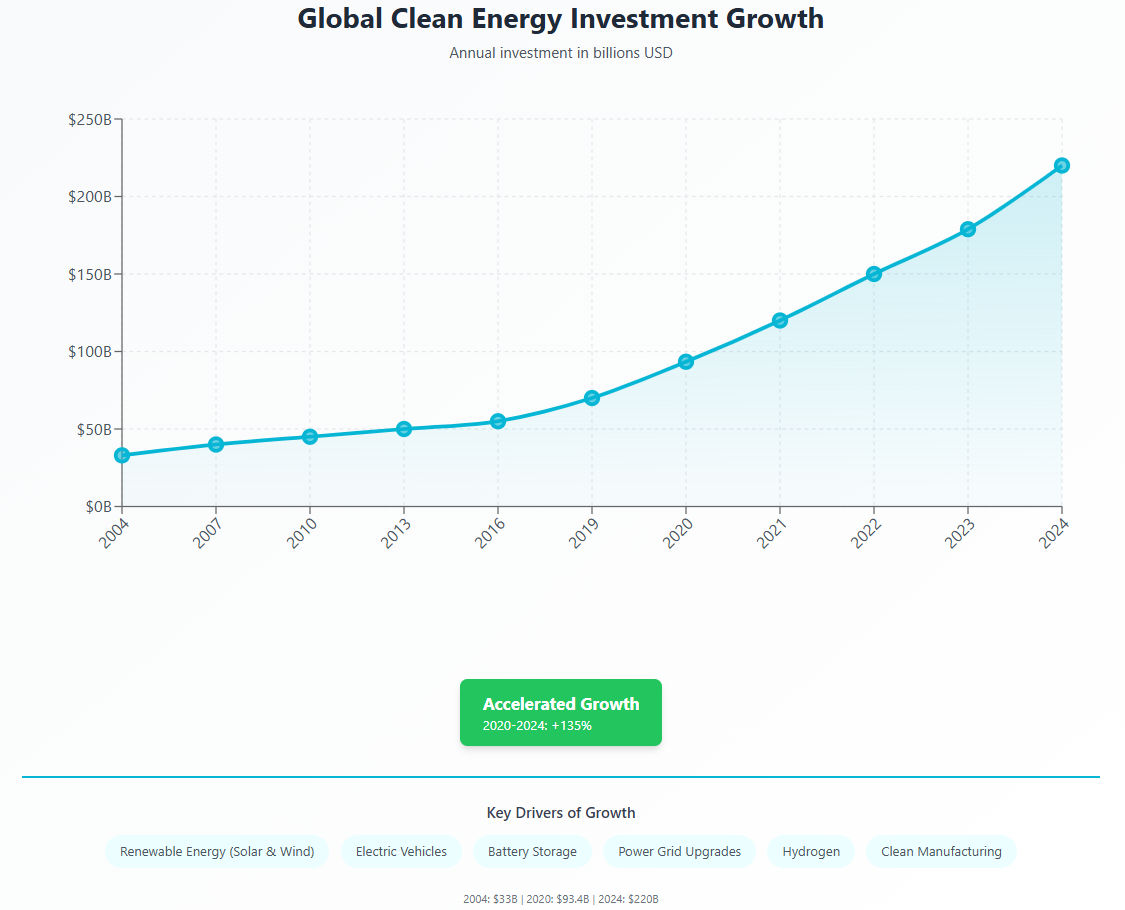
Global energy-transition investment has surged since 2015, reaching about $1.77 trillion in 2023 with renewables, grids and electrified transport driving most growth (BloombergNEF).
Cities are spending trillions on adaptation because the math says it's cheaper than not adapting. Companies are investing trillions in clean energy because it's becoming the economically rational choice. Workers are building skills in these areas because that's where the job growth is. Real estate markets are already pricing in climate resilience.
More and more people and institutions are making these moves, not because they're environmentalists, but because the economics make sense. That's what makes the transition inevitable. When the economic incentives align with the climate goals, change happens fast. You can be part of the early wave, the mainstream wave, or the late wave. All are fine. But the early wave is already seeing benefits the others aren't yet and some of those benefits (limited incentives, establishing expertise in growing fields, buying resilient assets before premiums fully materialize) won't be available later.
The opportunity isn't "now or never." But it is larger now than it will be later. And recognizing that isn't FOMO, it's just paying attention to what's already happening.
Want to learn more?
Get updates on climate progress and how you can help.