Depopulation and degrowth won't solve climate change
Some think fewer people or shrinking economies would solve climate change. The data shows otherwise and we're already proving there's a better way that doesn't require sacrifice.
There's a certain type of climate conversation that goes like this: "You know what would really solve climate change? If we just had fewer people." Or its cousin: "We need to stop economic growth entirely."
These ideas sound logical at first glance. Fewer people means less consumption, right? A smaller economy means fewer emissions? But here's the thing, the data doesn't support these ideas at all. And even if it did, good luck convincing eight billion people to voluntarily make their lives worse.
More importantly, we don't need to. The real story happening right now is way more interesting.
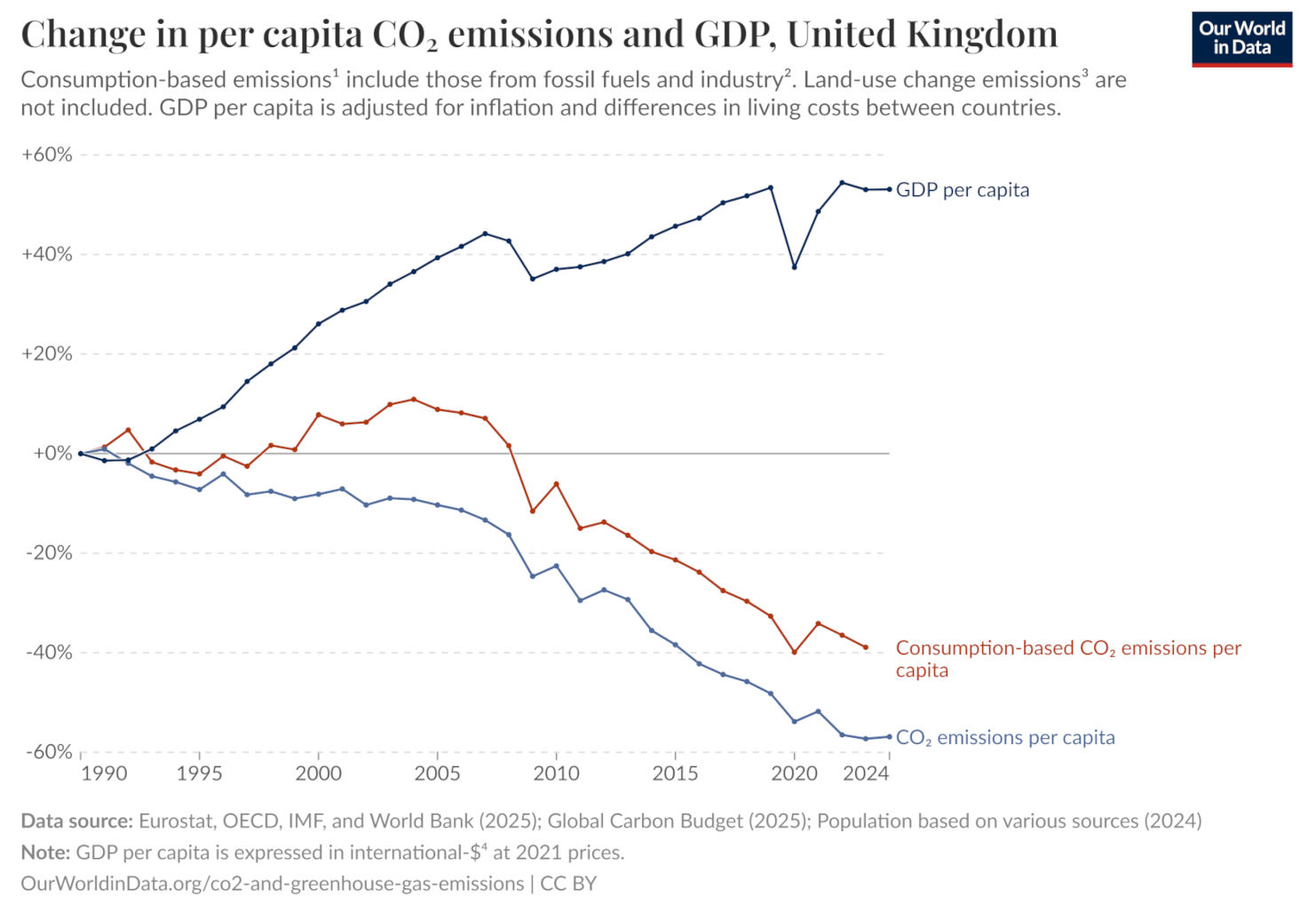
Source: Our World in Data
Look at the United States. Since 1990, GDP per capita has grown by 70%. Americans are significantly more prosperous than a generation ago. Yet per capita emissions have fallen by 30%. The economy grew while emissions shrank. This is what decoupling looks like in action, and it happened in the world's largest economy without anyone sacrificing their standard of living.
Pushing a Ship Backward vs. Turning the Wheel
Picture this: climate change is like a massive cargo ship heading toward an iceberg. The ship has enormous momentum, carrying the weight of 8 billion people, their needs, their aspirations, and the entire global economy. It's not going to stop on a dime.
Now, the depopulation and degrowth approach says: "Everyone rush to the bow and push backward! If we all push hard enough, we can slow this thing down." And sure, in theory, if you could get everyone pushing in perfect coordination, you might reduce the ship's speed a little. But here's the problem, you're not changing the direction. The ship is still pointed at the iceberg. You're just approaching it slightly slower while exhausting everyone in the process.
Plus, try coordinating that effort across every deck. Billions of passengers just finally got aboard after generations of waiting. The last thing they're willing to do is push the ship backward when they've only just started moving forward.
Now contrast that with the clean energy approach: you're turning the wheel. You're actually changing where the ship is headed. The momentum is still there, people still want prosperity, comfort, and opportunity but now that momentum is carrying us in a different direction. Away from the iceberg entirely.
Turning the wheel works with the ship's momentum instead of against it. You're not asking people to sacrifice or push against their own interests. You're redirecting the energy that's already there toward a destination that doesn't involve disaster.
One approach is exhausting, divisive, and doesn't solve the fundamental problem. The other actually changes the outcome. Which one sounds more likely to work?
Rich Countries Are Getting Cleaner While Getting Richer
Here's a pattern that shocked researchers when they first discovered it: countries don't just pollute more and more as they get wealthier. They pollute more for a while, then hit a peak, and then this is the wild part, they start polluting less even as their economies keep growing.
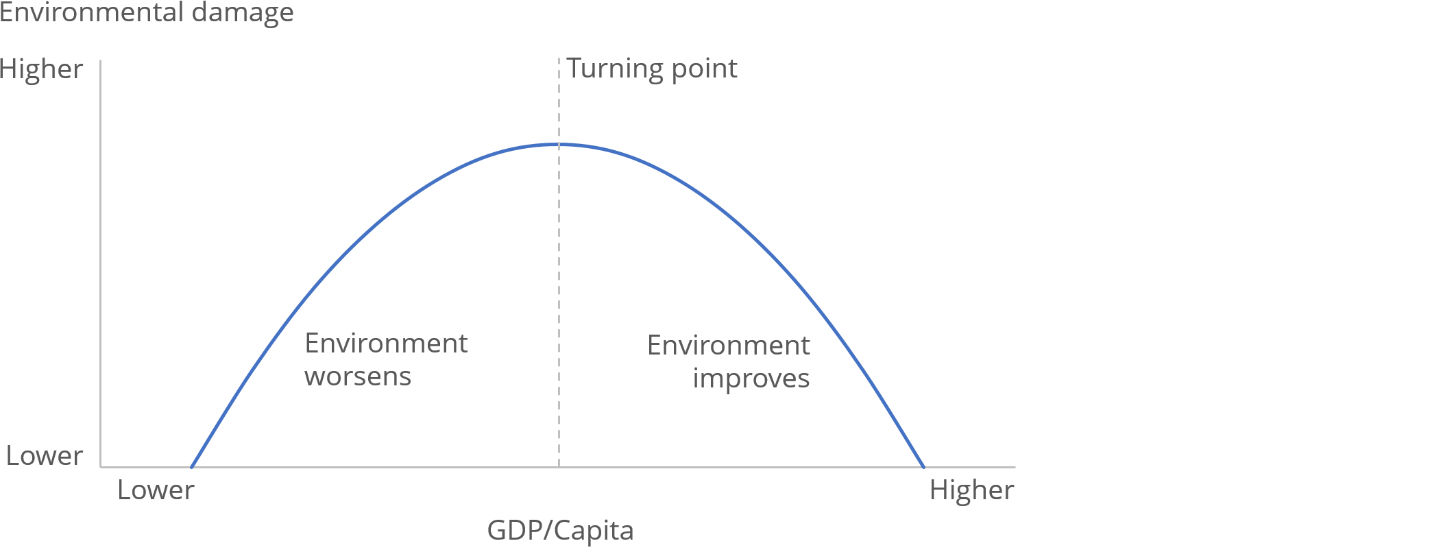
Initial increases in GDP per head result in increased greenhouse gas emissions but, as an economy transitions from industrial production to service-based industries the environmental damage gradually falls (Source: Environmental Kuznets Curve)
It's called the Environmental Kuznets Curve, and it's playing out across the developed world right now. The UK's emissions have dropped back to levels not seen since 1890, before cars existed while its economy has grown massively. The U.S. hit peak emissions in 2007 and has cut them significantly while GDP increased by over 20%. Germany, France, Spain, the pattern repeats.
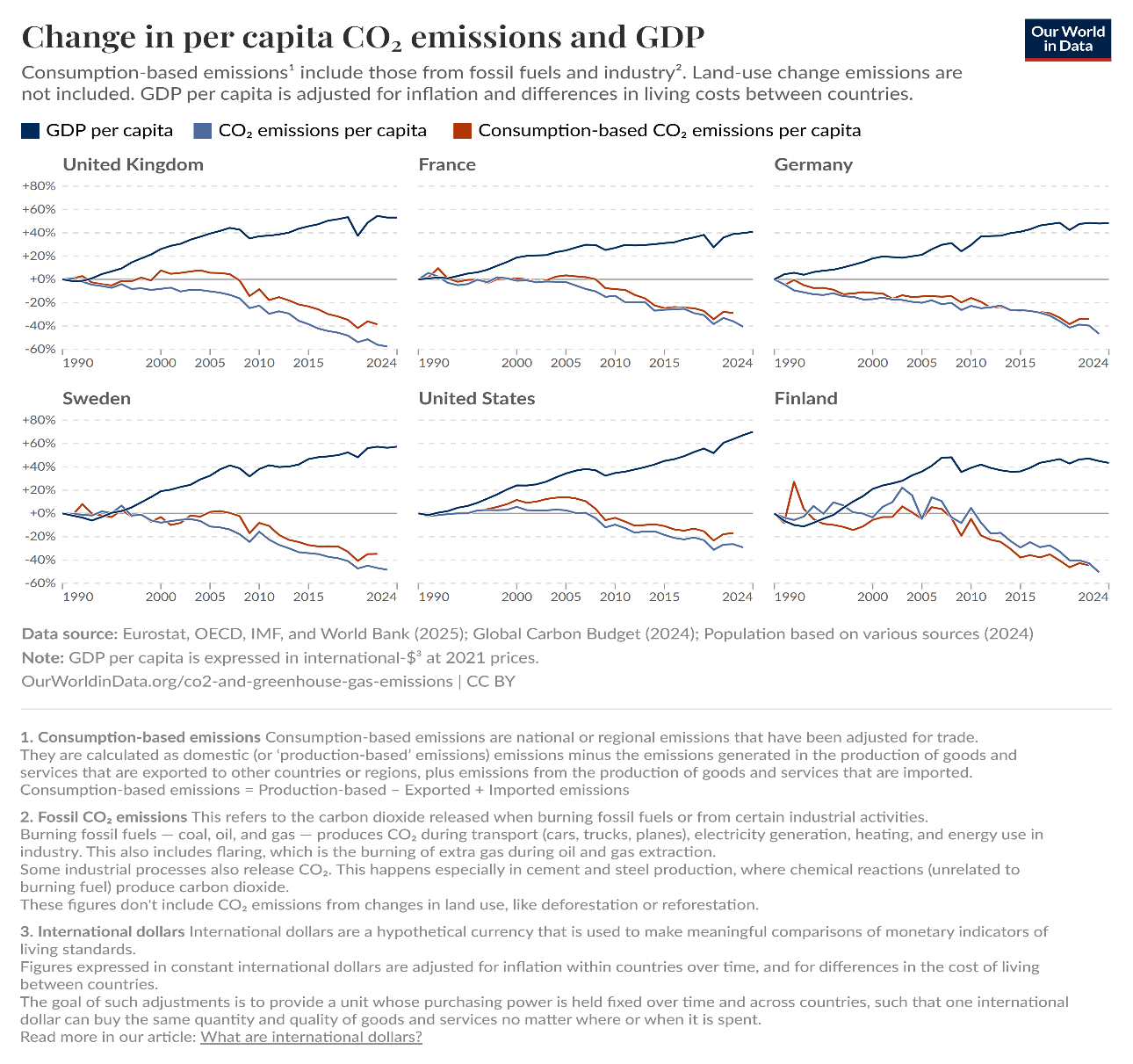
Source: Our World Data
Why does this happen? Because wealthy economies can afford to do things differently. They invest in renewable energy. They build efficient transit systems. They regulate pollution. They research better technologies. They shift from heavy manufacturing to services and high-tech industries. The very development that seems like the problem becomes part of the solution.
There's also a psychological shift that happens with development. When people aren't worried about making rent or feeding their families, they have mental space to think about sustainability. It's not that wealthier people are morally better, they just have the breathing room to think about more than staying afloat. This is why environmental concern naturally grows as countries develop.
Now, you might think, "Wait, didn't rich countries just shift their pollution to China and India?" It's a reasonable concern and is true to some degree, but it doesn't explain the decline. Even when researchers track consumption-based emissions, accounting for all the products imported from manufacturing hubs, the reduction remains real. Wealthy nations have cut emissions both domestically and in their total consumption footprint. While some production relocated overseas, the overall trajectory shows genuine progress, not just accounting tricks.
Poor countries couldn't afford technologies like solar panels and electric cars until recently. Wealthy nations adopted them first and through that early adoption and heavy investments in research and development, drove costs down dramatically. Renewables have gotten to the point where they are competitive and often cheaper than fossil fuels, even when accounting for needed battery storage. This creates an opportunity: developing countries can skip the fossil fuel phase entirely, leapfrogging straight to clean energy as they grow, without having to pay more. They can reach that emissions turning point faster, without repeating the previously necessary polluting development path wealthier nations took.
Population Growth Is Already Solving Itself
Let's talk about population, because this one drives me crazy. Every time someone brings up overpopulation as the main driver of increasing emissions, they're operating on outdated information. The explosive population growth everyone talks about? It isn't even happening anymore.
Global population growth has been slowing for decades. We're on track to peak sometime around 2080-2090 and then likely decline. And this isn't happening because of anything sinister, it's happening because when people's lives get better, they naturally have fewer children.
It's a pattern so consistent that demographers have a name for it: the demographic transition. Give people access to education, healthcare, and economic opportunity, and birth rates drop. Not because anyone forces them to, but because people with options make different choices.
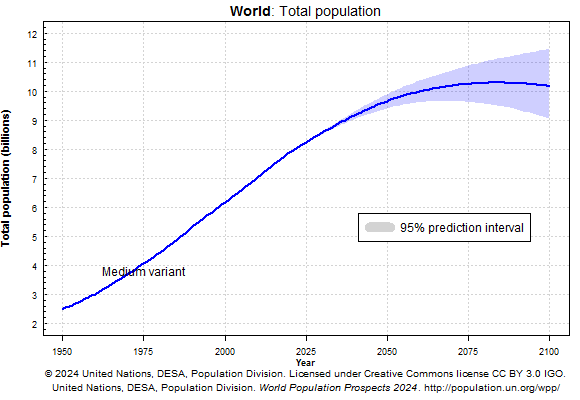
World Population Projection byUnited Nations - Department of Economic & Social Affairs(Population Division)
The global fertility rate is already down to 2.3 children per woman, just barely above the 2.1 needed to maintain the current population. Most of Europe, East Asia, and parts of the Americas are well below replacement rate. Japan's population is actively shrinking. So is Italy's. China's working-age population peaked in 2015.
And here's the kicker: from 2012 to 2023, the world added over 900 million people, yet per capita emissions actually declined. Population growth isn't the determining factor, how we generate energy is.

Source: Our world in Data - CO2 emissions per capita
The Sacrifice Problem (Or: Why This Would Never Work Anyway)
Okay, let's do a thought experiment. Imagine I told you that to save the climate, you need to:
- Give up air conditioning.
- Get rid of your car (no replacement).
- Stop eating meat
- Never travel more than 100 miles from home again.
- Have no more than one child, or ideally none.
How excited are you? Would you do it? Even if you personally would, could you convince your neighbors? Your city? Your country?
Of course not. And you shouldn't have to.
There are billions of people on this planet actively working to improve their lives right now. A family in Vietnam saving up for their first car. A couple in India finally able to afford air conditioning for brutal summers. A homeowner in Ohio wants to upgrade to a heat pump. Someone in Berlin switched to an electric vehicle. A student in Kenya getting internet access for the first time. A parent in California installing rooftop solar. These are all people trying to improve their lives, just in different ways depending on where they're starting from. The degrowth argument treats all of this as the problem. But asking a family to not pursue these improvements, whether it's their first car or their first EV, goes against everything that motivates us as humans. We want progress. We want better for ourselves and our kids.
This is why degrowth fails before it even starts. It's not just impractical, it's swimming against the fundamental current of human nature. People want better lives. They want their kids to have opportunities. They want comfort and security and the ability to see the world.
Any real solutions have to work with human nature, not against it.
Technology Is Already Changing Everything
Here's what's actually happening while people debate degrowth: clean technology is getting ridiculously good and ridiculously cheap.
Solar and wind are now the cheapest forms of new electricity in most of the world not with subsidies, just straight up cheaper than building new coal or gas plants, even if you include the cost of battery storage. Electric vehicles are approaching price parity with gas cars due to huge strides in battery tech, while being cheaper to operate. Heat pumps are more efficient than any fossil fuel heating system.
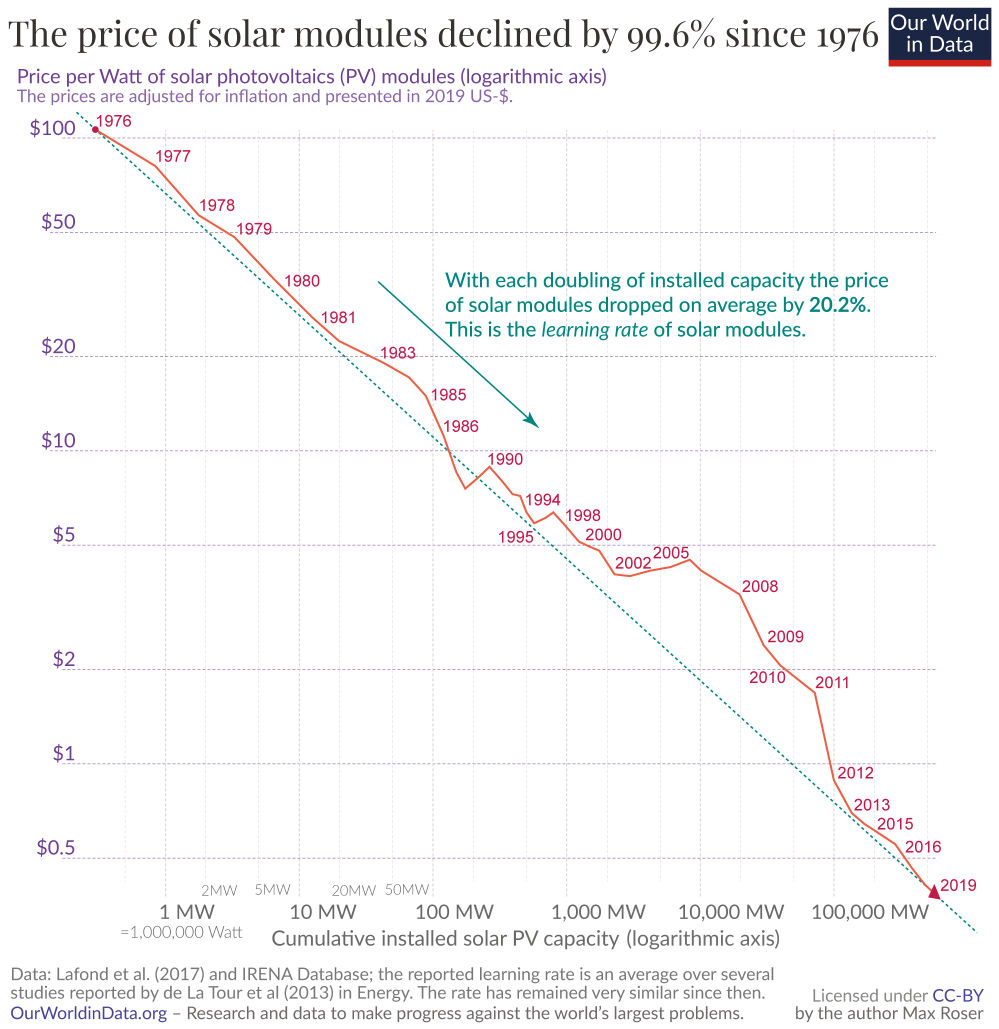
Source: Our World in Data-Cheap renewable growth
These technologies keep getting better and cheaper. That's why emissions are already declining in many developed countries even as people live comfortable, modern lives. Nobody had to sacrifice anything—the clean option just became the better option.
You're Not the Problem—You're Part of the Solution
Here's the thing about being someone who can afford to try new technologies: you're not carrying some burden of guilt. You have an opportunity.
When someone switches to an electric car, they're not just reducing their own emissions. They're creating demand that helps manufacturers scale up, which brings prices down for everyone else. They're normalizing the technology so their neighbors see it and think, "Huh, maybe that's not so weird after all." They're proving to the market that clean options work.
This is how change actually happens in the real world. It's not everyone simultaneously deciding to live with less. It's some people trying new things that work well, industries responding to that demand, costs falling, and eventually the new technology becoming so obviously better that everyone switches.
Think about LED bulbs. Nobody had to guilt-trip you into switching from incandescent bulbs. LEDs just got better and cheaper until using anything else seemed outdated. That's the path we're on with clean energy—we just need to keep pushing forward.
The Real Path Forward
Multiple developed countries are already proving you can cut emissions while growing economically and maintaining comfortable lifestyles. The UK, Germany, France, Denmark, they're all doing it right now. Emissions down, quality of life up.
The technologies exist. The economics increasingly favor them. While we have the momentum, we still have a lot of work to do. We need to accelerate this transition even faster to avoid the worst climate impacts. And that doesn't mean we need fewer people. We need more hands on deck.
Think back to the ship analogy: turning the wheel changes direction, but the more people helping turn it, the faster the ship responds. Every person who switches to clean energy, every early adopter who proves new technology works, every voice pushing for better policy, they're all adding force to turn that wheel. Small individual actions create the social proof and market signals that speed up systemic change.
We don't need to push the ship backward. We don't need to convince billions of people to sacrifice their aspirations and livelihoods. We just need to keep turning the wheel toward solutions that actually work, solutions that make life better, not worse.
That's a future worth building. And unlike depopulation or degrowth, it's a future we can actually achieve.
Want to learn more?
Get updates on climate progress and how you can help.