Most people focus on the wrong things for reducing carbon emissions
Research shows people dramatically misunderstand which personal actions have the biggest climate impact — overestimating recycling while underestimating the power of diet, driving, and flying choices. Here's what the data actually says.
Picture this: You've been diligently washing out your yogurt containers, sorting your plastics, and toting a canvas bag to the grocery store for years. You feel good about it. You should feel good, you're doing something. But what if the mental energy you've spent on recycling is wildly disproportionate to its actual climate impact? And what if the actions that could make a real dent are ones barely anyone talks about?
Turns out, this is exactly what the research shows. More and more people are genuinely trying to reduce their carbon footprint, a 2024 UNDP survey of over 73,000 people across 77 countries found that 80% want their governments to take stronger climate action, and personal concern is growing year over year. The desire is there. What's often missing is accurate information about where to direct that energy.
A 2023 Washington Post/University of Maryland poll put this gap into sharp relief: the majority of Americans surveyed were largely uninformed about which personal actions are most climatically effective. And the mismatches were not small.
The Gap Between What We Think and What the Science Shows
When researchers ask people to rank everyday actions by their climate impact, a consistent pattern emerges: we overestimate the small stuff and underestimate the big stuff.
A 2025 study published in PNAS surveyed nearly 4,000 U.S. adults and found that the three actions with the highest actual climate impact; avoiding long-haul flights, choosing renewable electricity, and reducing or eliminating high-carbon meat were also the three most underestimated by participants. Meanwhile, the lowest-impact actions; changing light bulbs, washing clothes in cold water, and recycling were the most overestimated.

The 2023 Washington Post poll found that a full 51% of Americans believe flying less would make "little or no difference" to their carbon footprint. And 74% don't believe that cutting out meat would change their environmental impact in any meaningful way.
This matters because it shapes where people focus their time, attention, and advocacy. If we're directing our climate energy toward things that barely move the needle, we're leaving enormous potential impact on the table.
What Actually Has the Biggest Impact
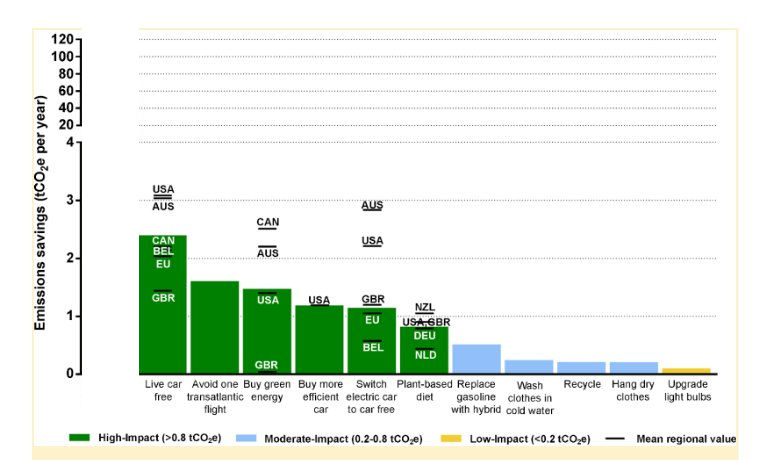
The most comprehensive individual-level analysis of this question comes from Seth Wynes and Dr. Kimberly Nicholas at Lund University, who reviewed 148 scenarios across 39 peer-reviewed sources to calculate the real CO₂ savings of different lifestyle choices. Their findings are striking:
- Living car-free: ~2.4 tons of CO₂ saved per year
- Avoiding one transatlantic round-trip flight: ~1.6 tons saved
- Eating a plant-based diet: ~0.8 tons saved per year
- Comprehensive recycling: ~0.2 tons saved per year
- Switching to LED light bulbs: even less
The comparisons get more striking the further you dig. A plant-based diet saves about four times more emissions per year than comprehensive recycling. Skipping one transatlantic flight saves eight times more. Living car-free saves eleven times more.
Yes, recycling is worth doing. AND it's about as climatically effective as one short car trip.
The real point here isn't "do all these things and you'll solve climate change", it's that when people understand where the weight is, it changes what they prioritize, what they talk about, and what they push for. That last part matters a lot. Your influence extends well beyond your own footprint.
Why Do We Get This So Wrong?
It's not because people are careless, it’s because the information environment around climate action has been shaped in ways that point us toward the convenient rather than the impactful.
Researchers have identified a few key reasons for this. First, there's what psychologists call visibility bias: we can see a recycling bin being emptied. Carbon emissions from a flight, on the other hand, are invisible; they disperse into the atmosphere without leaving any trace we can observe. Our brains assign importance to things we can see, touch, and act on immediately.
Second, for decades, large-scale marketing campaigns, sometimes funded by the very industries with the most to lose from behavioral change have emphasized small individual actions. The concept of a personal "carbon footprint" was itself popularized by a BP advertising campaign in the early 2000s. These campaigns weren't necessarily wrong that recycling is good, but they consistently directed attention away from choices that most constraint fossil fuel demand: flying less, driving less, eating less meat.
As one researcher in the 2025 PNAS study noted: "For decades, campaigns have pushed recycling and light bulbs as the main climate solutions, and there's even been some deliberate confusion on the part of fossil fuel companies who emphasize small individual actions while downplaying systemic-level solutions."
Third, the actions with the biggest impact often require the most significant lifestyle changes so government recommendations and school curricula have defaulted to easier alternatives instead. Wynes and Nicholas found that climate communications from the U.S., EU, Canada, and Australia all focused primarily on lower-impact actions. It's a well-intentioned choice that inadvertently creates a giant information gap.
What This Actually Means (Without the Guilt Trip)
Here's the thing: none of this is about shaming anyone for recycling or using reusable bags. Those habits are genuinely worthwhile. The goal isn't to do everything perfectly, it's to understand the hierarchy so you can prioritize. As we've written before, imperfect action beats perfect inaction every single time.
Think of it like personal finance. Clipping grocery coupons is a fine habit, but if you're trying to build wealth, it helps to know that your housing and income decisions are doing most of the heavy lifting. You don't have to stop clipping coupons, you just don't want to skip negotiating your salary because you were too focused on the coupons.
The same logic applies here. More and more people are finding that even partial shifts in the high-impact categories make a meaningful difference. You don't need to go completely car-free tomorrow if that's not realistic but knowing that your vehicle contributes ten times more to your footprint than your recycling habits might help you prioritize carpooling, remote work days, or an EV when you're next in the market. (EVs used to be a niche luxury item; now they're approaching price parity with gas cars in many segments, and the economics keep improving every year.)
On diet, you don't have to go fully vegan overnight. Even shifting beef meals toward chicken, pork, or plant-based options makes a measurable dent, since beef generates several times more emissions per kilogram than most other protein sources. And more and more plant-based options are becoming genuinely delicious and widely available, the category has come a long way.
On flying: knowing that one transatlantic round-trip can equal a year's worth of other personal climate efforts helps put decisions in context. That doesn't mean never flying, it means the decision is worth weighing with accurate numbers in hand.
The Bigger Picture
Knowing which actions matter most isn't just useful for personal decisions, it shapes the conversations you have and the things you advocate for. Your influence extends well beyond your own footprint. When more people understand that flying and diet are the big levers, those conversations start to shift from "did you remember to recycle?" to "what does our company's travel policy look like?" or "what if we made the team lunch plant-based by default?"
And while individual action is genuinely meaningful, it's worth noting that the same knowledge that helps individuals prioritize also informs communities and policymakers. Technology is already dramatically changing what's possible, clean electricity keeps getting cheaper, EVs are going mainstream, and plant-based foods have never been more widely available. Things are moving faster than most people realize. The goal is to make sure our effort and attention move just as fast, and in the right direction.
The information gap is real. But it's also closeable. And knowing where to focus is the first step.
Want to learn more?
Get updates on climate progress and how you can help.