
The Ministry for the Future - Kim Stanley Robinson
A near-future novel that takes climate economics seriously; one of the most discussed climate fiction books of the decade.
Most climate books tell you what's wrong or what to do. Very few ask you to imagine, in real and specific detail, what actually fixing it would look like over decades.
That's the case a lot of serious people have made about The Ministry for the Future, and after reading it, it's hard to argue with them. Noted economist and climate policy writer Kate Aronoff called it essential reading for anyone serious about the energy transition. Ezra Klein said if he could get policymakers everywhere to read one book, it would be this one.
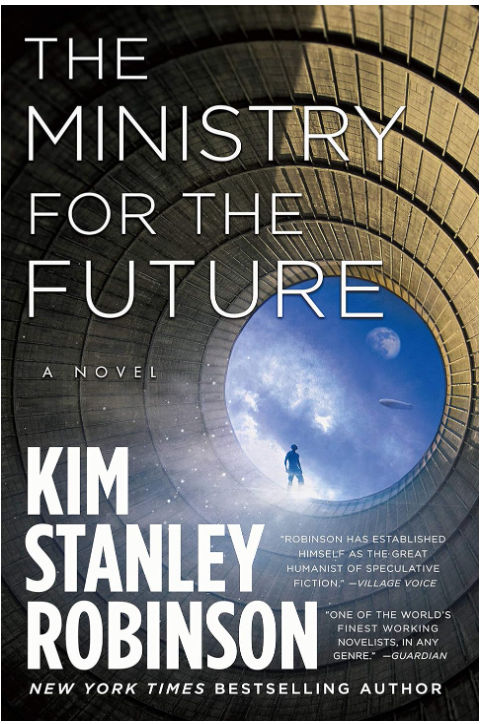
Published in 2020, The Ministry for the Future is the twentieth novel from Kim Stanley Robinson, a New York Times bestselling author and winner of the Hugo, Nebula, and Locus awards, widely regarded as one of the greatest living science fiction writers. The book follows two central characters: Mary Murphy, an Irish diplomat who leads a fictional UN agency called the Ministry for the Future, charged with defending the rights of future generations, and Frank May, an American aid worker who barely survives a catastrophic heat wave in India that kills millions in a matter of weeks. Around them, across 106 short chapters, Robinson builds a near-future world grappling with everything from geoengineering and carbon pricing to monetary theory, wildlife corridors, and the psychology of systemic change.
It is unlike any climate book you have read before, because it isn't quite a book. It's something harder to classify.
What the Book Actually Is
The Ministry for the Future occupies a strange and deliberate space between fiction and nonfiction. Some chapters follow Frank and Mary through recognizable human drama. Others are written as meeting minutes, economic treatises, riddles told from the perspective of a photon or a glacier, or dense explainers on blockchain technology and modern monetary theory. Robinson is not trying to write a thriller. He is trying to imagine, as completely and honestly as possible, what the decades-long process of actually solving climate change would look like, who would do it, what tools they would use, and what it would cost.
The result is a book that reads like a fever dream of plausible futures. Some of it is deeply uncomfortable. The opening heat wave chapter is one of the most harrowing pieces of climate writing ever committed to the page, precise enough to feel like a news report, visceral enough to stay with you long after you've finished. But the book doesn't stay there. It moves, chapter by chapter, toward something genuinely surprising for a climate novel: hope, earned slowly and at great cost, but real.
One of the book's most discussed ideas is the carbon coin, a reserve currency backed by central banks designed to pay fossil fuel companies to leave reserves in the ground. It is not presented as a perfect solution. Robinson shows it being fought, gamed, and imperfectly implemented. But the point isn't the specific policy, it's the demonstration that systemic financial mechanisms, not just individual action or protest, are part of what a real climate transition requires.
Why It Works for ClimateInvested.org Readers
Most climate content asks you to understand the problem or take a specific action. Robinson asks you to imagine the full arc of what solving it would actually look like, the institutions, the decades, the setbacks, the unlikely coalitions, and the slow accumulation of choices that eventually tip a system in a new direction.
That kind of imaginative exercise is more valuable than it sounds. More and more researchers and communicators who study climate behavior are finding that the ability to picture a livable future, concretely and specifically, is one of the most important drivers of sustained action. The Ministry for the Future gives you that picture more completely than almost anything else in the climate space, fiction or nonfiction.
It also validates something Climate Invested readers already sense: that the path forward runs through economics and institutions as much as technology and individual choice. This is not a book about recycling. It is a book about how the world actually changes.
One Honest Note
This book will not work for every reader. The structure is deliberately fragmented, the characters serve the argument more than the plot, and several chapters read more like policy documents than storytelling. Readers who need a propulsive narrative with strong character arcs may find it frustrating. It took some readers multiple attempts to get through it, and that is worth knowing before you start. It rewards patience and a willingness to let a book be something other than what you expected. If you go in looking for a novel in the conventional sense, you may be disappointed. If you go in looking for the most serious and complete imagining of a climate-solved world that exists in any format, you will find it here.
The Bottom Line
The Ministry for the Future is the book that answers the question most climate content never gets around to asking: not what is wrong, or even what we should do, but what actually fixing this looks like, over decades, across institutions, with all the friction and failure and unlikely progress that real change involves. There is nothing else quite like it.
🔗 Pick up your copy — Amazon.
Who It's Best For: Readers who are already climate-literate and want to go deeper on the systemic and institutional dimensions of change. Strong pick for anyone in policy, economics, finance, or anyone who has ever wondered what a serious global climate response would actually look like in practice. Also essential for readers who respond to storytelling and want their imagination stretched rather than just their knowledge updated.
Difficulty: Intermediate to Advanced, unconventional structure requires patience and tolerance for dense economic and political material
Read Time: Two to three weeks for most readers; not a book to rush
Pages: 563
Want to learn more?
Get updates on climate progress and how you can help.