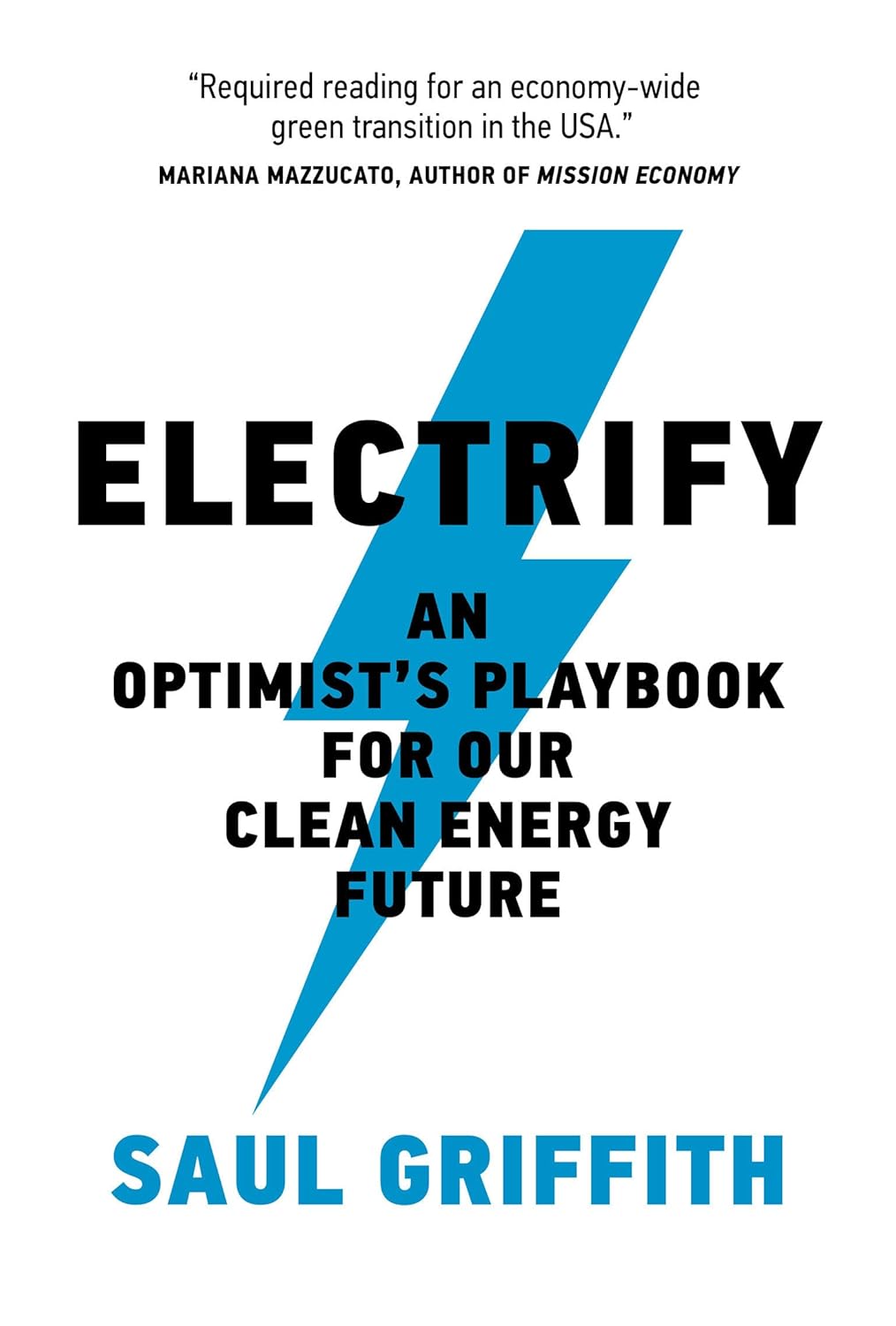
Electrify: An Optimist's Playbook for Our Clean Energy Future
An optimistic but realistic and feasible action plan for fighting climate change while creating new jobs and a healthier environment: electrify everything.
What if solving climate change didn't require giving anything up, just replacing the machines?
That's the central argument of Electrify, and it's a more radical reframe than it first appears.

Published in 2021 and written by Saul Griffith, an inventor, engineer, entrepreneur, and MacArthur "genius grant" recipient, Electrify is the product of years of research behind Rewiring America, the nonprofit Griffith founded with a single mission: decarbonize the United States by electrifying everything. The book is his public case for why that mission is not only necessary but entirely achievable with technology that already exists today.
The plan, distilled to its simplest form: stop burning things. Replace every gas-powered machine in your home and garage with an electric version, power the grid with renewables, and the emissions problem largely solves itself. No sacrifice required. Just a hardware upgrade.
What Electrify Actually Argues
Griffith opens with a number that anchors everything that follows: the average American uses over 100 pounds of CO2 per day. The goal isn't to use less energy. It's to use the same energy, just from a different source.
From there, the book walks through the full picture of what electrification would actually require: upgrading the grid, replacing the roughly one billion fossil fuel machines currently in use across American homes and transportation, rewriting regulations built for a fossil fuel era, and financing the transition in a way that works for ordinary households rather than just early adopters with deep pockets.
Griffith is direct about scale. This is a mobilization effort comparable to World War II in terms of industrial output and national coordination. He calls for grid neutrality, where households, businesses, and utilities operate as equals in a two-way energy system. He estimates the transition could create up to 25 million jobs. He is not shy about what is being asked of government and industry.
But throughout, the tone stays grounded. Griffith is an engineer, and the book reads like one: precise, unsentimental, and focused on what works.
Why It Works for ClimateInvested.org Readers
One of the most common forms of climate fatigue is the sense that personal action is too small to matter at the systemic level. Electrify directly addresses that tension. Griffith's argument is that household decisions do connect to the larger system, because the machines in our homes, our driveways, and our communities are exactly the infrastructure that needs replacing. Choosing an electric vehicle, a heat pump, or an induction stove isn't just a personal choice. It's a market signal, a demand driver, and a proof point that the transition is underway.
For Climate Invested readers who want to understand not just what to do but why it matters at scale, this book provides the clearest technical and economic framework available.
One Honest Note
Electrify is unapologetically US-focused. The policy recommendations, the grid analysis, and the economic projections are built around American infrastructure and American politics. Readers outside the US will still find the core argument valuable, but the specifics won't always translate. The book also largely sets aside the political complexity of actually implementing what it proposes. Critics have noted that the optimism, while earned on the technical side, sometimes glosses over the harder questions of supply chains for critical minerals, international coordination, and what happens in communities economically dependent on fossil fuel industries. The vision is compelling and the engineering is sound. The path from here to there involves more friction than the book fully reckons with.
The Bottom Line
Electrify is the clearest, most technically grounded case that a modern, comfortable, prosperous life and a stable climate are not in conflict. The tools exist. The economics increasingly favor them. The only question left is speed.
🔗 Pick up your copy — Amazon.
Who It's Best For: Readers who want to understand the full picture of what energy transition actually requires, not just the headline. Ideal for engineers, policy-minded readers, business owners, and anyone tired of vague climate optimism and ready for something concrete. Also essential for anyone making decisions about home appliances, vehicles, or energy systems.
Difficulty: Intermediate, Griffith writes accessibly but the material is detailed and policy-dense in places
Read Time: A focused weekend read; rewards slower reading in the technical sections
Pages: 288
Want to learn more?
Get updates on climate progress and how you can help.