Is eco-anxiety normal?
If you feel the eco-anxiety, just know that, it is very normal, many people experience this feeling. And the good news is acknowledging and sharing how you feel can become a catalyst for connection and shared actions.
For a growing number of people, climate change isn’t an abstract future risk or a line item in a policy report. It’s something felt viscerally as unease, grief, guilt, anger, or a persistent sense that something is deeply off. This emotional response has a name now: eco-anxiety. And as it becomes more widely discussed, a simple question keeps surfacing: Is eco-anxiety normal?
The short answer is yes. But the more important answer is why and what that tells us about the world we’re living in.
Understanding Eco-Anxiety
Eco-anxiety refers to chronic or acute anxiety related to environmental degradation and climate change. It’s not a clinical diagnosis, but a psychological response to a very real threat. People experience it differently: sleeplessness after reading climate news, guilt over everyday consumption, fear about having children, or a quiet dread that never quite goes away.

Unlike traditional anxiety disorders, eco-anxiety is not irrational. Climate change is happening. Biodiversity is declining. Extreme weather is intensifying. The science is clear, and the impacts are increasingly visible. Feeling distressed in response to this information isn’t a malfunction, rather it’s a reasonable emotional reaction to an unstable reality.
In that sense, eco-anxiety isn’t a sign that something is wrong with individuals. It may be a sign that something is wrong with the systems they inhabit.
Why Eco-Anxiety Is Becoming More Common
Eco-anxiety is rising not because people are becoming more sensitive, but because they are becoming more informed. Climate data is no longer buried in academic journals. It’s in headlines, social media feeds, and daily conversations. Wildfires, floods, heatwaves, and air pollution are no longer distant problems but they’re lived experiences.
But the way information travels today also shapes how people experience it. Climate news often circulates through highly emotional headlines, viral posts, and dramatic imagery. Social media algorithms amplify the most alarming content because it spreads fastest. In that environment, complex scientific findings can sometimes be compressed into simplified or sensational narratives, and uncertainty or nuance can disappear. The result is that many people encounter climate change primarily through a stream of worst-case scenarios, catastrophic projections, and “doomer” framing.
At the same time, many people feel caught in a contradiction. They are told climate change is an emergency, yet are expected to continue life as usual: commute, consume, grow, compete. Individual actions are emphasized through recycling more, fly less, buy greener products while systemic change often feels slow, compromised, or out of reach.
This mismatch between the scale of the problem and the scale of response is a key driver of eco-anxiety. When people understand the severity of the crisis but feel powerless to influence outcomes, anxiety is a predictable result.
One reason eco-anxiety feels so heavy is that responsibility is often framed at the individual level. People are encouraged to calculate their carbon footprints, optimize their consumption, and make “better choices”. While personal action matters, this framing can quietly shift responsibility away from structural drivers like fossil fuel dependence, extractive supply chains, and policy inertia.
The result is a moral pressure cooker. People worry that every choice: what they eat, wear, buy, or discard is ethically charged. For many, eco-anxiety isn’t just fear about the future; it’s guilt about the present.
Yet there is another imbalance in climate communication: progress often receives far less attention than problems. Breakthroughs in renewable energy, falling costs of clean technologies, large-scale policy shifts, or successful conservation efforts rarely generate the same viral momentum as disaster headlines. Many people are therefore exposed to constant signals of crisis but relatively few signals of progress.
This matters because guilt is not a sustainable motivator. It exhausts rather than empowers. And when systemic problems are individualized, people can end up blaming themselves for outcomes shaped by forces far beyond their control.
It’s tempting to medicalize eco-anxiety like to treat it as something to be cured or managed away. But doing so risks missing the point. Eco-anxiety is not simply a personal mental health issue; it’s also a collective signal.
Psychologists increasingly argue that distress about climate change can be a healthy response to an unhealthy situation. From this perspective, eco-anxiety reflects awareness, empathy, and moral engagement. It shows that people are paying attention and care about more than short-term comfort.
These nuances suggest that eco-anxiety doesn’t always cripple people, but when it becomes intense and persistent, it can contribute to distress, especially if individuals feel powerless to act.
Who Feels Eco-Anxiety and How Much?
Eco-anxiety doesn’t affect everyone equally.
A cross-national European study using data from over 52,000 participants across 25 countries found that almost 43 % of people were “very” or “extremely” worried about climate change. Women and people with higher education were among those more likely to report high worry levels.
Young people report particularly high levels of climate-related distress. A study found that nearly half of Generation Z respondents reported high eco-anxiety - more than four times higher than older generations, partly because they will live with the consequences longer and had little say in the systems that created them. Communities already facing climate impacts from heat stress to flooding or food insecurity experience anxiety alongside tangible loss.
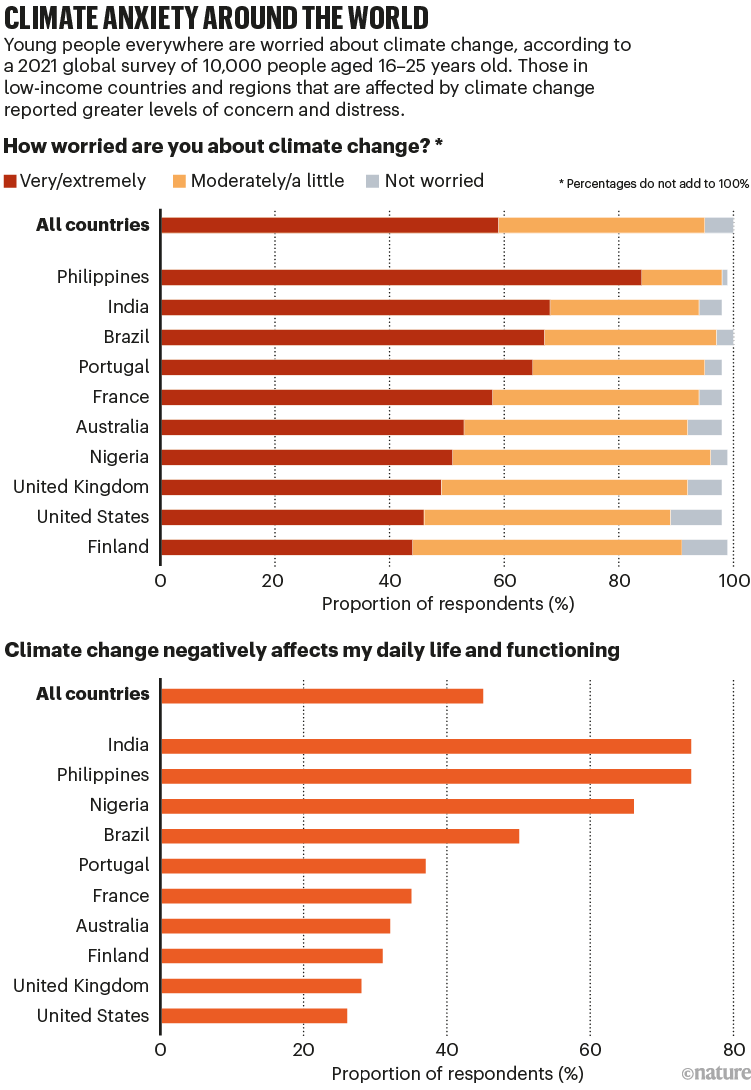
Interestingly, eco-anxiety is also common among people working in sustainability, climate science, and environmental advocacy. Proximity to the data can sharpen concern rather than dull it. Knowing exactly how narrow some of our windows for action are can be emotionally taxing.
This highlights an uncomfortable truth: eco-anxiety often correlates with awareness, not weakness.
So Is Eco-Anxiety “Normal”?
Eco-anxiety is not a flaw in human psychology. It’s a response to ecological instability and social contradictions. In that sense, it may be one of the most honest signals we have.
The danger is not that people care too much about the planet. The danger is that we normalize a world that demands emotional numbness in the face of crisis.
So yes — eco-anxiety is normal. Recognizing the legitimacy of eco-anxiety doesn’t weaken climate discourse, it enriches it. It moves the conversation from dismissing emotional experiences to understanding them as part of our shared response to one of the defining challenges of our time.
The question, then, isn’t whether eco-anxiety is normal. It’s what we do with it.
Left unaddressed, eco-anxiety can lead to disengagement as people tune out, avoid news, or adopt a kind of quiet nihilism. But when acknowledged and shared, it can also become a catalyst for connection and action. Research suggests that collective action such as joining climate groups, community initiatives, or advocacy efforts can reduce feelings of isolation and helplessness. Acting with others transforms anxiety from a private burden into a shared motivation.
Crucially, this shifts the narrative away from individual perfection toward systemic impact.
Want to learn more?
Get updates on climate progress and how you can help.