
A Field Guide to Climate Anxiety: How to Keep Your Cool on a Warming Planet - Sarah Jaquette Ray
Gen Z's first "existential toolkit" for combating eco-guilt and burnout while advocating for climate justice.
What if the problem isn't that you care too little about climate change, but that you've never been given the tools to carry that caring without it breaking you down?
That's the gap A Field Guide to Climate Anxiety: How to Keep Your Cool on a Warming Planet was written to fill, and it fills it better than almost anything else in the climate space.
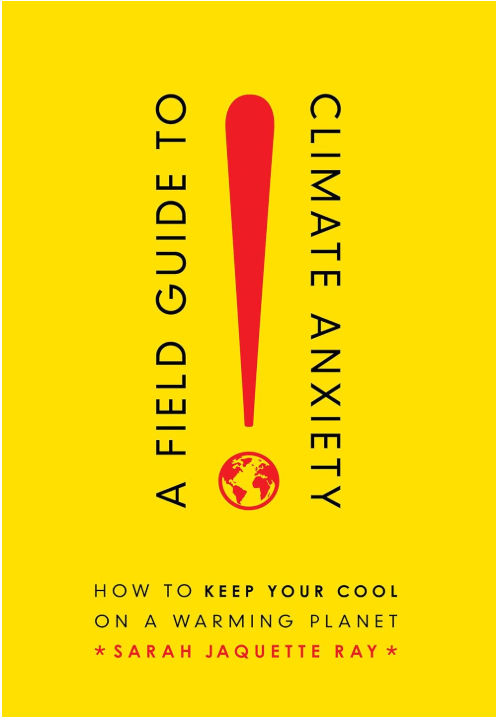
Published in 2020 by Sarah Jaquette Ray, professor and chair of environmental studies at Cal Poly Humboldt, this book grew directly out of a decade of teaching climate-aware students who understood the science, cared deeply about the future, and were still freezing up. Not from ignorance or indifference, but from the sheer weight of it all. Ray watched her students arrive informed and leave paralyzed, and she decided to do something about it.
The result is what she calls an "existential toolkit for the climate generation," drawing on psychology, sociology, mindfulness, social movement theory, and the environmental humanities to help readers stay functional, grounded, and effective in the face of a genuinely difficult situation.
What the Book Actually Argues
Ray's core argument is that climate emotions, grief, guilt, anxiety, rage, are not obstacles to climate action. They are part of it. The goal isn't to eliminate those feelings or power through them. It's to understand them, work with them, and build the kind of resilience that makes long-term engagement possible rather than burning out after a year of intense caring.
The book is organized around this framework in a way that's genuinely practical. Chapters cover topics like understanding the role of emotions in climate work, resisting burnout, moving beyond guilt, finding your specific role in the larger effort, and learning to imagine a livable future rather than only a catastrophic one. Each chapter ends with reflection prompts and concrete exercises. It reads linearly but works just as well dipped into by topic.
What makes Ray's approach distinctive is that she doesn't separate the emotional from the political. Climate anxiety, she argues, is not a personal failing to be treated in isolation. It exists inside a social context, and the response to it has to be collective as well as individual. This isn't a self-help book with a climate skin. It's a serious engagement with what it means to stay human while working on an inhuman problem.
Why It Works for ClimateInvested.org Readers
The Climate Invested audience is defined by people who already care, which means they are also the exact people most vulnerable to what Ray is writing about. The guilt of not doing enough. The exhaustion of following the news. The sense that individual action is both necessary and insufficient at the same time.
This book speaks directly to that tension without dismissing it or offering false comfort. It gives readers a framework for staying in the game for the long run rather than cycling between intense engagement and total shutdown. That kind of sustained, grounded engagement is precisely what meaningful climate progress requires, and it's what this book trains.
One Honest Note
Ray's framing is rooted in climate justice and draws heavily on social movement theory, which means parts of the book sit in a more explicitly political register than some readers may expect or prefer. Readers who are primarily interested in the psychological tools and less interested in the structural critique may find certain chapters feel like a detour. The tools themselves are broadly applicable regardless of where you sit politically, but the framing around them is not neutral. Worth knowing before you start.
The Bottom Line
A Field Guide to Climate Anxiety doesn't tell you what to do about climate change. It helps you figure out how to be someone who can keep doing something about it, year after year, without falling apart. For a long crisis, that might be the more important skill.
🔗 Pick up your copy — Amazon.
Who It's Best For: Anyone who cares deeply about climate change and has felt the weight of that caring become counterproductive. Particularly valuable for educators, students, advocates, and anyone in a climate-adjacent career who wants to stay engaged without burning out. Also a strong pick for readers who feel stuck between wanting to act and not knowing how to hold the emotional load of it.
Difficulty: Easy to Intermediate, accessible writing with some academic framing in places
Read Time: A focused weekend; works well read chapter by chapter over time
Pages: 232
Want to learn more?
Get updates on climate progress and how you can help.