How to deal with climate guilt
Its easy to feel guilty about climate change. We know its happening and why, so its easy to internalize a feeling that you are responsible, and need to make sure you aren't part of the problem through your personal carbon footprint. The issue is, its impossible to not have any carbon impact in the modern world, so it can feel like an impossible burden. Fortunately, there are things to can do to help frame these feelings in a positive way, and see that there is a way to have more positive impact than negative.
I spent twenty minutes last week standing in the grocery store aisle, paralyzed by guilt over buying strawberries. They were flown in from California. The carbon footprint of that flight. The plastic container. Should I buy them? Should I not? What kind of person buys strawberries in November?
I bought them anyway, then felt terrible about it for the rest of the day.
If you've ever felt this way, guilty about ordering delivery, guilty about driving somewhere, guilty about buying something new, guilty about existing in a modern society that runs on fossil fuels, you're not alone. Climate guilt is real, it's widespread, and honestly, it's exhausting.
Here's what I've learned: that guilt isn't helping the climate, and it's definitely not helping you. You're not the problem. And obsessing over your personal carbon footprint while ignoring your actual sphere of influence is missing the bigger picture entirely.
You can't opt out of modern society (And that's not our fault)
Let's get real: there is no zero-carbon lifestyle in modern society. You could move to a homestead in the woods, grow all your own food, and live "off the grid," and you'd probably increase your emissions from all the wood burning and the lack of efficiency that modern infrastructure provides.
Even if you did everything "right" like no car, no plane travel, fully vegan, minimal consumption, renewable energy, you're still part of a system built on fossil fuels. The roads you walk on, the water that comes to your tap, the infrastructure that keeps society functioning, all of it has a carbon footprint you can't individually escape.
This isn't defeatism. It's reality. And recognizing this is actually liberating, because it means you can stop torturing yourself over whether your strawberries are morally acceptable.
The problem isn't you buying strawberries. The problem is systemic, a food system that makes sustainable options harder than they should be, infrastructure that makes driving necessary, an energy grid still dependent on fossil fuels. You didn't create these by existing.
Climate guilt comes from an impossible standard: be perfect, have zero impact, or you are part of the problem. But perfect isn't an option. It never was.
The Carbon Footprint Trap
Calculating your carbon footprint can be helpful for figuring out where the biggest opportunities are in your life. Flying generates way more emissions than driving. Driving generates way more than biking. Eating beef has a bigger impact than eating chicken, which has a bigger impact than eating beans.
Knowing this helps you prioritize. If you're flying multiple times a year, that's your leverage point. If you commute an hour by car, transportation is key. If you eat meat with every meal, shifting that pattern could be significant.
But there's a point where tracking every gram of CO2 becomes counterproductive. You start agonizing over whether used clothing shipped from across the country is better than new clothing made locally. You calculate the emissions of a banana versus an apple. I once spent an embarrassing amount of time calculating whether streaming a movie had a bigger carbon footprint than driving to a theater. (It doesn't, but this is not a useful way to spend your mental energy.)
Here's the other problem: the carbon footprint concept was literally popularized by BP in a 2004 advertising campaign to shift responsibility from corporations to individuals. It's designed to make you feel like climate change is your fault for not making better choices, rather than their fault for extracting and selling fossil fuels.
So yes, look at your footprint to identify high-impact changes. Switch to an EV or hybrid if you can. Fly less if you fly a lot. Eat less meat. These things matter.
But don't let footprint obsession become your entire climate engagement. Because here's what that framework misses: you're not in a bubble.
Your real impact isn't just your emissions
Every action you take sends signals beyond your personal carbon equation. When you buy an electric car, you're not just cutting your own emissions, you're showing neighbors that EVs are normal. You're creating demand that helps scale production and drive costs down. You're contributing to market signals that push manufacturers to invest more.
When you put solar panels on your roof, they're visible. Your neighbors notice. Some start asking questions. A few end up getting solar too. Each installation makes the next one more normal, less weird, more achievable.
When you eat plant-based meals regularly and talk about it casually, you're shifting perceptions. Ten years ago, being vegetarian was often seen as extreme. Now? It's increasingly normal. Restaurants have multiple plant-based options. Grocery stores have entire sections. This didn't happen because one person went vegan, it happened because enough people shifted their eating that markets responded.
I switched to mostly biking for transportation a few years ago, and I've lost count of how many coworkers have mentioned they're thinking about it too. I'm not evangelizing. I just show up on my bike, mention it's faster than traffic, and suddenly it's not weird, it's just another option.
This ripple effect; the social proof, the market signals, the normalization can easily exceed your personal emissions impact. If your choices influence even three other people to make similar changes, you've effectively tripled your direct impact. If your visibility helps shift norms in your community, you're contributing to systemic change that goes way beyond your individual footprint.
And here's the really encouraging part: this is already happening at scale.
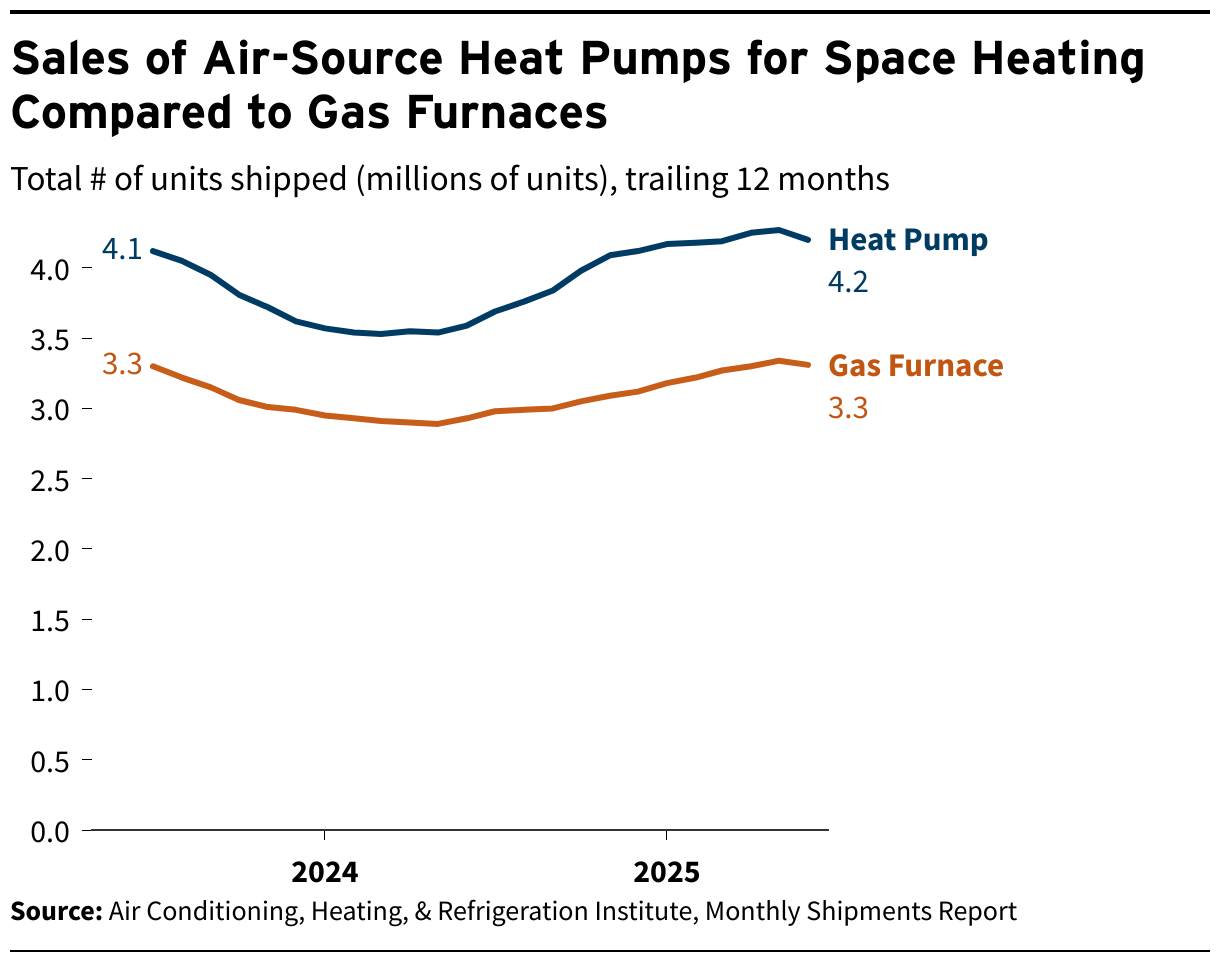
Adoption curves showing normalization over time. U.S. heat pump sales (blue) surpassed gas furnace sales (orange) for the first time in 2022, demonstrating how climate-friendly technology is rapidly becoming mainstream. What was once a niche choice is now the more popular option, a pattern repeating across EVs, solar panels, and plant-based foods.
Things are getting normal (Fast)
In 2010, electric cars marked the driver as either very wealthy or very environmentally committed. Now? EVs are everywhere, and more and more people are driving them because the cars are good, not to make a statement.
In 2010, being vegetarian meant limited options and lots of explaining yourself. Plant-based alternatives were sparse and often not very good. Now? Impossible Burgers are at Burger King. Oat milk is standard at coffee shops. The plant-based food market has grown from about $4.9 billion in 2018 to over $8 billion in 2023.
In 2010, solar panels were expensive and niche. Now? Solar is the cheapest form of new electricity generation in most of the world. Installation costs have dropped 90%. U.S. residential solar installations went from under 100,000 per year in 2010 to over 500,000 per year by 2022.
Heat pumps were barely on anyone's radar in 2010. Now they're rapidly becoming the default. U.S. heat pump sales exceeded gas furnace sales for the first time in 2022.
This normalization didn't happen by accident. It happened because early adopters made these choices visible, markets responded, costs came down, and more people followed. Each person who chose the cleaner option made it slightly easier for the next person.
You're part of that process. Every time you make a climate-friendly choice—especially one visible to others, you're contributing to this normalization. You're making it less weird, more accessible, more normal.
The political change you're already creating
Political change follows cultural change. Politicians respond to what they think voters want, and they figure that out from the zeitgeist, the general mood, the conversations happening, what seems normal versus fringe.
Twenty years ago, climate change was a niche issue. Now it's mainstream. Majorities support clean energy investment. Even voters who don't identify as environmentalists support renewable energy, EV infrastructure, and efficiency programs often for reasons unrelated to climate (jobs, energy independence, cost savings).
This shift happened because more and more people started caring, talking about it, and acting on it. You don't have to be politically active to be part of this. Just by living in a way that reflects climate concern, you're contributing to the cultural shift that makes political action possible.
When you casually mention your EV, or talk about your heat pump, or suggest a plant-based restaurant, you're normalizing these things. You're making them part of everyday conversation. That normalization is what allows politicians to support climate policies without political liability.
This is already working. Major climate investments are passing because there's enough political will built from years of shifting public opinion. None of this is fast enough. We need more momentum. But the momentum exists, it's building, and your part of it.
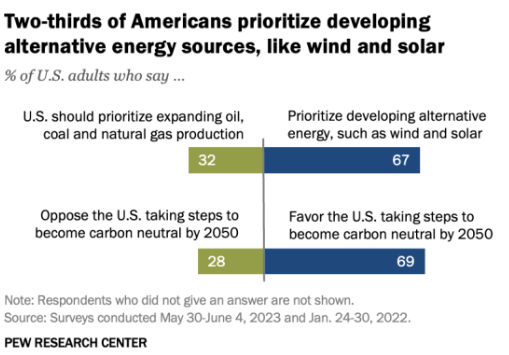
Public opinion polling over time showing increasing support for climate action across demographics. A majority of Americans now support prioritizing renewable energy development, reflecting a broader cultural shift toward climate action.
Talk about it (Without being annoying)
The most practical thing you can do with your climate guilt: channel it into conversation, not consumption obsession.
When you make a change, mention it. Not in a preachy way. Just as a thing you did.
"Yeah, I got a heat pump last year. It's great cooling and heating in one system, and my energy bill went down."
"I've been biking to work more. Honestly, it's faster than sitting in traffic and I'm in better shape."
"We've been doing more plant-based dinners. There are some really good options now, way better than ten years ago."
Notice what these don't include: judgment, moral grandstanding, or demands that anyone else do the same. You're sharing your experience. But that sharing matters.
When people hear about your choices casually, it plants seeds. It makes these options feel achievable rather than extreme. It shows that real people are doing this stuff.
Don't force climate into every conversation. But when it comes up naturally, don't hide it. Share what you're doing and why it's working for you.
This is how norms shift. Not through lectures, but through visibility and normalization.
What to do with the guilt
Focus on high-impact changes, not perfect consumption. Remember that your influence exceeds your footprint. Talk about what you're doing. Give yourself credit for trying. Take breaks, burnout helps no one.
The guilt you feel is understandable. But it's often misplaced. You're not the problem. Systemic issues are the problem, and your part of the solution not just through personal emissions reductions, but through the norms you shift and the conversations you have.
More and more people are figuring this out. Climate action is becoming normal. The options are getting better. The momentum is building. You don't have to be perfect to be part of that.
So, buy the strawberries if you want them. And then maybe bike to work tomorrow, tell a friend about your heat pump, or vote for the candidate with the better climate plan. All of it counts. None of it has to be perfect.
Want to learn more?
Get updates on climate progress and how you can help.