How to talk about climate change without being a downer
Most people don't know how much climate progress is happening, and talking about just the bad parts makes most people disengage. Here's how to share good news, validate concerns, and inspire action without being a downer.
Last Thanksgiving, I watched my cousin shut down a climate conversation in under thirty seconds. "We're all going to be underwater in ten years anyway," she said. "Nothing we do matters." The table went silent. Someone changed the subject to football.
A year later, a different approach. My uncle mentioned his new solar panels, and instead of launching into a speech about the climate crisis, I asked what made him decide to get them. "The electric bill was killing me," he said. "After about 8 years these things will pay for themselves, then it's just free money. Plus the house stays cooler in summer." Three other people at the table immediately wanted to know more.
Same family. Same topic. Completely different outcome. Here's the thing: focusing on the dire impacts of climate change feels honest, but it's the fastest way to make people tune out. And these conversations actually matter, they spread information about solutions that improve people's lives, show that progress is real, and break the isolation that makes people think nobody else cares.
Why the Doom Approach Backfires (Especially for Younger People)
Research consistently shows that fear-based messaging without solutions leads to disengagement, not action. A 2025 study in the Journal of Environmental Psychology found that when people feel overwhelmed and powerless, they cope by avoiding the topic entirely. It's not that they don't care, caring feels unbearable when the message is "everything's doomed."
This hits younger people especially hard. Gen Z and millennials have grown up with constant warnings and dire predictions. Many genuinely believe we have only a few years left before everything collapses. But here's what the science actually says: we're in a fight to prevent the worst outcomes, and that fight is showing results. Expected warming by 2100 has already dropped from 4-5°C in early projections to around 2.7°C as action has accelerated.
When you talk to someone who thinks we're past the point of no return, the most helpful thing you can do is share accurate information about where we actually stand. Things are serious, but we're not doomed. For someone paralyzed by fear, learning that progress is real can be genuinely life-changing.
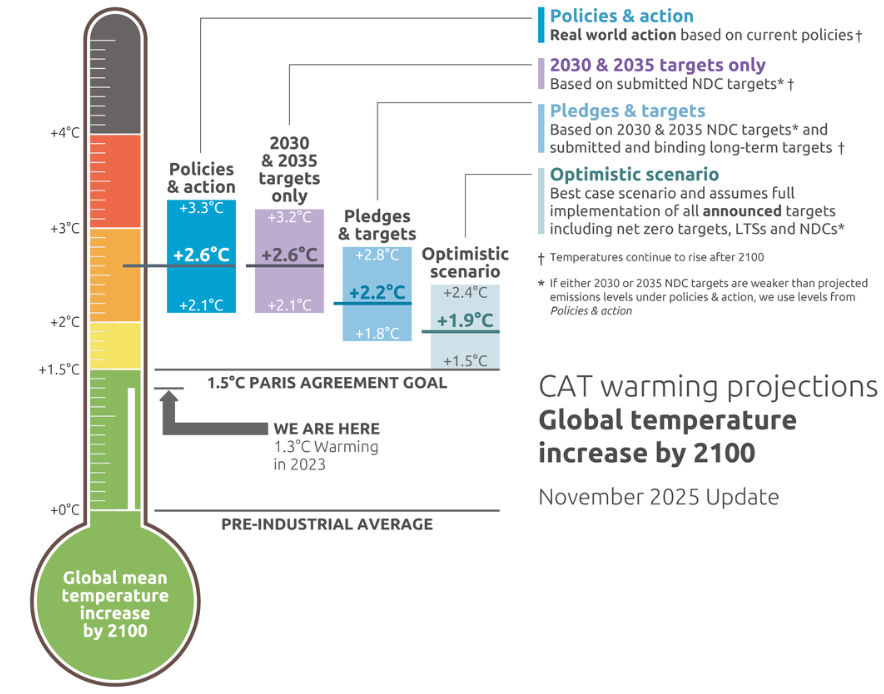
Source: Current policies in place around the world are projected to result in about 2.6°C warming above pre-industrial levels.
Start with What's Working (Most People Don't Know This Stuff)
Here's what consistently surprises people: most have no idea how much progress has happened. A lot of folks are still operating on facts from 5 or 10 years ago, and the landscape has changed dramatically in that time. They know climate change is bad, but they haven't heard that global per-capita emissions peaked in 2012, or that renewables are now the cheapest power source, or that EVs are approaching price parity with gas cars. Someone might still think solar panels are prohibitively expensive because that was true in 2015 but costs have dropped nearly 90% since then. This information is genuinely news to most people, and it fundamentally shifts the narrative from "we're failing" to "we're making progress and need to move faster."
There’s a lot of ways to lead with something surprisingly good: "Did you know solar panels are now cheaper than coal in most of the world?" That opens conversation. "We're all going to die if we don’t give up all technology" closes it.
I started doing this when a neighbor asked about my e-bike commute. Instead of lecturing about emissions, I mentioned I'd saved $200 monthly on gas and parking, and my commute was actually faster. Two weeks later, he bought one too. Not to save the planet - because it made his life better.
This reflects a broader shift that's worth highlighting. Climate action used to mean sacrifice. Now it increasingly means better technology and lower costs. EVs used to be expensive with limited range, now they go 300+ miles and cost less to fuel and maintain. Heat pumps used to be niche, now they're often the most cost-effective option. LED bulbs used to be terrible, now they're better in every way.
When you frame it as "this new thing is actually better and more people are choosing it," you're not guilting anyone. You're sharing genuinely good news.
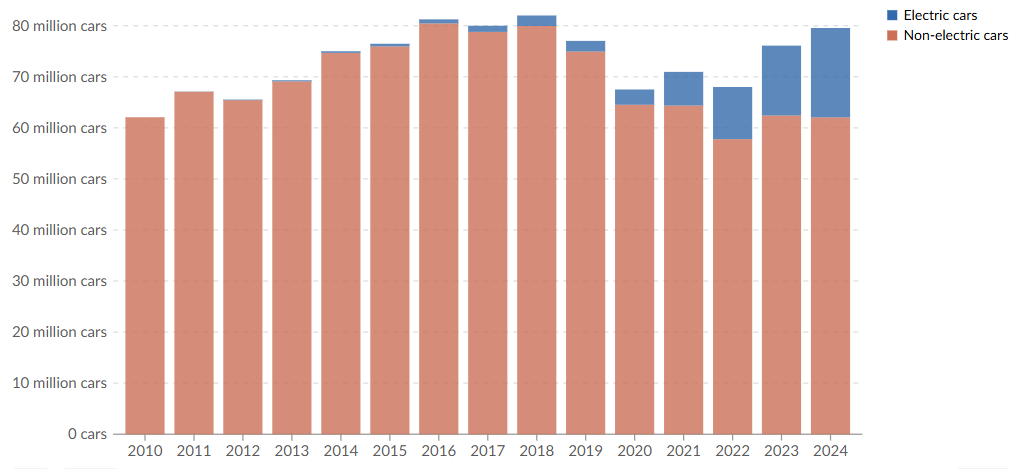
Source:Number of new electric & non-electric cars sold globally.
The "Yes, And" Technique
Every climate solution has legitimate concerns. The key is acknowledging them honestly, then providing accurate context.
Someone says: "Electric cars aren't that green because of battery manufacturing."
Better response: "That’s true, battery production does have emissions about 15-20% of the car's lifetime total. But even accounting for that, EVs are still around 60% cleaner over their lifetime."
You validated their concern and provided context. The pattern is: acknowledge the truth, show improvement, highlight growing momentum.
"Yes, wind turbines do kill some birds. Windows, cars, and fossil fuel pollution kill far more"
“I agree, giving up all meat would be really hard. I actually just try to eat less beef which actually makes a pretty big impact, and honestly I like some of the alternatives better.”
"Yes, renewable energy is variable, it's definitely one of its biggest downsides. And that's exactly why battery storage costs have dropped 97% since 1991, and deployment is growing exponentially. We're actively solving this problem."
This approach doesn't dismiss concerns or pretend problems don't exist. It shows that smart people are working on these issues and making real progress, which is both accurate and encouraging.
Source: Global battery storage capacity additions, 2010-2023.
Share Your Own Actions (Imperfectly)
Nothing kills a conversation faster than self-righteousness. But sharing what you're actually doing, including the imperfect parts? That's relatable.
I bike to work, but not in winter because I hate being cold. I eat less meat but I'm not vegetarian because I love a good burger. I'm interested in an EV someday, but right now I drive a 2015 hybrid because it works for my situation.
These admissions don't undermine the message, they make it credible. Perfect is intimidating. Imperfect progress is achievable.
When I mention my bike commute, I don't frame it as a noble sacrifice. I mention it's faster than driving, and I've saved enough to pay for the bike three times over. I also mention the rainy days when I definitely drive. People laugh, ask questions, and sometimes mention they've been thinking about biking too.
This normalizes that climate action doesn't require perfection. People who take some initial actions are more likely to take additional ones later. Small steps build momentum.
The Shift That's Already Happening
Here's the encouraging part: climate concern is growing and action is normalizing. Just a decade ago, caring about climate marked you as a particular type of person. Now it's increasingly mainstream. Majorities across political parties support clean energy investment. Red states lead in wind power. More and more people from all backgrounds are taking climate action.
Still think caring about climate is a fringe position? Check the data. Below are the estimated % of adults who think citizens should do more to address global warming (Nat’l avg. 61%), 2024. (Yale Climate Opinion Maps 2024)
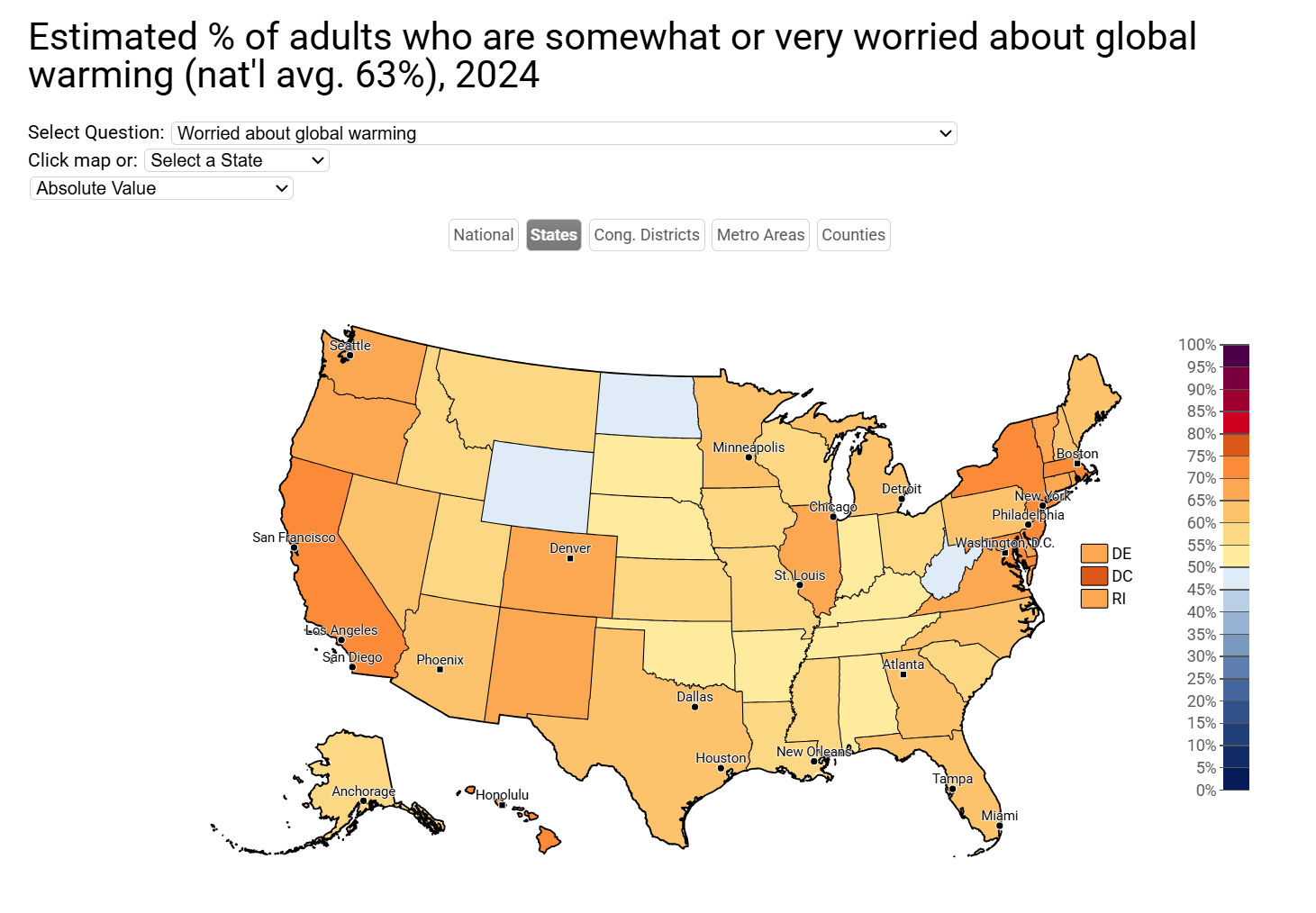
This makes conversations easier. You're not convincing someone to care about a fringe issue, you're discussing something increasingly normal. The person you're talking to probably knows someone with solar panels or an EV.
When I talk about climate now, I mostly discuss solutions that are working, technologies improving, and momentum building. I mention that more people are making these changes because they make sense financially, practically, personally. I acknowledge problems honestly but don't dwell on doom. And I share my own imperfect actions as examples, not prescriptions.
It's not about being a downer or sugarcoating. It's about being honest that things are serious, progress is real, and more action is needed, all at the same time. That's a conversation people can actually engage with. And honestly? It's more interesting than doom-scrolling our way to despair.
Want to learn more?
Get updates on climate progress and how you can help.