Buying local food actually doesn't make much difference climate wise
Buy local is a common sustainability tip, but when you look at the data, it doesn't really make as big a difference as you'd think. Its true that buying local reduces transportation, but food is shipped in such large volumes that the shipping costs per item don't add up to much
“Buy local” is one of the most commonly promoted sustainability tips as we hear it from many blogs or news. The idea seems obvious: if your food travels fewer miles, it must produce fewer emissions, right?
It is technically true, but when we look closely at the data, the reality is more complicated. While buying local food can reduce transportation emissions, the impact is often much smaller than we think. Food is moved in highly efficient, large-scale systems, and transportation usually accounts for only a small fraction of a food product’s total carbon footprint. In most cases, what you eat matters far more for your carbon footprint than where your food comes from.
It’s easy to picture trucks, cargo ships, and airplanes as the biggest culprits in food-related emissions. They’re visible, tangible, and they move products across the world. But research consistently shows that transport actually accounts for only a small fraction of total greenhouse gas emissions from food. For the average U.S. diet, only around 4–6% of food’s emissions come from transportation. This relatively low share is largely due to scale: while a ship or truck does emit greenhouse gases, it can move massive quantities of food at once, so the emissions per individual item are relatively small compared with the emissions embedded in producing the food itself. By contrast, about 80–83% of emissions come from food production itself — including land use change, fertilizer use, livestock feed, and on-farm energy use. You can see this in the chart below; transport is barely visible compared to other factors
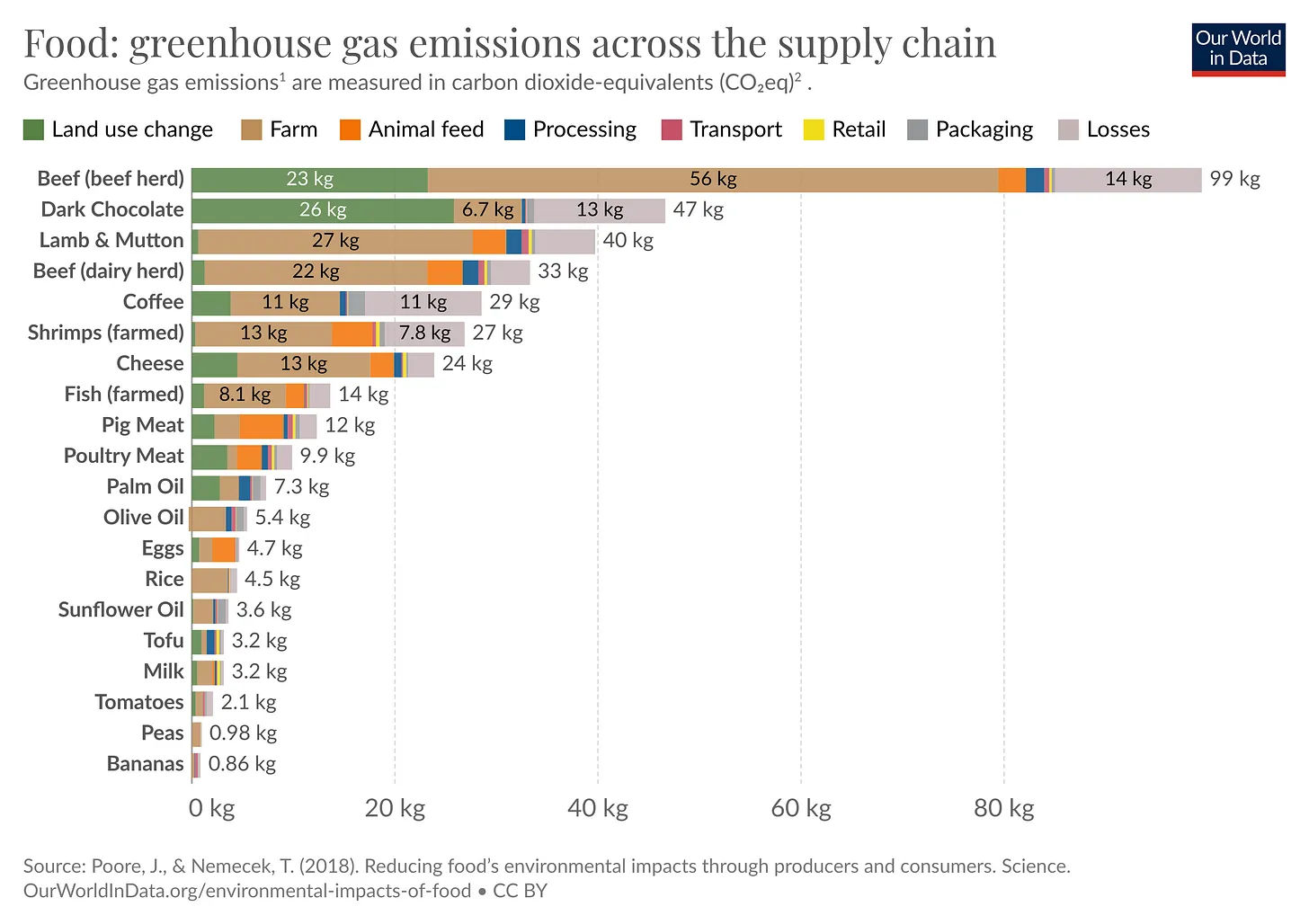
Transport emissions are very small in comparison to other factors of food production (Image from Our World in Data)
This means even if we could magically eliminate all long-distance food transport, it would barely dent the total emissions from food. And because food is shipped in very large volumes using highly efficient logistics systems, the emissions per item are often quite small. For example, a container ship carrying thousands of tonnes of produce can be more efficient per kilogram of food than a few cars driving to farmers’ markets. So, the idea that simply buying local will make a huge difference for the planet isn’t quite accurate.
In fact, sometimes local food can even be worse for the environment than imported food.
Consider tomatoes grown in heated greenhouses in cold climates (like Germany or the UK in winter), the extra energy needed to keep them alive and growing can actually create more carbon emissions than tomatoes grown naturally in sunny regions like Spain or Morocco and transported by ship. A well-known study on apples found that German apples had the lowest footprint during harvest season, but by spring, apples shipped from New Zealand had a lower carbon footprint than stored German apples, because storing local apples in refrigerated warehouses for months consumed a lot of energy. So, local isn’t automatically low-carbon. Factors like production energy, storage methods, and supply chain efficiency can matter just as much—or even more—than distance. Even the season doesn’t always make a huge difference, since global trade can supply fresh fruit year-round with relatively low emissions.
The question we as consumers should ask is “What am I eating” not “Where is my food coming from”. Most of the emissions associated with food come from the production phase, and the differences can be enormous. For example, for beef (beef herd) 79kg out 99kg CO₂-equivalent is due to land use change and farming practice. Furthermore, producing 100 grams of protein from beef can emit 10 to 100 times more greenhouse gases than producing the same amount from peas or beans. Animal products (especially beef, dairy, and eggs) contribute the majority of food-related emissions. Eating local beef is still far more carbon-intensive than eating imported soybeans, lentils, or other plant-based food. So, if climate is your primary concern, reducing high-impact foods like beef and lamb will have a much bigger effect than switching from imported to local produce.
Here is another uncomfortable truth: sometimes you have to choose between ethical treatment and a bigger footprint.
Many people opt for grass-fed beef because it’s considered more ethical. Grass-fed cattle tend to have better living conditions, more natural grazing behaviors, and less reliance on industrial feedlots. From an animal welfare perspective, it’s an easy choice to support. But from a climate perspective, it’s complicated. Grass-fed beef generally has a larger carbon footprint than intensively farmed beef because these animals grow more slowly and produce methane through cow burp over a longer period. They need more land, which can contribute to land-use change and biodiversity loss, and their feed efficiency is lower, meaning more emissions per kilogram of meat produced. According to data from Our World in Data, producing beef from a dedicated beef herd emits roughly 99 kilograms of CO₂-equivalent per kilogram of meat, while beef from dairy herds emits around 33 kilograms per kilogram. That’s a huge difference. So if you are looking for a choice of food to lower emissions while still supporting better animal welfare, you can replace beef with other meats, like chicken, pork, or sustainably sourced fish. Environmental solutions are full of trade-offs; there’s rarely a perfect choice, but thoughtful substitutions can significantly reduce your impact.
All of this doesn’t mean that buying local is useless. Local food supports small farmers, strengthens local economies, fosters community resilience, and often ensures fresher, higher-quality produce. These are all valuable benefits, even if they don’t directly translate into a massive reduction in carbon emissions. Local produce can also increase transparency about how your food is grown and handled, which matters for food safety and quality control.
But if your primary concern is climate impact, it’s important to prioritize differently. The most effective steps are to focus on what you eat, reduce high-impact animal products, minimize food waste, and only then consider how local your food is. “Buy local” is still a positive action, but it’s not the climate silver bullet it’s often made out to be.
So next time someone tells you “always buy local,” it’s worth pausing and thinking about what really matters. The biggest impact usually comes from eating less high-impact foods like beef and reducing food waste - actions that make a real difference without major downsides. Other things like where your food comes from matter less in comparison. In sustainability, there are rarely perfect answers, but focusing on these high-impact areas is a clear and effective place to start.
Want to learn more?
Get updates on climate progress and how you can help.