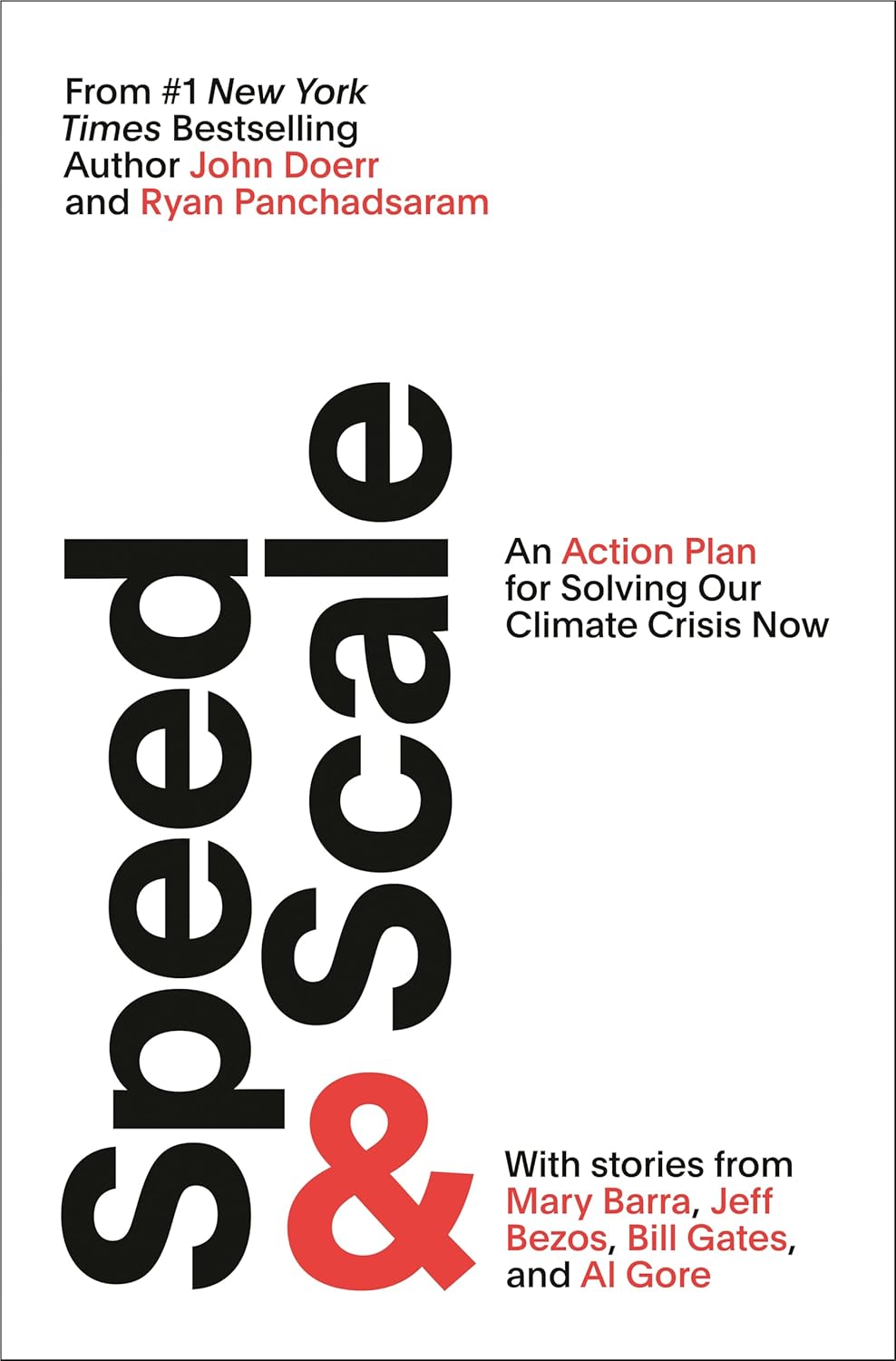
Speed & Scale - John Doerr
A venture capitalist's measurable action plan for reaching net zero by 2050, organized around six key objectives with clear timelines and accountability.
What if you could fit the entire plan to solve climate change on a cocktail napkin?
That's not a rhetorical question. John Doerr actually did it, and the napkin is in the book.
Published in 2021, Speed and Scale is written by John Doerr, engineer, venture capitalist, chairman of Kleiner Perkins, and the early investor behind Google and Amazon. Doerr is also the author of Measure What Matters, the book that popularized Objectives and Key Results (OKRs) as a management framework inside some of the world's most successful organizations. In Speed and Scale, he applies that same framework to what he considers the most important goal humanity has ever faced: getting from 59 gigatons of annual carbon emissions to net zero by 2050.
The result is one of the most structured, measurable, and frankly unusual climate books ever written.
What the Book Actually Argues
Doerr opens with a single number: 59. That's how many gigatons of CO2 equivalent the world emits every year. Everything in the book flows from the question of how to get that number to zero within three decades.
He organizes the plan around ten OKRs, six focused on emissions reduction across transport, electricity, food, nature, industry, and carbon removal, and four focused on what he calls accelerants: policy, movements, innovation, and investment. Each objective comes with specific, measurable key results and a timeline. Each chapter includes interviews with practitioners, investors, and policymakers actually working on that piece of the puzzle.
The transport OKR, for example, isn't just "electrify cars." It breaks down into specific targets: what percentage of new vehicle sales need to be electric by what year, what charging infrastructure needs to exist, what policy changes need to happen. The same precision runs through every chapter. Doerr treats the climate crisis the way a good engineer treats a complex systems problem: define the goal, measure the current state, identify the gaps, assign accountability.
There is also a companion website, speedandscale.com, where Doerr and his team update progress against each OKR over time. It functions as a living tracker that extends the book beyond its publication date, which is a genuinely useful feature for a topic that moves as fast as this one.
Why It Works for ClimateInvested.org Readers
One of the most paralyzing aspects of climate change is its scale. It touches every sector of the global economy simultaneously and the timelines feel either impossibly urgent or impossibly distant depending on what you're reading that day.
Speed and Scale directly addresses that paralysis by making the problem legible. When you can see the full system laid out with specific targets, measurable milestones, and real examples of progress already happening, the enormity starts to feel navigable rather than overwhelming. More and more people working in climate solutions, investment, and policy point to this book as the clearest single-volume overview of what a credible path to net zero actually requires across every major sector.
It also sits in a useful spot in the Climate Invested library. Where Drawdown tells you what works, Speed and Scale tells you how fast it needs to happen and who needs to do what. The two books complement each other well.
One Honest Note
The OKR framework is a genuine strength of this book, but it can also feel constraining for readers who aren't already familiar with it. The structure is rigorous to the point of being occasionally dry, and the sheer number of targets and metrics can make parts of the book feel more like a reference document than a reading experience. Some critics have also noted that Doerr's investment background at Breakthrough Energy Ventures shapes his solutions lens in ways that lean heavily toward technological breakthroughs over policy and behavior change, which may not reflect the full picture. The book is comprehensive, but it reads like it was written for people who are already in the room making decisions, not for people trying to figure out how to get in the room. Readers looking for a more narrative-driven entry point may find Drawdown or Electrify more accessible starting points.
The Bottom Line
Speed and Scale is the most rigorous, measurable, sector-by-sector plan for reaching net zero that exists in book form. It won't make you feel inspired in the way a great story does. It will make you feel oriented, which for a problem this complex might be more valuable.
🔗 Pick up your copy — Amazon.
Who It's Best For: Business leaders, investors, policy professionals, and anyone who thinks in systems and wants a comprehensive, data-grounded overview of what net zero requires across every sector. Also a strong pick for readers who finished Drawdown and want to understand the timeline and accountability side of the equation.
Difficulty: Intermediate, accessible writing but dense with targets, metrics, and sector-specific detail
Read Time: A focused week; rewards slower reading in the technical sections
Pages: 320
Want to learn more?
Get updates on climate progress and how you can help.