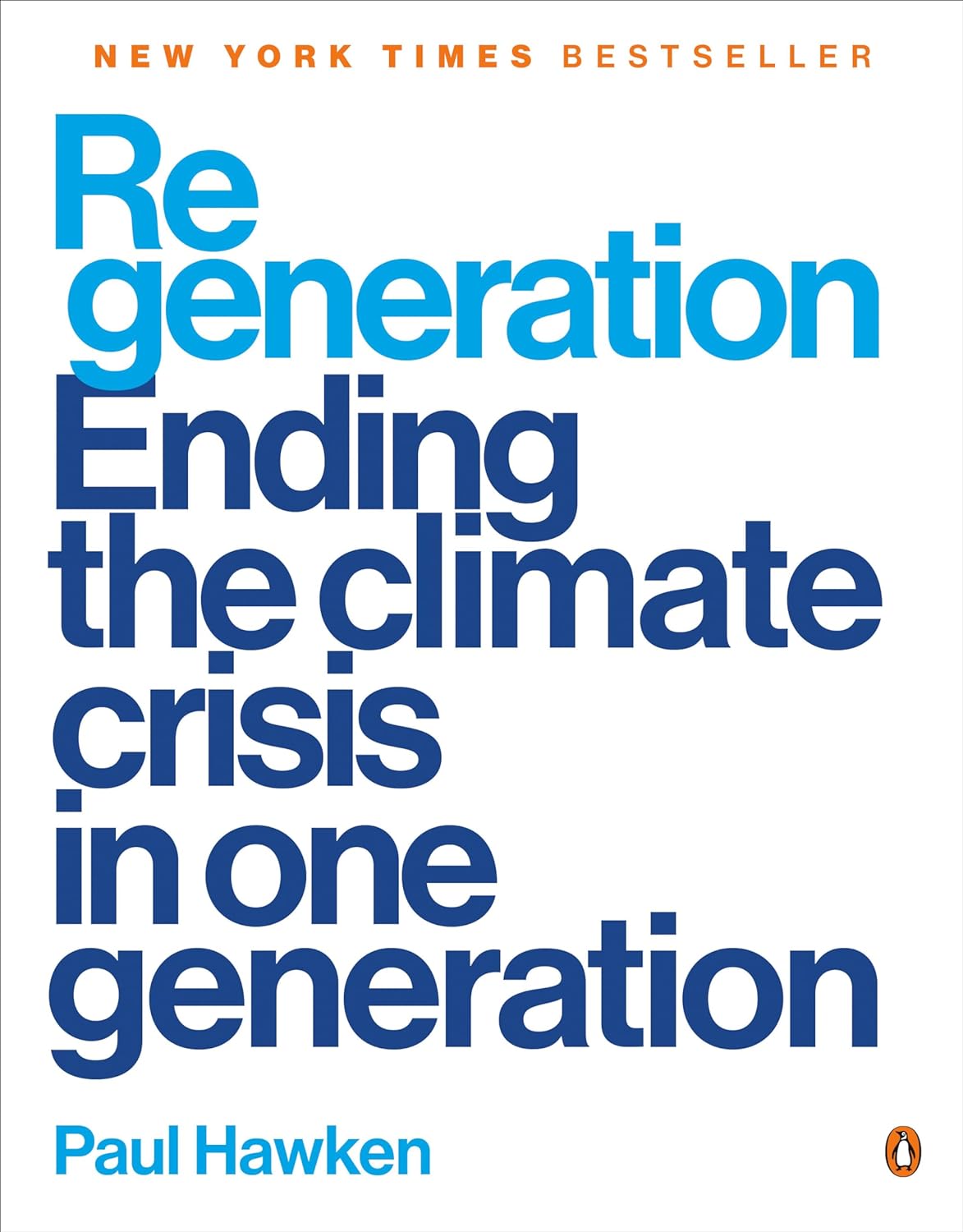
Regeneration - Paul Hawken
Spiritual successor to Drawdown; broader and bolder
What if the climate conversation has been asking the wrong question all along?
For decades the dominant framing has been about preventing future damage: stopping emissions, avoiding catastrophe, protecting what we have. Paul Hawken's Regeneration proposes something different. Instead of asking how we stop destroying the planet, it asks how we restore our relationship with it entirely, and argues that the only path to solving the climate crisis runs directly through addressing the needs of people alive right now.
Published in 2021 and written by Hawken, the environmentalist, entrepreneur, and creator of the New York Times bestseller Drawdown, Regeneration is his most ambitious work yet. Where Drawdown ranked 100 solutions by carbon impact, Regeneration goes broader, weaving together climate, biodiversity, equity, and human dignity into a single framework built around one central idea: that regeneration is what life has always done, and that humans can choose to work with that process rather than against it.
What the Book Actually Argues
The book's core reframe is worth sitting with. Hawken argues that climate change has largely been communicated as a story about future existential threats, which has left the majority of humanity feeling either overwhelmed or uninvolved. Regeneration flips that by grounding every solution in present human needs. Cleaner air, food security, community resilience, economic opportunity, dignified work. The climate benefits follow from addressing those needs, not the other way around.
From that foundation the book spreads wide. Solutions covered include electrifying everything, food localization, regenerative agriculture, ocean health, bioregions, forest restoration, the fifteen-minute city, fire ecology, and decommodification of land and resources. The range is intentional. Hawken wants readers to see climate action not as a narrow technical problem but as a comprehensive reimagining of how human civilization relates to living systems.
The book is visually striking too. Full-color photography throughout, paired with short, precise prose, gives it a different texture than most climate books. It can be read cover to cover or dipped into by section, and either approach works.
Why It Works for ClimateInvested.org Readers
Drawdown told readers what solutions exist. Regeneration tells them why those solutions matter beyond carbon numbers, and that shift in framing matters for a specific type of reader: one who already cares, already understands the basics, but is looking for a deeper sense of meaning and direction in the work.
More and more people engaging with climate are finding that data alone doesn't sustain long-term motivation. What does sustain it is a sense of connection, to a larger movement, to a coherent vision of what we're building rather than just what we're avoiding. Regeneration provides that. It is less a manual and more an orientation, one that fits naturally alongside the solutions-focused, empowerment-driven approach Climate Invested is built around.
One Honest Note
Readers who come to Regeneration directly from Drawdown may find the experience slightly disorienting. Drawdown was precise, ranked, and data-forward. Regeneration is broader, more philosophical, and less structured around measurable impact. Some readers have noted that it covers familiar ground from Drawdown without always going deeper, and that the sheer range of topics can make the book feel diffuse rather than focused. It is more inspiring than instructive, which is a feature for some readers and a limitation for others. If you want to understand what to prioritize and why, start with Drawdown. If you want to understand the bigger picture those priorities exist within, Regeneration is the follow-up.
The Bottom Line
Regeneration doesn't give you a ranked list or a policy roadmap. It gives you a way of seeing, one in which climate action and human flourishing are not in tension but are the same project. For readers ready to think at that scale, it is genuinely worth the time.
🔗 Pick up your copy — Amazon.
Who It's Best For: Readers who have moved past climate basics and are looking for a broader, more meaningful framework for their engagement. Strong pick for educators, community organizers, advocates, and anyone who wants to understand how climate connects to food, land, equity, and human dignity. Best read after Drawdown rather than instead of it.
Difficulty: Easy, accessible prose with a philosophical depth that rewards slow reading.
Read Time: A weekend cover to cover; works well dipped into by section over time.
Pages: 272
Want to learn more?
Get updates on climate progress and how you can help.