Your money is a climate tool
Your money is already shaping the climate, quietly and constantly. The real question isn’t whether it has an impact but instead it’s whether you’re choosing that impact intentionally or letting it happen by default.
Most people think climate action looks like buying an electric car, eating plant-based meals, or remembering to bring a tote bag to the grocery store. These actions are important and impactful, however, there’s one thing that has a large climate impact that is often overlooked: your money.
Whether you think about it or not, your money is already shaping the climate, every single day. Even when you’re not thinking about it. Your savings, your investments, your pension, your spending, all of it is quietly voting for the kind of world that gets built. The question isn’t whether money influences climate outcomes. It’s whether you’re using that influence intentionally or leaving it on autopilot.
Money doesn’t sit still
We like to think of money as neutral, just numbers in a bank account. But money doesn’t sit still. Banks lend it. Funds invest it. Companies use it to expand, drill, build, or innovate. When your money is parked somewhere, it’s usually being used to finance something. That something might be renewable energy, affordable housing, or climate tech. Or it might be fossil fuel extraction, deforestation-linked supply chains, or industries that lock in emissions for decades. So even if you’ve never bought an oil stock in your life, there’s a decent chance your money has still touched fossil fuels through pension funds, index funds, or bank lending. That’s what makes money such a powerful climate tool because it works whether you’re paying attention or not.
Let’s start with the simplest one: what you buy. Every purchase is a tiny signal. When millions of people make similar choices, those signals add up. That’s how renewable energy demand grows, why plant-based food markets are expanding, and why companies have started caring about sustainability claims, even if they aren’t honest.
Putting your money where your mouth is
The other way your money has power is through your investments. If you have a bank account, your savings are being lent out by your bank. If you have a pension or retirement fund, that money is invested across global markets. These pools of capital are massive, and they shape what gets built next. Historically, a lot of that capital has gone to fossil fuels because they were profitable, familiar, and politically supported. But now that’s changing slowly, unevenly, and not always voluntarily. When money flows into renewables, grid upgrades, energy efficiency, or climate adaptation, costs come down and adoption speeds up.
Some people use their money by divesting by pulling funds out of fossil fuels. Others focus on investing in climate solutions. These aren’t opposing strategies, they’re just different tools.
Divestment works best as a signal. It tells markets which business models are losing legitimacy as it shifts norms and expectations. But on its own, divestment doesn’t automatically reduce emissions. Investment, on the other hand, builds alternatives. It finances the solar farms, battery storage, electric transport, and low-carbon materials that replace fossil-heavy systems. Climate finance isn’t about moral purity. It’s about direction. Even small shifts matter when they happen at scale. Asking where your pension is invested. Choosing a bank that doesn’t aggressively finance fossil fuel expansion. Supporting funds or platforms that prioritize real climate impact over vague green labels. None of these actions alone will solve climate change. But collectively, they reshape financial incentives and markets respond to incentives.
It is also worth remembering that you don’t need to optimize every dollar to make a difference. Using money as a climate tool doesn’t mean everyone needs to become a climate finance expert. It means recognizing that money has influence and choosing to do something about it. It means asking basic questions: Where is my money? What is it supporting?
So, What Can You Actually Do With Your Money?
Using your money as a climate tool doesn’t mean flipping your entire financial life upside down. It means making a few intentional moves instead of leaving everything on autopilot. Here are some practical places to start.
1. Look at Where Your Money Is Sitting
Check where your savings accounts are held and what they’re invested in. Sites like bank.green are a great way to see how much your bank is invested in fossil fuels, as well as offering alternatives that focus on clean energy investments. While completely switching banks can be difficult, you can get most of the benefit from just moving some of your savings to a green bank. See our article on green banking for more details
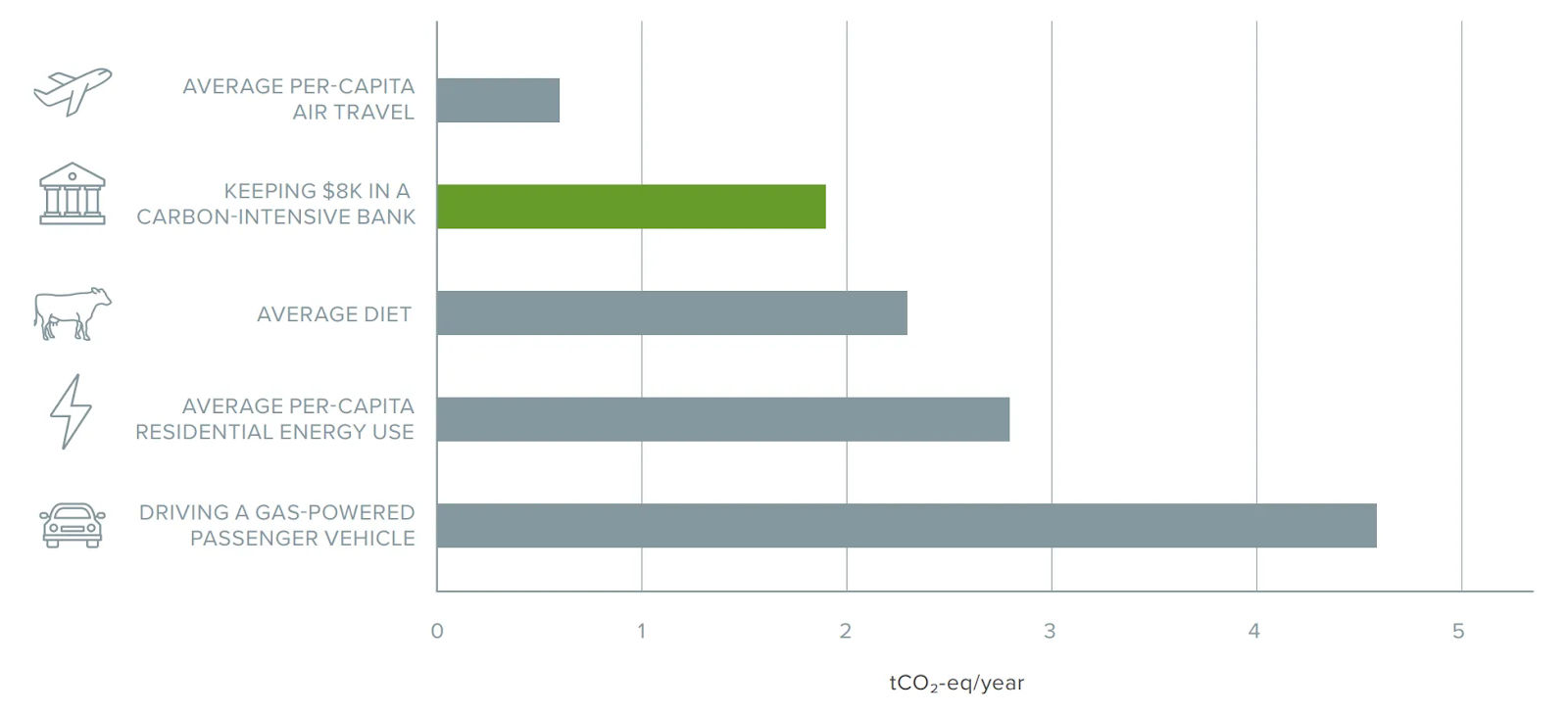
(image from project drawdown's report on personal banking)
2. Ask Your Bank or Pension Fund Questions
You don’t need to move your money immediately to have an impact. Simply asking questions like: Ask your bank how it manages climate risk or whether it finances new fossil fuel expansion. Ask your pension provider about climate policies, transition plans, or net-zero commitments. Few people reach out to their financial institutions, so you can have an outsized influence by doing so.
3. Avoid Financing the Worst Offenders
If you do make changes, start by avoiding the obvious red flags: companies or funds heavily exposed to new coal, oil, or gas expansion with no credible transition plan. Look for funds that are “ESG” (environment, social, and governance), which indicate that included companies meets a bar of social responsibility
4. Reinvest in Real-World Climate Solutions
When possible, move money toward things that actually reduce emissions or build resilience which might include renewable energy, energy efficiency, grid upgrades, climate-smart infrastructure. Sites like energea.com allow individuals to invest in solar projects across the world, and provide a great return as well.
Want to learn more?
Get updates on climate progress and how you can help.