Use the Six Americas framework to tailor climate conversations
Explain the Six Americas segmentation and how readers can choose message framing strategies that match different audience mindsets.
You have probably been there before. You are sitting at a dinner table or standing in a breakroom when the topic of the weather comes up. It starts with a casual comment about a weirdly warm February or the smoky haze from a distant wildfire. Then, the tension arrives. You want to talk about the bigger picture, but you hesitate. You wonder if you should bring up the new solar credits or if that will just spark an argument with your uncle. You worry that if you mention the latest climate data, people will tune out or start feeling guilty about their plastic straws.
The problem is that we often talk about the climate as if we are speaking to a single, giant audience. We treat every person like they are either a scientist or a skeptic. In reality, Americans fall into very different camps when it comes to how they feel about our changing world. If you want your words to actually land, you need to know who you are talking to. This is where the Global Warming’s Six Americas framework comes in. Developed by the Yale Program on Climate Change Communication, this research shows that Americans are not just divided into "believers" and "deniers." Instead, we occupy six distinct points on a spectrum of concern and engagement. Understanding these groups gives you the power to move past the shouting matches and start having conversations that actually lead to change.
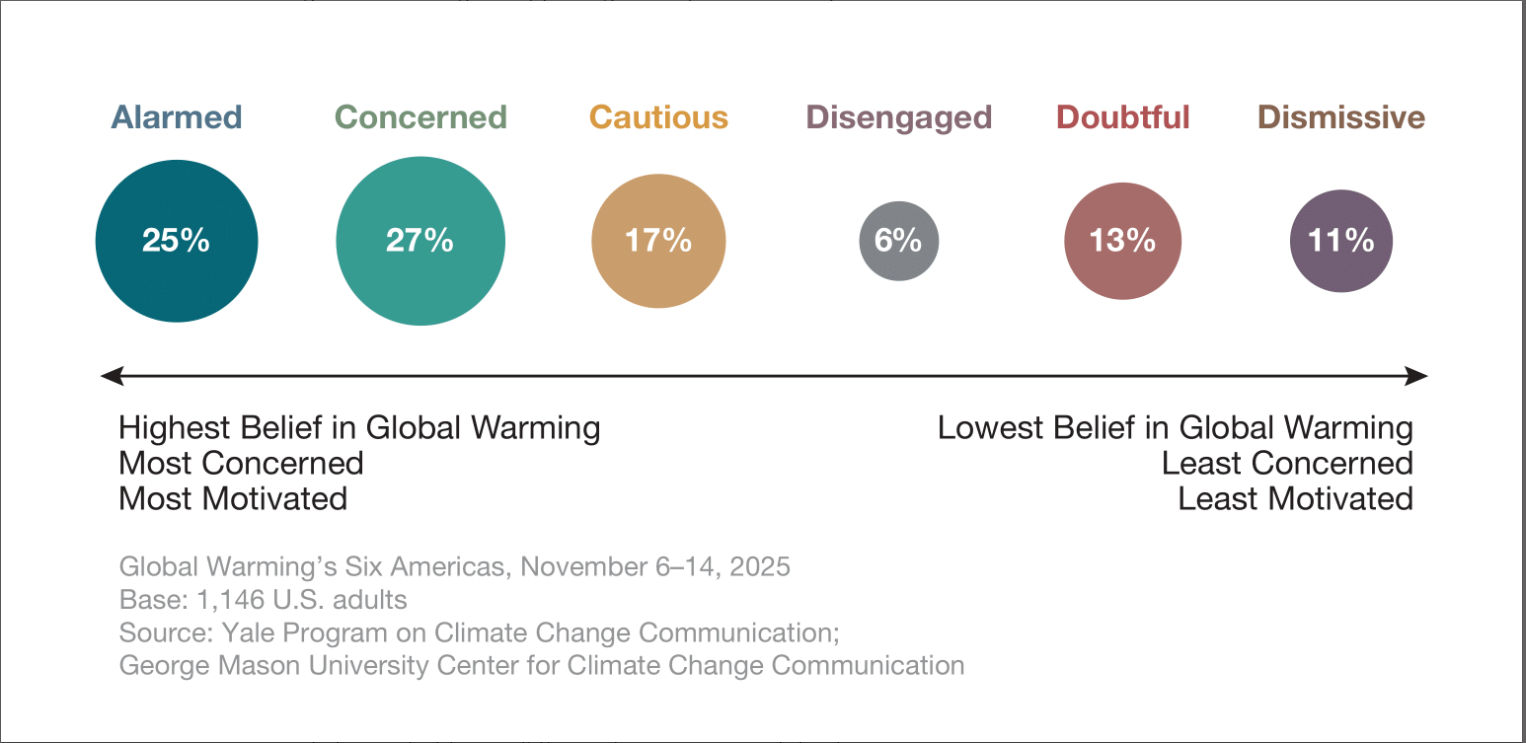
A horizontal bar chart showing the April 2025 distribution of the Six Americas: Alarmed 25%, Concerned 27%, Cautious 17%, Disengaged 6%, Doubtful 13%, Dismissive 11%. Source: Yale Program on Climate Change Communication
The Six Ways We See the World
The first step in being a better communicator is identifying the person in front of you. Currently, the largest group in the United States is the Concerned, representing the broad middle of the population that understands the reality of the issue but often lacks a clear path to action. This group believes global warming is a major threat, but they tend to see it as a distant problem. They think it will hurt people in other countries or future generations rather than their own backyard. This is the group that needs to hear about local solutions and the immediate benefits of a cleaner economy.
Right next to them are the Alarmed.These are the people who are already convinced that the climate is changing and see it as a serious threat. They want to help, but they often feel overwhelmed or unsure of what to do next. If you are talking to someone who is Alarmed, you do not need to convince them that the problem is real. This group is characterized by a high level of concern, yet they often struggle with an undefined sense of agency and a lack of a clear path to follow. They are your natural allies, even if they aren't always active. This is the group that needs to hear about local solutions and the immediate benefits of a cleaner economy.
The middle of the pack includes the Cautious and the Disengaged. The Cautious are still on the fence. They haven't quite made up their minds about whether global warming is happening or if humans are the cause. They are looking for more certainty. The Disengaged simply do not think about the issue much at all. They might have more pressing concerns, and likely think it is not as important as other more pressing issues. For these folks, climate change is a low-priority background noise that doesnt feel connected to their lives.
Finally, we have the Doubtful and the Dismissive. The Doubtful think global warming is either not happening or is just a natural cycle. The Dismissives are actively opposed to climate policy and often believe the issue is a hoax. While these groups are the loudest on social media, they are actually the smallest segments of the American public. Most of your neighbors and coworkers are likely somewhere in the first three groups. When you realize the Dismissives are a small minority, the prospect of talking about climate change feels a lot less like entering a battlefield.
Why One Size Fits None
Most of us make the mistake of "data dumping." We think that if we just show people one more chart about carbon parts per million or the melting rate of Greenland, they will finally see the light. This rarely works because humans do not make decisions based on data alone. We make decisions based on our values, our identity, and our sense of belonging. A study published in Nature Communications suggests that many Americans actually underestimate how much their peers support climate action. This "pluralistic ignorance" means we stay quiet because we think we are in the minority, even when we are actually the majority.
When you tailor your message to one of the Six Americas, you are respecting their worldview. You are not trying to change who they are. Instead, you are showing them how climate action fits into the life they already lead. For example, talking to a Cautious person about the national security benefits of energy independence is often more effective than talking about polar bears. Talking to a Concerned person about how local heat waves affect the local high school football schedule makes the "distant" problem feel very real and very personal.
Audience awareness allows you to bypass the psychological defenses that people build up when they feel judged. If you approach a conversation with the intent to "fix" someone's opinion, they will sense it and retreat. If you approach it with the intent to find where your goals overlap, you can build a bridge. This is not about manipulation. It is about effective translation. You are taking a global issue and putting it into a language that your specific listener can actually use.
Practical Talking Points for Every Group
When you are talking to the Alarmed, your goal is to move them from anxiety to action. The already understand the impacts, so avoid sharing more "doom" news that will only be discouraging. Instead, focus on progress and solutions: talk about the record growth of renewable energy in the last year. Mention specific, high-influence ways to help that you have tried, like joining a local community solar program or writing a letter to a city council member. They need to feel that their effort matters and that they are part of a winning team, and encouragement from someone they know is a big part of that.
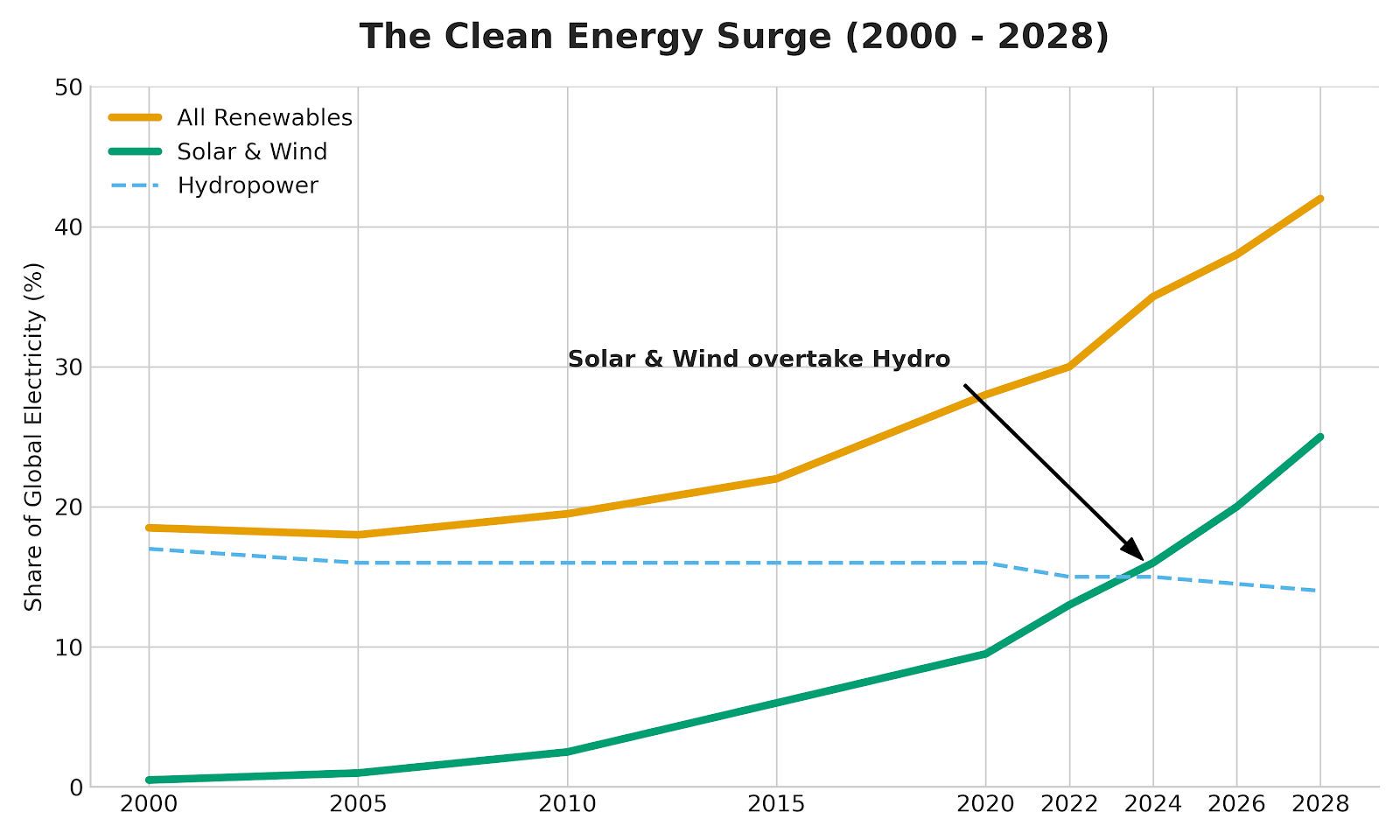
Around 2024, solar and wind officially outpaced hydropower to become our top clean energy source. By 2028, renewables will power over 40 percent of our world. The future is arriving ahead of schedule.Source: IEA
For the Concerned, you want to bring the issue home. Help them see that climate change is happening here and now, but focus on the "co-benefits" of the transition. Talk about how electric buses improve air quality in your specific city or how new building codes are making homes cheaper to cool during the summer. You are moving them from the idea that this is a faraway problem to the reality that it is an opportunity for their neighborhood. Use examples of how Americans view future energy to show that most people want a cleaner path forward.
The Cautious and Disengaged respond best when they see the transition as a practical, mainstream shift rather than a fringe movement. Instead of direct persuasion, the focus is on demonstrating that involvement isn't limited to "activists," but is being led by relatable, everyday figures; like a local business owner or a neighbor. By setting an example through these trusted voices, you show that moving toward cleaner energy is a common-sense modernization that benefits the community and the wallet, without requiring them to fundamentally change their personal views or political identity.
Dealing with the Doubtful and Dismissive is a bit different. Your goal here is usually not to win an argument, as that often leads to a "backfire effect" where they dig in further. Instead, find a small sliver of common ground. The objective here is to illustrate that the goals of the climate movement are often much closer to their existing views than they might realize. By highlighting shared ground such as the need for a more reliable power grid or ensuring farmers maintain control over their own land, you demonstrate that these efforts are aligned with their own interests. If the conversation turns toxic, it is perfectly okay to move on. Your energy is much better spent empowering the Alarmed and the Concerned who just need a little nudge.
Avoiding the Doom Trap
One of the biggest mistakes in climate communication is relying on fear alone as a motivator. While the situation is urgent, human brains are wired to shut down when they feel a threat is too big to handle. This is known as the "fear-paralysis" response. If you only talk about the end of the world, you are not motivating people. You are accidentally telling them that it is too late to try. We need to focus on the fact that we are moving in the right direction, that we have already likely mitigated the worst effects, and that we can continue to push progress.
Another pitfall is the identity threat. If someone perceives that "climate action" means they have to stop being who they are, they will reject the message to protect their identity. This happens often with people who associate climate policy with a specific political tribe or with a type of person. We must frame the transition as an evolution. We are still Americans who value freedom and innovation. We are just finding better ways to power that freedom.
Finally, skip the personal emissions guilt. Rather than viewing individual actions as a distraction from systemic policy, it is more effective to see them as deeply interrelated. The real power of personal choice isn't found just in lowering a specific CO2 number, but in expanding your influence. When our individual habits align with our values, they act as a necessary catalyst for large-scale change, proving to leaders and markets that the demand for systemic policy is both real and growing.Focus on the big wins we can achieve together through policy and technology.
Your Pre-Conversation Checklist
Before you head into your next gathering, take a moment to prep. You can think of this as a mental worksheet to keep you grounded. First, identify your goal. Are you trying to share information, or are you trying to build a relationship? If it is a family member you love, the relationship comes first. If they feel respected, they will be more open to your ideas later.
Second, try to guess which of the Six Americas they fall into. Have they expressed worry about the future lately? That is an Alarmed or Concerned trait. Do they seem totally indifferent? They might be Disengaged. Once you have a guess, pick one specific "bridge" topic. This could be anything from the growth of American manufacturing in the "Battery Belt" to the way local parks are being redesigned to handle heavy rain. Avoid the abstract and stick to the tangible.
Identifying Where Someone Stands
Before choosing an approach, the priority is to understand the other person's perspective through active discovery. This begins with asking open-ended questions about their concerns for the future or their observations of local changes such as shifts in seasonal weather or the development of new energy projects in the area.
The goal of this initial conversation is not to convince or persuade, but to genuinely listen. By focusing on hearing their values and level of engagement, you can identify where they sit within the Six Americas framework. Paying attention to whether they express urgency, caution, or indifference allows you to meet them where they actually are, rather than where you might assume they are. This stage of listening is essential; it ensures that when you do move forward, your conversation is grounded in their reality rather than a pre-packaged argument.
Finally, remember to listen more than you speak. Ask them what they have noticed about the local environment or what they think about the new electric car chargers at the grocery store. When people feel heard, they are much more likely to listen to your perspective. You do not have to be a climate scientist to have these talks. You just have to be a person who cares about their community and knows how to meet people where they are. By using the Six Americas framework, you can turn a potential argument into a meaningful connection.
Want to learn more?
Get updates on climate progress and how you can help.