How to talk to your parents about climate change
Learn how to talk to your parents about climate change with simple, practical tips that build understanding, reduce conflict, and turn conversations into meaningful action.
The conversation usually starts the same way. You mention climate change over dinner. Your parents nod politely, maybe ask a question, then smoothly pivot to literally anything else. Or worse, the discussion turns tense. You feel frustrated. They feel defensive. Nobody changes their mind, and now Thanksgiving feels awkward.
Here's what makes these conversations so hard: the gap between generations isn't always about facts. Research from Yale and George Mason University shows that most Americans across all age groups believe climate change is happening and humans are causing it. The real divide shows up in what people think should be done about it, and whether individual action matters.
A 2023 study published in Communications Earth & Environment found that generational differences in climate beliefs are smaller than people think. The bigger gap? Emotions. Younger people feel climate anxiety more intensely. Older generations might believe the science but feel less personal urgency. That emotional disconnect creates friction that facts alone can't fix.
Why the Usual Approach Doesn't Work
Most climate conversations fail because they start from the wrong place. You come armed with data, charts, and urgent warnings about what needs to happen now. Your parents hear: you think they're ignorant, you're judging their life choices, and you want them to upend everything.
Research on climate communication shows that leading with doom and demands triggers something called psychological reactance. People dig in harder when they feel pressured or attacked. Your parents aren't resisting science. They're resisting feeling like bad people.
The other common mistake? Assuming they don't care. A 2024 Ipsos study found something surprising: 54% of Americans aged 18-34 think individual action makes no difference, compared to just 19% of those over 55. Your parents might actually be more optimistic about personal action than you are. The conversation stalls because you're solving different problems.
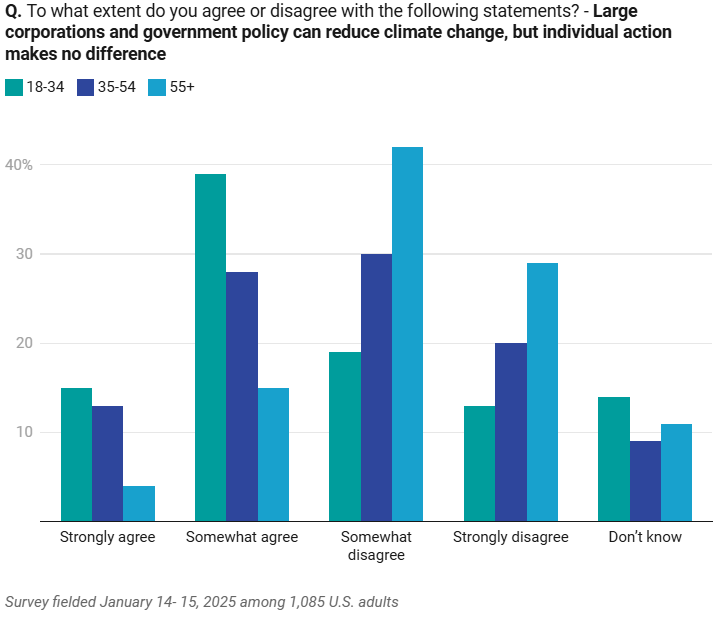
Younger people are more likely to feel that individual actions don’t make a difference, while older groups show more skepticism toward that idea, revealing a clear divide in how different generations view personal climate impact. Source: Ipsos study
Start With What You Share, Not Where You Disagree
The most productive climate conversations begin with connection, not correction. Ask questions that invite your parents to share their perspective without judgment. What changes have they noticed in weather or seasons over their lifetime? What do they think when they see climate news? How do they feel about the world you're inheriting?
These aren't rhetorical questions. Actually, listen to the answers. It also made a difference when young people and older adults had structured conversations about climate, both groups will discover unexpected common grounds. Older participants often expressed concerns they'd never voiced before. Younger people realized their parents weren't as dismissive as they'd assumed.
Qualitative research into these family dynamics often reveals a recurring theme, perfectly summarized by one participant’s realization: "I thought my dad didn't care. Turns out he just didn't know how to talk about it without feeling helpless." That distinction matters. Feeling helpless and not caring are completely different problems requiring completely different conversations.
Make It About Them, Not The Planet
Climate conversations get abstract fast. Global temperature targets, carbon budgets, and policy debates feel distant and technical. Your parents are more likely to engage when the topic connects to something they already care about deeply.
Does your mom worry about your younger sibling's asthma? Talk about air quality and cleaner energy. Is your dad proud of his vegetable garden? Mention how changing weather patterns affect growing seasons. Do they complain about rising electricity bills? Solar panels and heat pumps suddenly become relevant.
This isn't manipulation. It's meeting people where they are. Connecting climate action to immediate, personal benefits tends to work better than abstract appeals about saving the planet. People are more likely to act when they see how climate solutions improve their daily lives.
Update the Software, Not the Person
Instead of a clash of values, consider this a "software update." Many in the older generation formed their view of environmentalism decades ago, during an era where the movement often felt anti-growth or even anti-human. Back then, "going green" usually meant a sacrifice—doing without—and solar or wind were expensive experiments that couldn't reliably power a house, let alone a city.
If your parents are resistant, they might simply be operating on these "Frozen Facts." They aren't being stubborn; they are being logical based on the data of the 1990s. But in 2026, the math has flipped. Renewables are now the cheapest form of new power on the planet, and the "green" transition is actually the most significant pro-growth engine of our lifetime.
Try a pivot like this: "I totally get the skepticism, for a long time, this felt like it was about making life harder. But the tech has changed so much recently. It’s not about stopping growth anymore; it’s about upgrading to a system that’s actually cheaper and more reliable."
This approach allows them to change their minds without feeling like they were "wrong" before. They weren't, they were just using an older map. By focusing on how technology has evolved, you move the conversation from a fight about identity to a shared discovery of how the world works today..
Give Them Specific, Achievable Steps
Vague urgency overwhelms people. "We need to act on climate" sounds like an impossible task with no clear starting point. Your parents are more likely to engage when you offer concrete, manageable actions they can actually take.
Instead of "You should care more about climate," try "Have you thought about switching to an electric car when your current one needs replacing? The technology has gotten really good, and you'd save money on gas." Or "I've been learning about heat pumps. They might work well for this house and cut your heating bills."
Talking about climate solutions instead of just problems tends to make conversations more constructive and less divisive. Solutions feel actionable. Problems feel paralyzing. Guide your parents toward actions that fit their lives, not yours.
Accept That Change Takes Time
Your parents won't transform overnight, and you shouldn’t go in expecting them to. That's not failure. It's how people actually work. A decade-long study from New Zealand found that climate change beliefs increased across all age groups over time, with similar rates of change between generations. Older people start from a different baseline, but they're not stuck there.
Small shifts matter more than you think. Your dad mentioned climate change to his brother. Your mom is choosing a hybrid for her next car. These aren't dramatic victories, but they're not nothing either. Every conversation plants seeds, even when you can't see immediate results.
One climate activist described it this way: "I spent two years having the same conversation with my parents. Then one day, my dad started telling his friends about solar panels. I didn't convert him in one talk. It happened slowly, through repetition and patience."
Know When To Step Back
Sometimes, despite your best efforts, the conversation goes nowhere. Your parents shut down, get defensive, or refuse to engage. That's painful, but it's also a signal to change tactics.
Pushing harder rarely helps. Research on climate conversations shows that building trust over time works better than winning arguments in the moment. If direct conversations aren't working, try indirect approaches. Share articles they might find interesting. Invite them to a documentary screening. Model the behavior you want to see.
And sometimes, you need to accept limits. Not every parent will become a climate advocate. Some will never take it as seriously as you do. That hurts, but continuing to bang your head against that wall just damages your relationship without changing their mind. Protect your mental health. Find support among people who get it.
The Long Game
Talking to your parents isn't about winning a debate. It is about opening a channel that stays open for years. You are in a unique position that no scientist or activist can ever occupy. You know their history, their worries, and the things that make them feel proud. Because you understand what truly resonates with them, you have the ability to bridge this gap through a deeper and more personal connection.
When you bring up the climate, you are not just talking about a global crisis. You are sharing something that occupies your thoughts often. You are inviting them into your world. This is not just about the planet. It is about building a family culture where you can face a changing future together.
Start small. Stay patient. Remember that your parents are people, not obstacles. Every conversation, even the ones that feel stalled, moves the needle just a little bit further.
Want to learn more?
Get updates on climate progress and how you can help.