How to talk to your kids about climate change
Kids hear everything, and they overwhelmingly feel like the planet is doomed. Parents often avoid the topic since they understandably don't want to worry their kids, but the fact is that reality is not as bad as they think it is or what they hear on the news and social media. There's a way to talk to them honestly while also instilling a sense of hope and empowerment.
Your kids are already worried about climate change. The real question isn't whether to have the conversation, but how to have it without either terrifying them or pretending everything's fine.
They're hearing about it everywhere. At school, from friends, scrolling through social media, catching fragments of news you thought they weren't paying attention to. Studies show that more than half of young people feel genuinely worried about climate change, with some reporting it affects their daily life. Younger children aren't immune either, researchers have documented kids as young as seven expressing fears that the world will end before they're old enough to see it.
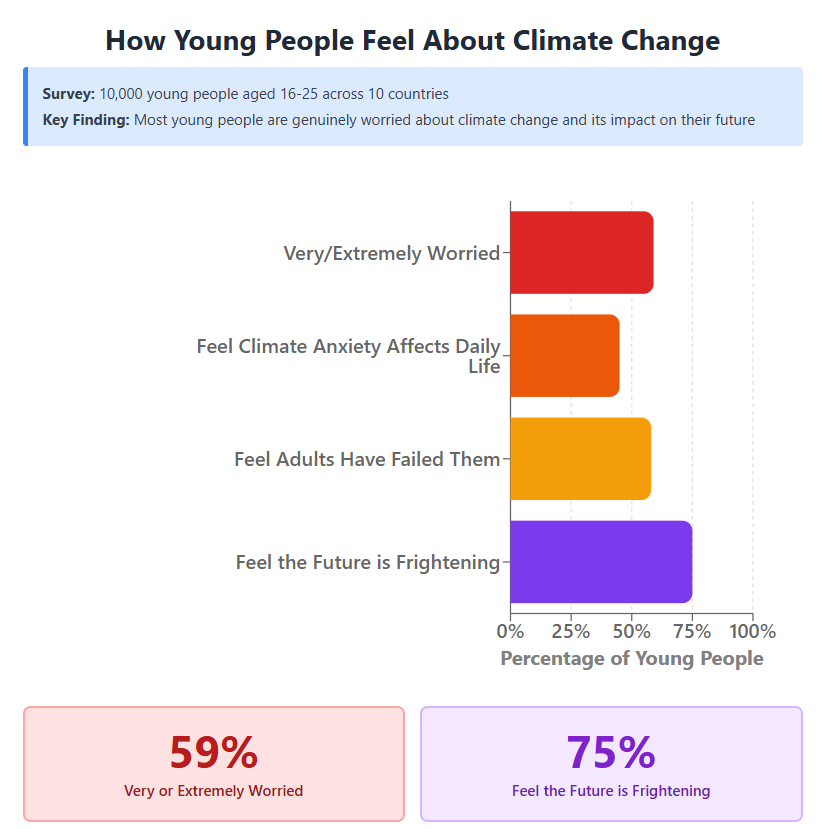
Most young people are very worried about climate change, and for many it impacts their daily functioning ( source )
That's a lot of fear for young shoulders to carry. And as parents, it puts us in an uncomfortable spot. We want to protect our kids from worry, but we also shouldn't pretend the problem doesn't exist. The good news? There's a middle path, one that's honest without being overwhelming, and hopeful without sugarcoating reality.
Start by Listening, Not Lecturing
Before you launch into explanations or reassurances, ask what they already know. Have they heard about climate change? Where did they hear about it, and do they understand why it is happening? How does it make them feel?
You might be surprised by what comes out. Kids absorb more than we realize, and their conclusions often run darker than the reality. One parent shared their seven-year-old saying, "You're lucky you got to have your adulthood before the planet was completely destroyed." Heavy stuff for someone who still loses teeth.
When they share their fears, resist the urge to immediately dismiss them. Saying "don't worry about it" can make kids feel like their concerns aren't valid or that you're not being honest. Instead, validate what they're feeling: "I understand why that's scary. It makes sense that you'd feel worried about that."
This isn't about dwelling on doom. It's about showing them their emotions matter before you help them process those emotions productively.
Why So Much Scary News?
Once they've shared what's on their mind, it's time to add perspective. Kids (and adults) today are bombarded with alarming headlines, and they need help understanding why the tone has been so urgent.
Here's how you might frame it:
"You're right that there's been a lot of scary news. The thing about news: bad and scary stories sell. They get more clicks, more attention, more shares. Progress doesn't make exciting headlines the way disasters do. So what you're seeing isn't always the full picture.
Sometimes the media takes scientific findings and exaggerates them to make bigger, scarier headlines. Scientists studying climate change tend to be careful and specific about their predictions, but by the time that research becomes a news story, the nuance gets lost. A headline saying 'Scientists warn of gradual temperature increases requiring urgent action' doesn't grab attention like 'Planet has 10 years left!' even though the first one is more accurate and the second one is entirely untrue.
That's not to say the problem isn't real or serious. It absolutely is, and scientists have been right to raise concerns and push for action. But the way the media covers it often amplifies the urgency and scale beyond what the actual science says."
Things Are Better Than They Think
Here's something kids need to hear: while most young people are worried about climate change, way fewer believe we can actually fix it, and that we are already doing a lot. That gap between caring and hoping doesn't match what's really happening.
You can explain it this way:
"We have so much access to news now, but more news stories doesn’t mean something is worse. News focuses on problems, not solutions, because problems grab attention. That makes it feel like everything's getting worse. But when you look at what's actually happening, we are heading in the right direction."
For example, just last year, wind and solar power made more electricity than coal in the United States for the first time ever. Think about that, the dirty, smoky power that used to run everything is now being outpaced by clean energy. And it’s not slowing down, it's accelerating: globally, nearly 80% of all new power plants built in 2024 run on renewables (up from ~50% ten years ago), showing that the shift isn’t coming someday, it’s already happening. Electric cars used to be weird science experiments, and now they’re just regular cars you see everywhere.
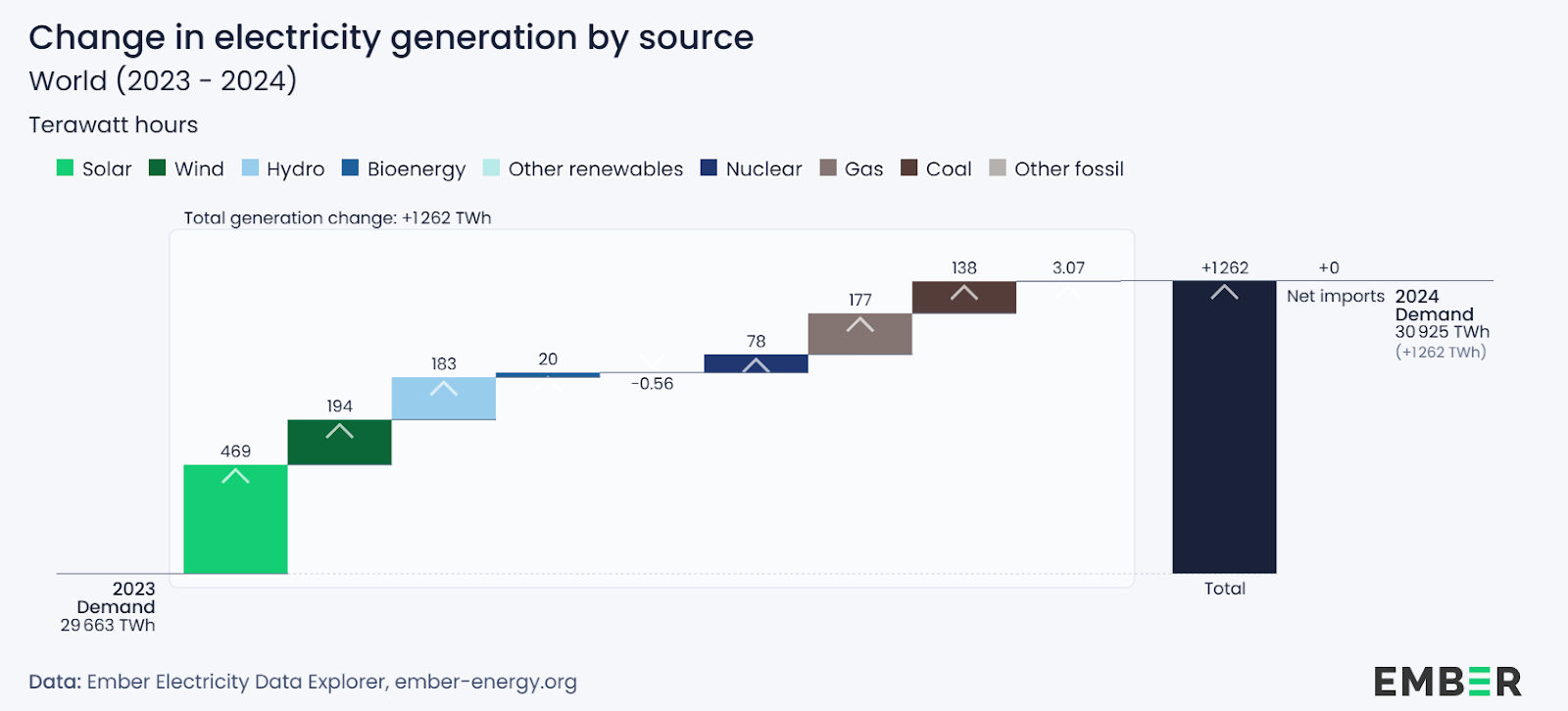
Change in electricity generation by source (2015-2024)
Kids need to know that some of the scariest predictions like claims that “the world will be uninhabitable in 10 years” or images of a “burning Earth” are emotional appeals meant to spark action, not scientific forecasts. The truth is, the threat of climate change is real and serious, we still have time to mitigate it significantly. We have already likely avoided the worst outcomes because many people are taking it seriously and started solving problems faster than many expected. Progress doesn’t mean the work is done, it means the future is still in our hands.
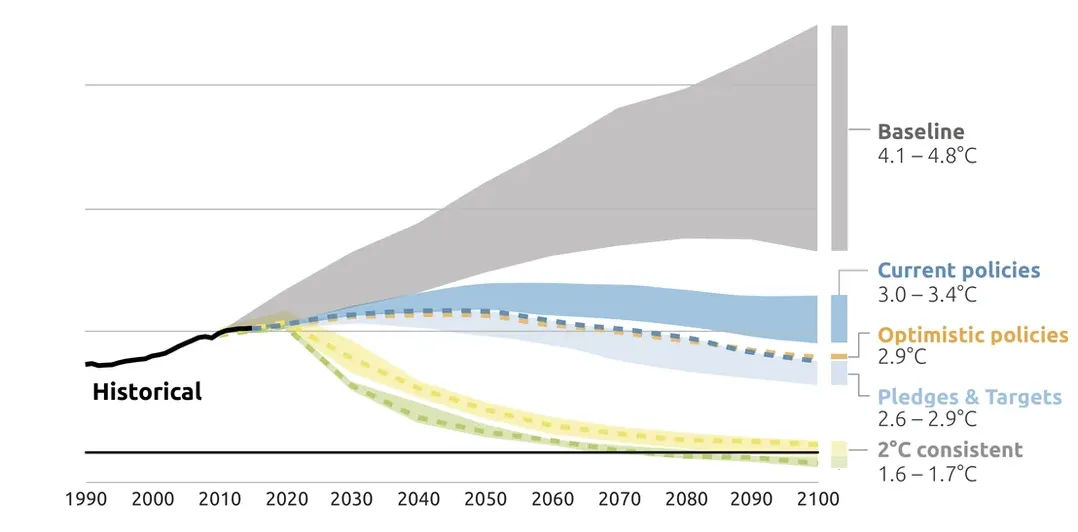
with current policies, emissions are leveling off and projections are around 3° C, instead of the 4-5° C baseline that was projected without the progress we have made. ( source - climateactiontracker.org )
Show Them Real Progress
Kids need concrete examples, not abstract promises that "someone's working on it."
They are not old enough to remember a time when solar and wind power were expensive novelties. Talk about how clean energy is taking over. Wind turbines and solar panels are getting cheaper and better every year. Entire countries run on wind power for whole days at a time. Companies are making bottles out of plants instead of plastic. Electric buses are replacing smelly diesel ones.
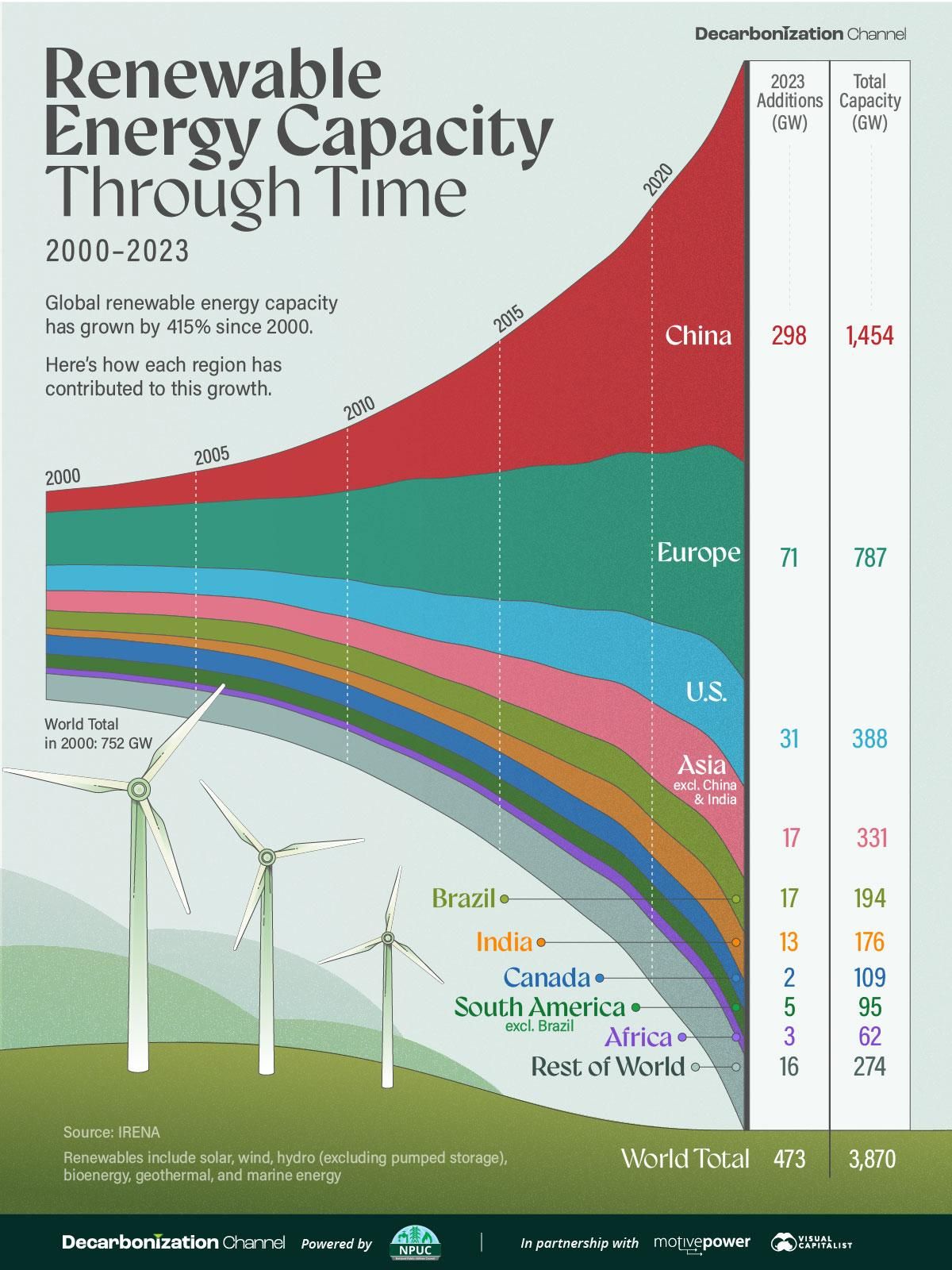
Visualized : Renewable Energy Capacity Through Time (2000–2023)
Point out examples they can see. Solar panels on buildings in your neighborhood. Electric car charging stations at the grocery store. Recycling bins at school. These aren't futuristic, they're here now, working.
For younger kids, focus on things they can picture. Giant solar farms in China shaped like pandas . Playgrounds where kids playing generates electricity. Wind turbines as tall as skyscrapers. For older kids, talk about batteries that store sunshine for night time, farms growing food in skyscrapers, or scientists figuring out how to pull carbon from the air.
The key is showing them that progress is real, speeding up, and working.
Make It Age-Appropriate
Not every kid needs the same level of detail.
Young kids (5-8): Keep explanations concrete and focus on people solving problems. Talk about scientists and engineers working together, how trees clean air, how communities cooperate. Show them small things you do to help; turning off lights, reusing items, planting flowers, or walking instead of driving short distances. Kids learn most from what they see and from the example you set.
Middle kids (9-12): You can introduce more complexity around cause and effect. Explain how fossil fuel combustion creates greenhouse gases, but also how cleaner alternatives are scaling up. At this age, kids often feel powerless, so focus on showing how everyday decisions matter. Talk about how choosing energy-efficient products, supporting companies that use sustainable materials, or buying less single-use stuff can inspire others and gradually shift what becomes normal in society.
Teens (13+): Engage with full honesty about the nuances and challenges. At this stage, conversations matter as much as actions like encouraging them to talk with friends about what’s happening and how they feel, and perhaps helping their peers see things in a more positive light. Many teens find purpose in helping their peers see progress and possibility, whether through school projects, social media, or community efforts. Supporting that kind of engagement can turn anxiety into connection and action.
Give Them Power, Not Burden
Research shows something interesting: young people who worry a lot about climate change and do something about it don't struggle with sadness the way kids who just worry do. Action is like medicine for helplessness.
Provide examples through your own actions rather than assigning responsibility to them. Kids learn most from what they see, so let them notice how you conserve energy, support sustainable choices, or stay informed. If they show curiosity or suggest their own ideas whether it’s planting something, starting a small project, or learning more about an issue encourage and help them explore it. That way, participation grows naturally from interest and inspiration, not pressure.
Connect these actions to their existing interests and values. Passionate about animals? Explore habitat conservation. Fascinated by technology? Investigate clean energy innovation. Concerned about justice? Examine climate impacts on vulnerable populations and response strategies.
And critically: remind them they're part of something much larger. Countless adults like scientists, engineers, policymakers, entrepreneurs, activists are working on solutions every single day. This isn't their generation's burden alone to carry.
What to Avoid
Don’t lie or sugarcoat. Kids can tell, and when they do, they stop trusting what you say. Avoid language that makes the problem sound beyond anyone’s control, like “there’s nothing we can do” or “it’s up to governments and companies.” Instead, focus on what science tells us clearly: the planet is warming, and human actions are driving it. Then balance that truth with what’s still uncertain like how severe the impacts might be, and how much difference our choices can make. Steer away from catastrophic phrases like “the planet is burning,” and if you don’t know an answer, look it up together. That honesty builds trust and shows that learning never stops, even for adults.
Keep Talking
This isn't a singular "big talk" that you check off a parenting list. Climate change is an evolving challenge, which means your conversations should evolve too.
Check in periodically. Ask how they're feeling. Point out positive developments when you encounter them like new policies, technological breakthroughs, local initiatives. Normalize discussing both challenges and solutions. Model informed engagement yourself, children internalize helplessness when they observe anxious paralysis, but they learn resilience when they see purposeful action.
Spend time together outdoors. Research consistently shows that children who develop strong connections to nature are more likely to protect it as adults. Help them cultivate that relationship with the world they're learning to care for.
The Bottom Line
Your kids are growing up in a world shaped by climate change. That's unavoidable. But they'll also grow up in a world where people are actively solving the problem where technology is improving, policies are changing, and communities are thriving despite challenges. They need both sides of that story. Yes, the challenge is real. Yes, there's work to do. But no, they're not doomed. No, it's not too late. And no, they're not alone.
What you're really offering them isn't certainty or guarantees. It's perspective: that serious people are tackling serious problems, that tangible progress is underway and accelerating, and that when they're ready, there will be substantive ways to contribute.
Hope doesn't mean pretending everything's perfect. It just requires believing that human ingenuity, collective action, and sustained effort can bend the trajectory of the future toward something worth inheriting.
Want to learn more?
Get updates on climate progress and how you can help.