Do many people even think about climate change?
Climate change often feels like a fringe issue, a small minority of activists trying to convince the world to listen. However, you might be surprised to learn what the data says about how people feel about climate change
When someone mentions “climate change”, what comes to mind? You probably think of protestors yelling into megaphones, or activists desperately shouting to make people believe. But the truth is, the vast majority of people already agree climate change is real, worry about it, and want action. Yet, most of them believe they are in the minority.
Global surveys and psychological research point to two powerful insights: A strong majority of people today support climate action, and people tend to massively underestimate this fact.
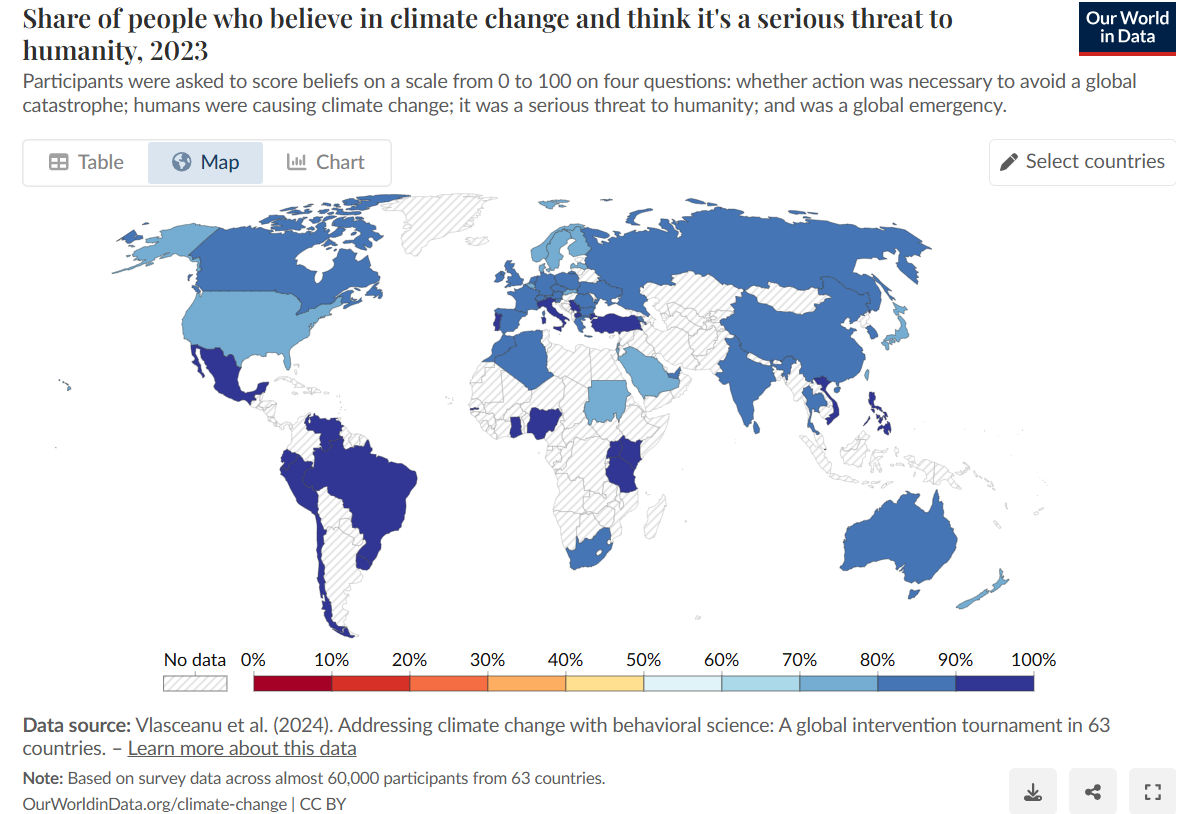
A substantial majority of people worldwide believe climate change is a problem we need to take action to address (Image from: OurWorldinData)
Madalina Vlasceanu’s report, published in Science Advances, surveyed 59,000 people across 63 countries and found that 86% agreed that humans are causing climate change problems and 73% or more in every country saw it as a serious threat. The pattern holds when you zoom in on individual nations: in the United States, around 75% of respondents across multiple surveys said that humans are driving climate change and that it poses a real concern. In the UK, the share was even higher.
Study after study points to the same conclusion: the overwhelming majority of people believe climate change is real and recognize it as a problem.
If so many people care, why does it feel like no one is doing anything? The answer lies in a psychological blind spot known as the “perception gap.” Most people don’t realize how many other people feel this way. Support for climate action is widespread, yet individuals consistently underestimate how common that support actually is.
A 2022 Nature Communications study found that 80–90% of Americans underestimated public support for climate policies or climate concern. People assumed only about 40% of their fellow citizens supported climate action, while the number was actually close to 75%.
A global study over 125 countries illustrates this perfectly. Participants were asked whether they would be willing to contribute 1% of their income to tackle climate change, and 69% said yes. When the same individuals were asked to guess how many others in their country would give the same answer, their estimate was dramatically lower with an average of just 43%.
This gap showed up in every single country, without exception. The chart below visualizes the difference between the actual level of support and what people think others believe in each country.
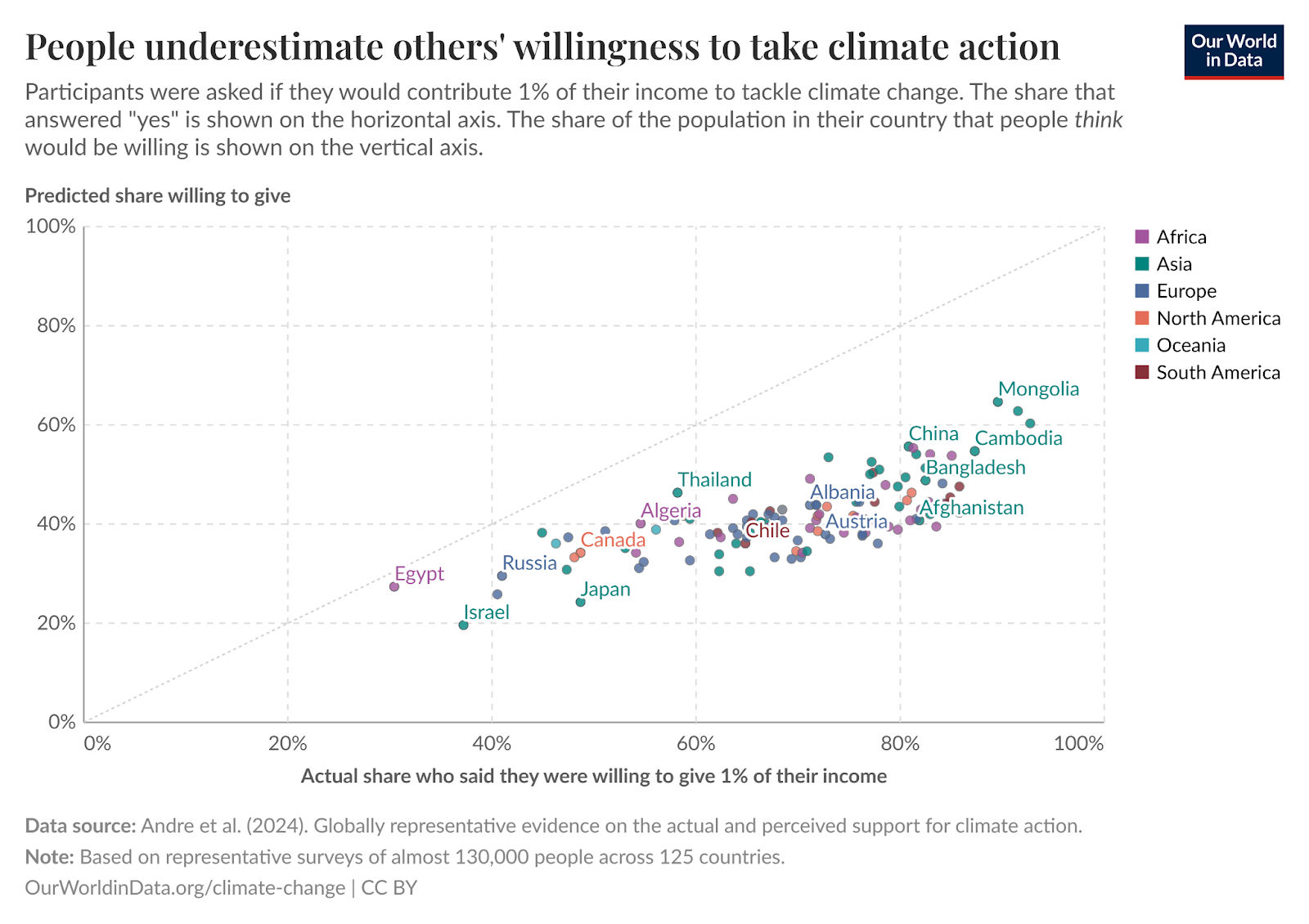
Researchers call this phenomenon “pluralistic ignorance”, when people wrongly believe their views are in the minority. Many care deeply, but few talk about it because they fear it will alienate them. This misunderstanding doesn’t just distort public opinion, it actively discourages people from speaking up, getting involved, or pushing for stronger climate policies.
Self-efficacy and individual action
Another related challenge is low self-efficacy, or feeling like your actions won’t make any difference. Many people genuinely want to help or make a difference, but they are convinced their individual efforts won't have any meaningful impact. This doubt is compounded when they believe that others don’t care: “if no one else is doing anything about it, why should I be the only one to make changes for the climate?”
It makes sense that a person would be less likely to take action if they don’t feel like it would have much impact. This is also confirmed by research: It shows that self-efficacy (the belief that your actions can actually make a difference) is a strong predictor of whether someone engages in climate-friendly behavior. For example, even when surveys find that 80% of people are willing to change lifestyle habits to reduce emissions, many still feel their actions won’t matter unless others also act. Across multiple studies, individuals with low self-efficacy are also less likely to discuss climate change, voice support for policies, or participate in collective action.
There are several factors fuel this perception gap:
- Traditional and social media amplify extreme opinions, while the average person who quietly supports climate action rarely shows up in the feed.
- This is a fairly recent trend - in the past, the majority was more undecided about climate change, but over time, more and more people have started caring about it
- Psychological biases shape how we see ourselves and others—we tend to be optimistic about our own reasoning and intentions but surprisingly pessimistic about everyone else’s.
Climate change isn’t a niche concern or a polarized fringe issue anymore - it’s a mainstream priority that’s simply hidden beneath a layer of false perception. These misperceptions matter. When people realize they are part of a caring majority, they become more willing to talk about climate issues, vote for climate-friendly policies, and support collective action. In fact, simply talking about climate is one of the easiest and most effective ways to break this false narrative.
For those starting the conversation for the first time, here are a few tips:
- Start small: Mention a recent climate-related news story or a personal experience like what you have tried to do recently.
- Connect to shared values: Link climate action to health, family, or community well-being—things everyone can relate to.
- Don’t convince, ask questions: Invite others to share their thoughts rather than launching into facts or arguments.
- Highlight the majority: Emphasize that most people support climate-friendly actions—this helps others feel part of a positive movement.
So to answer the question: Do many people even think about climate change?
Yes, many people do think about climate change, and globally the vast majority want stronger action. But ironically, most underestimate how many others feel the same.
Want to learn more?
Get updates on climate progress and how you can help.