
Offset airplane flights
You might have heard that, among all the activities people take part in as they go about their lives, airplane flights are the most carbon-intensive, and thus the most impactful to climate change. But there’s hardly an alternative when it comes to covering truly long distances, so what can we do about it? Carbon offsetting for flights is one of the simplest ways travellers can take responsibility for the emissions they can’t easily avoid.
What is carbon offsetting?
Carbon offsetting refers to ‘neutralizing’ or compensating for greenhouse gas emissions, typically by purchasing ‘credits’ to contribute to schemes designed to make an equivalent reduction in the amount of carbon in the atmosphere. For example, a company emitting a ton of CO2 can offset this by participating in a project to remove a ton of it elsewhere, aiming for a net-zero impact.
When you fly, your ticket price typically doesn’t reflect the environmental cost of the journey. Offsetting helps to bridge that gap by funding activities that reduce or remove carbon elsewhere, such as reforestation, peatland restoration, or renewable energy. According to the International Civil Aviation Organization, which pioneered a global flight offsetting scheme, market-based measures like this are expected to play an important role in stabilizing aviation emissions, alongside cleaner technologies and industrial regulations.
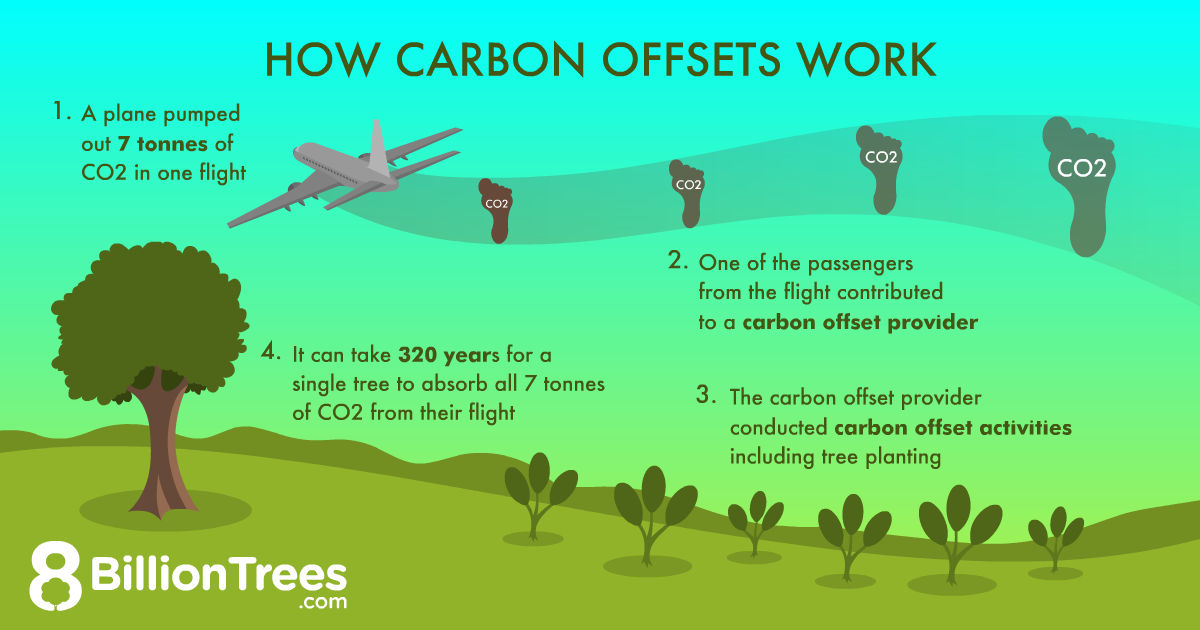
Carbon offsets help minimize the impact of your flight’s emissions | Source: 8BillionTrees
It isn’t perfect—it’s not a 1:1 solution that eliminates the impact entirely, and not flying in the first place (if a lower-impact option like trains is available) would still be preferable. But it can significantly reduce the environmental cost of unavoidable flights.
How do I offset my flight?
Many airlines and travel platforms now integrate offsetting into the booking process. Look for an opt-in check box when booking your flight. Offsetting a short-haul flight might cost only a few dollars. Even long-haul journeys typically add a relatively small percentage to the ticket price.
You can also use the International Civil Aviation Organization’s Carbon Emissions Calculator to work out how much to offset. There are other calculators, too, and it’s a good idea to independently verify the impact of your flight this way. They’ll also give you a choice of projects, or you can search around to find your own.
Here are some more tips for easy, effective offsetting:
- Look for projects certified by organizations like Gold Standard or Verified Carbon Standard. These ensure emissions reductions are properly measured and verified.
- Diversify your impact by supporting schemes that cover a mix of projects, combining carbon removal with community development or biodiversity protection.
- Make it routine—treat offsetting as part of the cost of flying, just like baggage or seat selection, to build a consistent habit.
With so many tools and projects around, it’s easier than ever to offset your flights. Carbon offsetting may not be a complete solution on its own, but it’s a powerful tool in the transition to a greener economy that we can put to use today.
Want to do more?
Get updates on climate progress and how you can help.